
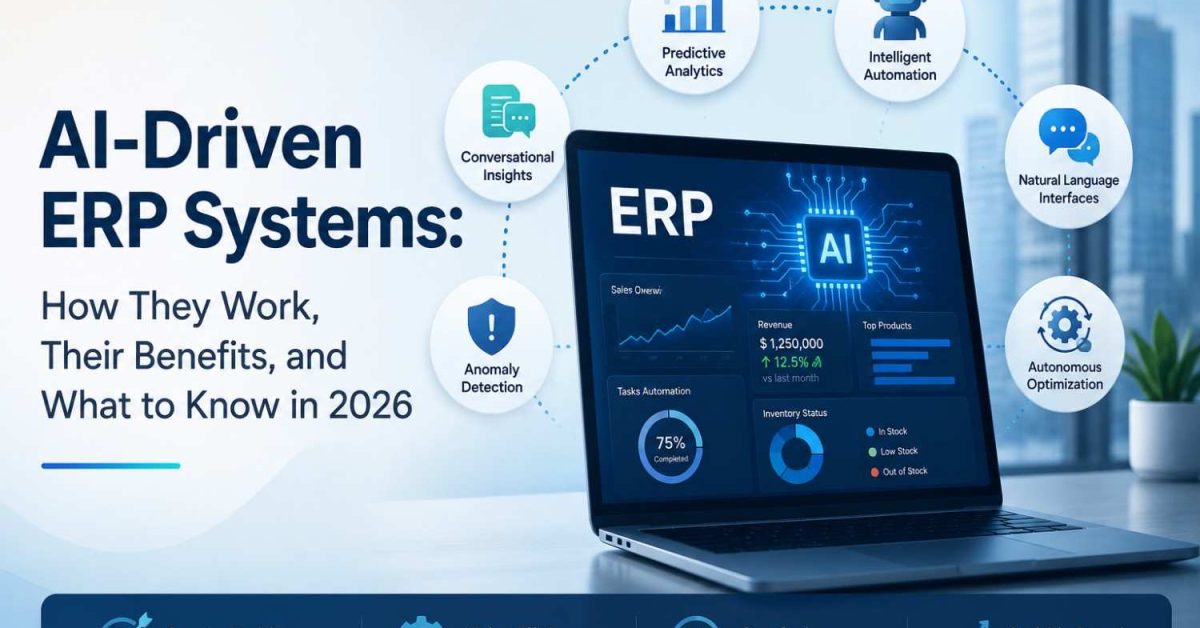
An AI-driven ERP systems is business software that uses Artificial Intelligence to predict outcomes, automate tasks, and recommend decisions. A normal ERP records what already happened. An AI-driven ERP looks ahead and tells you what to do next. That single shift changes everything. Your business stops just tracking the past. It starts planning for the future.
This guide explains AI-driven ERP in plain language. You will learn what it is, how it works, the real benefits, the honest challenges, the top platforms, and how to start. No jargon. No hype.
What Is an AI-Driven ERP System?
ERP stands for Enterprise Resource Planning. It is the central software that runs a company’s core functions. This includes accounting, inventory, purchasing, HR, manufacturing, and sales. All of it sits in one shared system.
For years, ERP was just a system of record. It stored your data well. But turning that data into action took a lot of manual work from your team.
An AI-driven ERP adds a layer of intelligence on top. It uses machine learning, natural language processing, and predictive analytics inside the ERP. This lets the system read huge amounts of data, spot patterns people miss, predict what comes next, and sometimes act on its own.
A traditional ERP is like a detailed logbook of everything your business has done. An AI-driven ERP is like an expert advisor who has read that whole logbook. It spots trends early, warns you about problems before they hit, and suggests your next move.
Traditional ERP vs AI-Driven ERP
The easiest way to understand the difference is side by side.
| Feature | Traditional ERP | AI-Driven ERP |
|---|---|---|
| Main job | Records what happened | Predicts what will happen |
| Data use | Stores and organizes data | Analyzes data and finds patterns |
| Decisions | People do the analysis | System suggests actions |
| Tasks | Manual input needed | Automates complex tasks |
| Over time | Stays the same | Keeps learning and improving |
| Focus | Looks backward | Looks forward |
A traditional ERP tells you what happened last quarter. An AI-driven ERP tells you what is likely to happen next quarter, and what to do about it.
How AI Changed ERP Over Time
This shift did not happen overnight. Early AI in ERP was basic. It used simple tools to guess inventory needs from past sales. Helpful, but limited. Today it is far more advanced. Modern AI-driven ERP can forecast demand, catch fraud, answer questions in plain English, and adjust operations in real time.
The big change is direction. Old ERP looks backward. New ERP looks forward. And it never sits still. The system keeps improving its predictions as new data comes in. Over time, it finds problems your business never knew it had.
Core Capabilities of AI-Driven ERP Systems
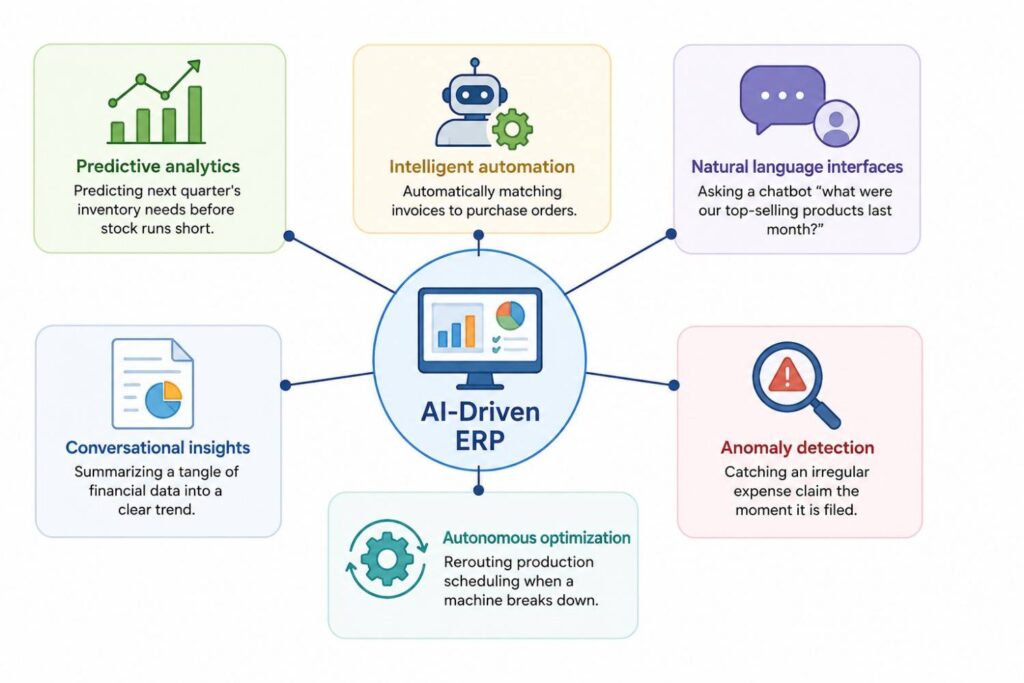
These features set an AI-driven ERP apart. Here is what each one does, with a real example.
| Capability | What it does | Example in practice |
|---|---|---|
| Predictive analytics | Forecasts demand, sales, and cash flow from historical and live data | Predicting next quarter’s inventory needs before stock runs short |
| Intelligent automation | Handles repetitive, rules-heavy tasks that go beyond simple scripting | Automatically matching invoices to purchase orders |
| Natural language interfaces | Lets staff ask questions in plain language and get instant answers | Asking a chatbot “what were our top-selling products last month?” |
| Conversational insights | Turns complex datasets into readable, plain-language findings | Summarizing a tangle of financial data into a clear trend |
| Anomaly detection | Flags unusual transactions or patterns that suggest errors or fraud | Catching an irregular expense claim the moment it is filed |
| Autonomous optimization | Adjusts operations in real time, often using coordinated AI agents | Rerouting production scheduling when a machine breaks down |
Under all of these sit the same core technologies: machine learning, natural language processing, generative AI, and predictive analytics. More and more, these work alongside AI agents that coordinate actions across the whole system.
Real Benefits of AI-Driven ERP
The value shows up in daily work, not just in theory.
- Smarter decisions. Your data becomes forecasts and recommendations, not just static reports. Leaders act on evidence, not gut feeling.
- Lower costs. Automation removes slow manual work. Predictive maintenance stops expensive breakdowns before they happen.
- Better scalability. The system keeps learning as your data and business grow. This is exactly where older systems get stuck.
- Higher accuracy. The system constantly cleans and checks data. This removes the small human errors that build up in manual work.
In manufacturing, AI now helps with scheduling, quality control, and supply chains. Many firms report large efficiency gains once the system is fully running. Some studies point to 30 to 40 percent improvements in those settings.
The market reflects this momentum too. Analysts expect the AI-in-ERP market to grow rapidly over the next decade, reaching tens of billions of dollars. The interest is not just hype. The value is real.
Common Use Cases by Department
AI-driven ERP helps almost every part of a business. Here is how it works in each area.
- Finance. Forecasts cash flow, automates invoice matching, and flags fraud or errors in real time.
- Supply chain. Predicts stock needs, prevents shortages, and spots disruptions before they spread.
- Manufacturing. Schedules production, predicts machine maintenance, and improves quality control.
- Sales and CRM. Predicts which leads will convert and personalizes customer interactions.
- HR. Screens resumes, ranks applicants, and supports fair, data-driven reviews.
- Customer service. Powers chatbots that answer common questions instantly, around the clock.
- Procurement. Recommends the best suppliers based on price, performance, and past orders.
These are not far-off ideas. Companies use every one of these today.
The Challenges Vendors Rarely Highlight
A balanced view matters here. AI-driven ERP is powerful. But it is not magic, and it is not fully self-running.
This is the key point. We do not yet have AI that runs a business by itself. These systems support decisions. They do not replace human judgment. Important calls still need a person in the loop.
The other challenges are practical:
- Data quality. AI is only as good as its data. Messy data leads to weak predictions.
- Cost and complexity. Setup can be expensive, especially when moving off an old ERP. It usually needs process change, not just a software install.
- Integration. Connecting AI to your existing tools takes real planning.
- Training. Staff need to learn the system before they trust and use it.
- Security. The system touches more sensitive data, so governance matters more, not less.
None of this is a reason to avoid AI-driven ERP. It is just a reason to go in with eyes open.
How Much Does an AI-Driven ERP Cost?
Cost depends on your size, your needs, and how complex the setup is.
Smaller projects can start around the low tens of thousands of dollars. Large enterprise rollouts can pass one million dollars. On top of that, you pay for ongoing maintenance, training, and updates.
The smart approach is to start small. Prove the value on one module first. Then expand once you see results. This keeps cost and risk under control.
Leading AI-Driven ERP Platforms
Several trusted vendors have built AI deep into their ERP products. The right fit depends on your industry, size, and current systems.
| Platform | AI strengths | Best suited to |
|---|---|---|
| Oracle NetSuite | Demand forecasting, inventory optimization, AI-powered analytics | Mid-market and fast-growing companies |
| SAP | Machine learning automation across finance and supply chain | Large enterprises with complex operations |
| Microsoft Dynamics 365 | Copilot-style AI assistance and predictive insights | Teams already in the Microsoft ecosystem |
| Industry-specific ERPs | Vertical AI features built for one sector | Specialized industries such as construction |
Vendor features change fast. Treat this as a starting map. Always confirm current features directly with each provider before you commit.
How to Start With an AI-Driven ERP
- Name the problem. Pick a specific pain point. Maybe it is bad forecasting, slow invoices, or supply-chain blind spots. Do not adopt AI just to have it.
- Check your data. Clean, well-organized data is the biggest factor in success. Audit it first.
- Pick the right platform. Match the tool to your real needs and industry.
- Start with one module. Prove the results on a single high-impact area. Then expand.
- Train your team. Invest in change management so staff actually use the tools.
- Keep humans in charge. Hold human review on the decisions that matter most.
- Track the results. Measure outcomes in hard numbers so you know it is working.
The Bottom Line
AI-driven ERP systems mark a real change in how businesses run. They shift you from recording the past to shaping the future.
The payoffs are clear: smarter decisions, lower costs, better scalability, and steady efficiency gains.
But the best results come from going in clear-eyed. Success depends on good data, careful setup, ongoing human oversight, and picking a platform that fits your business, not the loudest marketing. Done right, an AI-driven ERP is not just another software purchase. It becomes a long-term engine for faster, smarter, more competitive operations.
What is an AI-driven ERP system?
It is an ERP platform enhanced with Artificial Intelligence, Machine Learning, Natural Language Processing, and predictive analytics. A traditional ERP mainly records data. An AI-driven ERP forecasts outcomes, automates complex tasks, and recommends actions. This helps a business move from reactive to proactive management.
How is AI-driven ERP different from traditional ERP?
Traditional ERP stores and organizes data, but leaves the analysis to people. AI-driven ERP adds intelligence on top. It predicts trends, automates decisions, and keeps learning from new data, so it improves over time.
What are the main benefits of AI in ERP?
The biggest gains are better forecasting, automation of repetitive work, lower costs, higher accuracy, and stronger scalability. Sectors like manufacturing often see notable efficiency improvements once the system is fully adopted.
What are the challenges of adopting an AI-driven ERP?
The main hurdles are data quality, setup cost and complexity, integration with existing tools, staff training, and data security. These systems also still need human oversight. They do not run a business on their own.
Which companies offer AI-driven ERP systems?
Leading providers include Oracle NetSuite, SAP, and Microsoft Dynamics 365. There are also industry-specific platforms built for fields like construction. The right choice depends on your size, industry, and current technology.
How much does an AI-driven ERP cost?
It varies widely. Smaller setups can start in the low tens of thousands of dollars. Large enterprise rollouts can exceed one million dollars, plus ongoing maintenance. Starting with one module helps control cost.
