
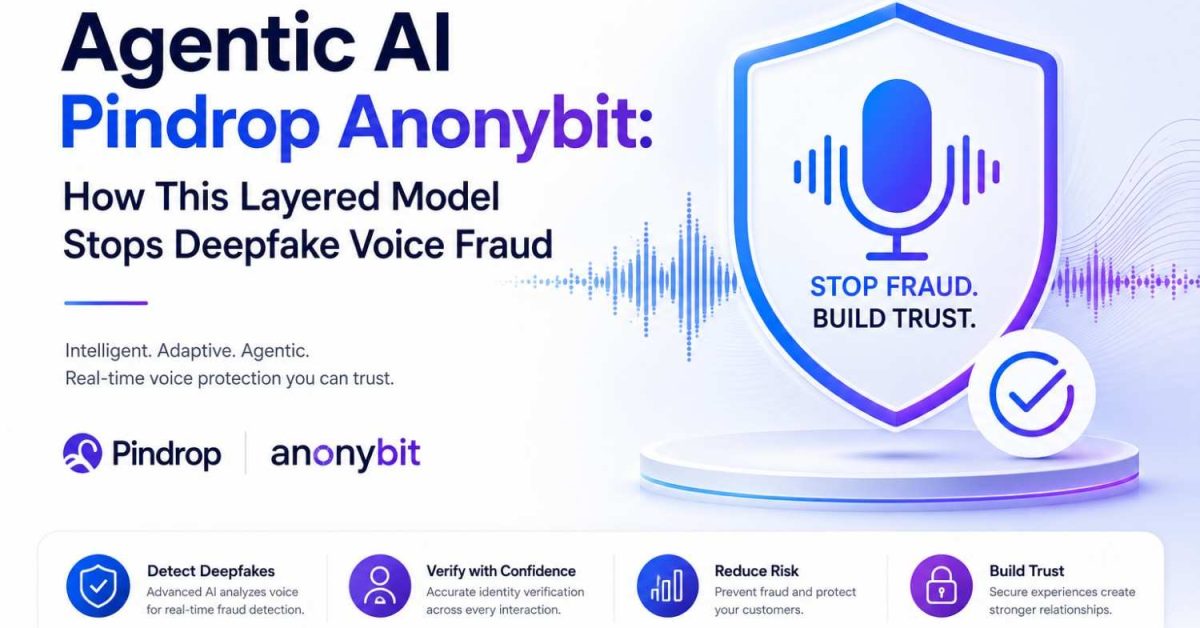
Agentic AI Pindrop Anonybit is a layered identity-security model that combines three things: autonomous AI decision-making, Pindrop’s real-time deepfake voice detection, and Anonybit’s decentralized biometrics. Together they spot and stop synthetic voices and identity fraud in milliseconds, before the damage is done.
One thing to be clear about from the start. This is best understood as a conceptual framework, not a single product you buy off a shelf. Pindrop and Anonybit are two separate companies with two different specialties. The phrase describes how their approaches, paired with agentic AI, form a complete defense for the deepfake era. This guide explains what each layer does, how they work together, the real numbers behind the threat, and where the model has limits.
Agentic AI Pindrop Anonybit refers to a three-layer security architecture for fighting AI-driven voice and identity fraud:
- Agentic AI is the decision-maker that scores risk and acts on it automatically.
- Pindrop detects deepfake and synthetic voices on calls and in meetings.
- Anonybit verifies identity using privacy-first, decentralized biometrics.
Read together, they authenticate both the signal (is this voice real?) and the person (is this really you?), fast enough to matter.
Why This Matters Now
The threat is no longer theoretical. With only three or four seconds of recorded audio, an attacker can clone a voice well enough to fool a family member, a bank, or a healthcare call center.
The numbers tell the story. According to Pindrop’s 2025 Voice Intelligence and Security Report, roughly 1 in every 599 calls to a contact center now involves some form of fraud. Deepfake voice attacks surged sharply over the past year, and fraud attempts now hit contact centers about every 46 seconds. The U.S. Federal Trade Commission reported consumers lost 12.5 billion dollars to fraud in 2024, across roughly 2.6 million reports, with AI-enabled impersonation a growing driver.
The core problem is simple. Most contact-center defenses were built for human attackers using human-speed tools. Passwords, security questions, and fixed rules do not hold up against AI that can clone a voice and run thousands of attempts at machine speed.
Who Is Pindrop?
Pindrop is a cybersecurity company that specializes in voice authentication and deepfake detection for phone calls and meetings. It has spent over a decade working with large banks, healthcare organizations, insurers, and retailers.
Pindrop’s technology analyzes more than 1,300 signals across voice, device, and behavior, then assigns each call a risk and liveness score within seconds. It listens for the tiny artifacts that synthetic voices leave behind, the kind of sub-audible patterns that human ears miss entirely but trained models catch.
Its main products include Pindrop Pulse for Calls, which detects AI fraud in contact centers, and Pindrop Passport, which passively authenticates callers using voice, device, and behavior. In April 2025, Pindrop released the beta of Pulse for Meetings, extending detection to live audio and video inside Zoom, Microsoft Teams, and Webex. By October 2025, it had integrated passive voice biometrics into the Webex Contact Center suite. Pulse for Meetings even made Time Magazine’s list of best inventions of 2025, and the company reports detecting synthetic audio with high accuracy and a low false-positive rate.
In short, Pindrop answers one question very well: is this voice biologically real, or is it a machine?
Who Is Anonybit?
Anonybit takes on a different part of the problem: how to verify someone’s identity without creating a giant biometric database that attackers can steal.
Most biometric systems store fingerprints, faces, or voiceprints in one central vault. That vault becomes a honeypot. One breach exposes everyone. Anonybit avoids this with a decentralized approach. It cryptographically fragments biometric data into pieces, called shards, and spreads them across multiple nodes. The system can verify your identity without ever reassembling a complete biometric record in one place.
This design shrinks the blast radius of any single breach and aligns with data-minimization rules like GDPR and HIPAA. In May 2025, Anonybit launched what it described as secure agentic workflows, an early implementation of decentralized biometrics for agentic commerce. A follow-on integration with the no-code platform SmartUp arrived in July 2025, extending the approach to teams without dedicated security engineers.
Anonybit’s key idea is identity-bound agents. The aim is that an AI agent’s actions are cryptographically tied to a real, authorized person, and only run after that person approves them.
What Agentic AI Adds
Agentic AI is the orchestration layer that ties everything together.
Traditional systems match a password and stop there. They flag a threat and wait for a human analyst. In a world where attacks unfold in milliseconds, waiting is losing.
An agentic layer behaves differently. It reasons across many signals at once: Pindrop’s liveness score, Anonybit’s biometric confirmation, the device fingerprint, behavioral patterns, session data, and transaction context. Then it decides what to do, approve, challenge, or deny, and acts on that decision immediately, without waiting for a person.
This is why the model fits high-risk moments like account recovery, new account creation, and call-center authentication. Those are exactly the points where AI-driven fraud does the most damage.
How the Three Layers Work Together
Here is the flow in plain terms.
A call or session comes in. Pindrop checks whether the voice is real or synthetic and produces a liveness score. Anonybit confirms the person’s identity through decentralized biometrics, without exposing a central record. Agentic AI takes both signals, weighs them against other risk factors, and makes a real-time call on whether to let the action through.
Each layer covers a gap the others cannot. Pindrop verifies the signal. Anonybit verifies the person while protecting their data. Agentic AI verifies the intent and acts. A single-product system leaves openings that this layered approach is designed to close.
The Honest Limits
A balanced view matters, and most competitor guides skip this part.
First, as noted, this is a conceptual stack, not a single off-the-shelf product with one invoice. Pindrop and Anonybit are separate vendors, and combining them means real integration work. Treat any guide that implies a ready-made joint product with caution.
Second, no detection system is perfect. Deepfake models keep improving, so this is an ongoing arms race, not a solved problem. Accuracy claims should always be tested against your own data and use case.
Third, biometrics and autonomous decisions raise privacy and governance questions. Decentralized storage helps, but you still need clear human oversight, consent practices, and compliance review before deployment, not after.
None of this argues against the model. It argues for going in clear-eyed.
Who Should Consider This Approach
This layered model is most valuable for organizations that handle sensitive identity verification at scale, including banks and credit unions, healthcare and insurance providers, large contact centers, and any enterprise exposed to executive-impersonation or account-takeover fraud.
If your defenses still rely mainly on passwords, security questions, or one-time codes, you are protecting against yesterday’s attacker. The agentic AI Pindrop Anonybit model is built for the automated, AI-powered fraud that legacy tools were never designed to catch.
The Bottom Line
Agentic AI Pindrop Anonybit is a useful way to describe the security model the deepfake era demands. Pindrop verifies whether a voice is real. Anonybit verifies who you are without hoarding your biometric data. Agentic AI makes the call and acts in real time.
The threat is automated, fast, and growing, and the defenses that worked for human-speed fraud no longer hold. A layered model that authenticates both the signal and the person, and acts in milliseconds, is what modern identity security increasingly looks like. Just remember to treat it as a framework to build thoughtfully, with real integration and human oversight, rather than a single switch you flip on.
Frequently Asked Questions
What is agentic AI Pindrop Anonybit?
It is a layered identity-security model that combines agentic AI for autonomous decision-making, Pindrop for real-time deepfake voice detection, and Anonybit for decentralized biometric identity. Together they detect synthetic voices and verify real people in milliseconds. It is a conceptual framework that pairs separate technologies, not a single product.
Are Pindrop and Anonybit the same company?
No. They are two separate companies with different specialties. Pindrop focuses on voice authentication and deepfake detection. Anonybit focuses on privacy-preserving, decentralized biometrics. The phrase “agentic AI Pindrop Anonybit” describes how their approaches can work together, not a merger or a single joint product.
What does Pindrop actually do?
Pindrop analyzes more than 1,300 voice, device, and behavior signals to give each call a liveness and risk score within seconds. It detects deepfake and synthetic audio on phone calls and, through Pulse for Meetings, inside Zoom, Microsoft Teams, and Webex.
How is Anonybit different from normal biometrics?
Normal biometric systems store data in one central database, which becomes a high-value target. Anonybit fragments biometric data into encrypted shards spread across multiple nodes, so identity can be verified without ever reassembling a complete record. This reduces breach risk and supports privacy rules like GDPR and HIPAA.
Why is agentic AI important for fraud prevention?
Because modern fraud moves in milliseconds. Agentic AI scores risk across many signals and acts on it automatically, approving, challenging, or denying, rather than flagging a threat and waiting for a human to review it. That speed is what legacy, rule-based systems lack.
Is this a real product I can buy?
Not as a single bundled product. Pindrop and Anonybit are sold separately, and the “agentic AI Pindrop Anonybit” stack is a conceptual architecture that organizations would integrate. Always confirm current products, partnerships, and capabilities directly with each company
