

Rapid prototyping is a fast, iterative way to turn an idea into a testable model. Instead of spending months developing a polished final product, teams create an early version, test it, collect feedback, improve the design, and repeat.
A rapid prototype can be physical, such as a 3D-printed product part, or digital, such as a clickable app interface. Software teams may build a proof of concept, while manufacturers use methods such as 3D printing, CNC machining, laser cutting, molding, and casting.
The goal is simple: learn what works before investing heavily in full development or production. This guide explains how rapid prototyping works, its main types and methods, real-world examples, benefits, limitations, and how AI is changing the process.
What Is Rapid Prototyping?
Rapid prototyping is the process of quickly creating and testing early versions of a product, component, interface, or system. Teams use these prototypes to validate ideas, identify problems, gather feedback, and improve a design before committing to full development or manufacturing.
Traditional product development can require significant time and money before users or stakeholders interact with a realistic version. If an important usability, engineering, or technical problem appears late, fixing it can be difficult and expensive.
Rapid prototyping moves that learning earlier.
Instead of building everything, teams create only enough of the product to answer an important question. A designer might test whether users understand a checkout flow, an engineer might check whether two parts fit together, or a developer might determine whether a new software feature is technically possible.
A typical rapid prototyping cycle looks like this:
Define → Build → Test → Learn → Refine → Repeat
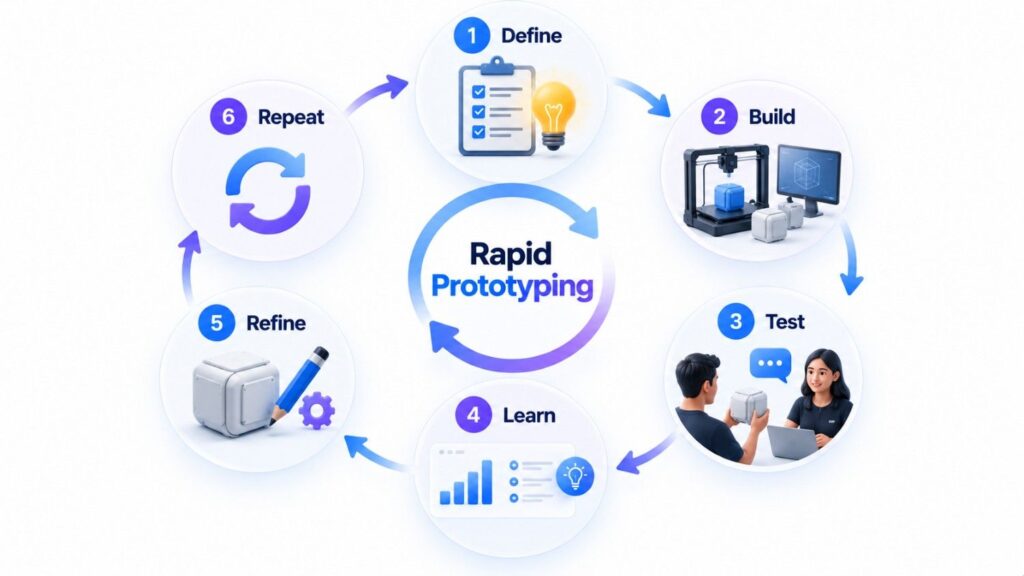
Speed matters, but rapid prototyping is not simply about building faster. Its real purpose is to learn faster and reduce uncertainty before making larger investments.
How Does the Rapid Prototyping Process Work?
The exact process depends on whether you’re developing software, a physical product, or a user interface. However, most rapid prototype development follows five basic stages.
1. Define What You Need to Test
Start with a specific question rather than trying to prototype the entire product.
For example, a product team may want to know whether users understand a new signup flow. An engineering team might need to determine whether a mechanical component fits correctly. A startup could be testing whether its core software concept is technically feasible.
A clear question keeps the prototype focused and prevents teams from spending time on features that provide no useful information.
2. Choose the Right Prototype Fidelity
Next, decide how realistic the prototype needs to be.
Early ideas may require only a paper sketch, wireframe, rough CAD model, or simple physical shape. Later testing might require an interactive interface or functional component that behaves more like the intended final product.
The prototype should be realistic enough to answer the question being tested, but no more complex than necessary.
3. Build the Prototype
Create the first testable version using the most appropriate rapid prototyping method.
Digital products may use wireframes, interactive design tools, code, or AI-assisted development platforms. Physical products might use CAD models, 3D printing, CNC machining, laser cutting, or casting.
The objective isn’t perfection. It is to get something useful in front of users, engineers, or stakeholders quickly.
4. Test and Gather Feedback
Evaluate the prototype against its original purpose.
Users might test a digital interface while designers observe where they struggle. Engineers could evaluate the strength, fit, or movement of a physical component. Developers might test whether an experimental API integration or technical architecture works as expected.
Useful feedback should answer three questions:
What worked? What failed? What needs to change?
5. Refine and Repeat
Use what you learned to update the design and create another version when necessary.
Several iterations may happen before the product is ready for full development or manufacturing. Each cycle should reduce uncertainty and move the design closer to meeting real user, technical, and engineering requirements.
This repeated feedback loop is what separates rapid prototyping from simply creating a one-time mockup.
Types of Rapid Prototypes
Rapid prototypes can be classified in different ways. One of the most useful is fidelity, which describes how closely a prototype resembles the intended final product.
Low-Fidelity Prototypes
Low-fidelity prototypes are intentionally simple.
Examples include paper sketches, basic wireframes, storyboards, rough CAD models, and simple physical shapes. They’re useful for exploring early ideas, comparing concepts, and gathering feedback before investing much time or money.
At this stage, speed and learning matter more than visual polish.
Medium-Fidelity Prototypes
Medium-fidelity prototypes add more realistic structure and interaction without unnecessary detail.
A digital example might be a clickable interface demonstrating the main user journey. A physical prototype might have the correct dimensions and basic functionality without using final production materials.
These prototypes work well for testing workflow, usability, layout, fit, interaction, and basic functionality.
High-Fidelity Prototypes
High-fidelity prototypes closely resemble the intended final product.
They may include realistic interfaces, interactions, materials, functionality, or physical characteristics. Because they take more time and resources to produce, they’re usually created after the basic concept has already been validated.
High-fidelity prototypes are useful for detailed usability testing, engineering validation, stakeholder demonstrations, and later-stage design decisions.
Proof of Concept, Looks-Like and Works-Like Prototypes
Fidelity describes how realistic a prototype is. Prototypes can also be classified according to what they’re designed to validate.
A proof of concept (PoC) tests whether an idea or technology is feasible. It may look nothing like the finished product because its purpose is simply to answer: Can this work?
A looks-like prototype focuses on appearance, dimensions, layout, ergonomics, or user-facing design. It may have little or no final functionality.
A works-like prototype focuses on behavior and functionality. A physical version might test movement, strength, or assembly, while a software version could validate an API, AI model, workflow, or technical architecture.
Later-stage prototypes may combine these approaches, increasingly resembling and behaving like the intended product.
Rapid Prototyping Methods and Technologies
There is no single rapid prototyping technique that works for every project. The right method depends on what you’re building, the level of fidelity required, and what you need to learn from the prototype.
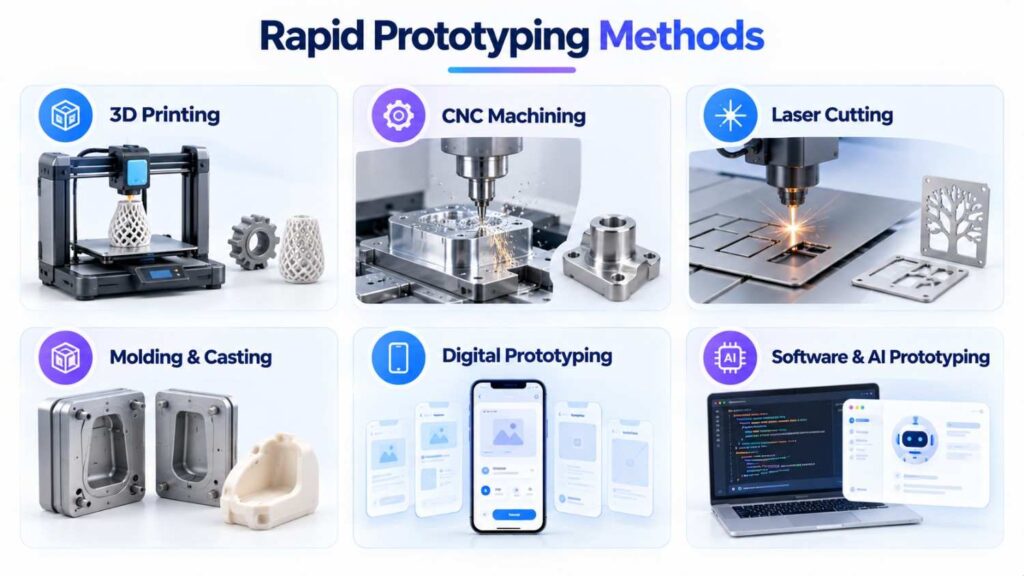
| Method | Best For | Main Advantage |
|---|---|---|
| 3D printing | Physical concepts and parts | Fast production of complex shapes |
| CNC machining | Functional engineering parts | Precision and realistic materials |
| Laser/water-jet cutting | Flat parts, panels and enclosures | Fast fabrication from sheet materials |
| Molding and casting | Small prototype batches | Multiple consistent copies |
| Wireframes | Early website and app concepts | Very fast concept validation |
| Interactive prototypes | UI/UX and user journeys | Realistic interaction testing |
| Code prototypes | Software and technical concepts | Tests actual functionality |
| AI-assisted prototyping | Software, UI and design exploration | Faster creation and iteration |
3D Printing
3D printing, also known as additive manufacturing, creates physical objects layer by layer from a digital model. It is closely associated with rapid prototyping because designers can change a CAD model and produce another physical version without first creating conventional production tooling.
For a deeper look at the manufacturing side, Formlabs’ rapid prototyping guide explains how 3D printing can support concept exploration, functional prototyping, product validation, and repeated design iterations.
Different 3D-printing technologies have different strengths:
| Technology | Typical Strength |
|---|---|
| FDM | Affordable concept and functional prototypes |
| SLA | Fine detail and smooth surfaces |
| SLS | Durable, geometrically complex functional parts |
| Metal additive manufacturing | Functional metal engineering prototypes |
The best technology depends on the required material, accuracy, surface quality, mechanical properties, budget, and purpose of the prototype.
CNC Machining, Laser Cutting and Water-Jet Cutting
CNC machining is a subtractive process. Instead of adding material layer by layer, computer-controlled equipment removes material from a solid workpiece to produce the desired shape.
It is particularly useful when prototypes require high dimensional accuracy or materials closer to those intended for the final product.
Laser and water-jet cutting provide fast alternatives for parts made from sheet materials. They can be useful for panels, brackets, enclosures, gaskets, fixtures, and other components that can be cut from flat material.
Rapid Tooling, Molding and Casting
Once a design becomes more stable, teams may need several realistic prototypes rather than a single model.
Silicone molding, urethane or vacuum casting, and rapid tooling can help bridge the gap between one-off prototypes and full-scale manufacturing. These methods are useful for producing small batches, evaluating finishes and materials, testing assembly, or collecting feedback from multiple users.
They allow teams to create more production-like parts without immediately investing in full production tooling.
Digital and UI/UX Prototyping
Not every rapid prototype is physical.
Designers use wireframes, clickable interfaces, interactive mockups, and simulated user journeys to test websites, mobile applications, dashboards, and other digital products. Tools such as Figma’s prototyping features let teams create interactive flows, test interactions, gather feedback, and demonstrate user journeys before full development.
Early wireframes can test information architecture and layout. Higher-fidelity interactive prototypes can show how users move through a product before developers build the underlying application.
Software and Code Prototypes
Rapid prototyping in software engineering focuses on validating functionality or technical feasibility without first building an entire production application.
A developer might prototype an API integration, recommendation system, AI feature, database architecture, automation workflow, or unfamiliar technology to determine whether the approach works.
These prototypes prioritize learning and technical validation rather than production-quality code.
AI-Assisted Prototyping
Generative AI has made fast prototyping possible across more stages of product development.
Teams can use AI-assisted tools to generate interface concepts, initial code, content, design variations, workflows, and early functional applications. This can be especially useful when quickly testing ideas for CRUD applications and other data-driven software. This can significantly shorten the distance between an idea and something people can actually test.
However, generating a prototype quickly doesn’t make it production-ready. AI-generated outputs still require validation, testing, security review, and engineering judgment.
Rapid Prototyping vs Traditional Prototyping
Both approaches help teams evaluate ideas before full development or production, but rapid prototyping emphasizes shorter feedback cycles and easier iteration.
| Area | Rapid Prototyping | Traditional Prototyping |
|---|---|---|
| Development speed | Fast | Usually slower |
| Iteration | Frequent | Changes may take longer |
| Early-stage cost | Often lower for early validation | May require more setup or tooling |
| Main purpose | Learn and validate quickly | Detailed or final validation |
| Flexibility | High | Often lower |
| Common methods | Digital tools, 3D printing, CNC, AI | Conventional fabrication and tooling |
Traditional methods still have value, particularly when highly realistic prototypes are required for final engineering, manufacturing, compliance, or validation.
Rapid prototyping doesn’t necessarily replace traditional methods. Instead, it allows teams to test assumptions earlier and iterate more frequently before reaching expensive later stages.
Benefits of Rapid Prototyping
The biggest advantage of rapid prototyping isn’t simply faster development. It reduces the cost of being wrong by exposing problems before a team commits heavily to a particular solution.
- Faster feedback allows teams to determine whether an idea works before spending months developing it. Early testing can uncover confusing interfaces, design flaws, engineering problems, and incorrect technical assumptions.
- Lower development risk comes from discovering these problems while designs are still relatively easy to change. Teams can test assumptions using something tangible instead of relying entirely on documents, meetings, or opinions.
- Better product decisions become possible because each iteration produces new information. Teams can compare alternatives and make decisions based on actual testing.
- Improved collaboration is another benefit. A clickable interface or physical model gives designers, developers, engineers, executives, customers, and other stakeholders something concrete to evaluate.
Rapid prototyping can also reduce time to market when faster testing and iteration help teams make important decisions sooner.
These benefits explain why rapid prototype development is used across software, UX design, manufacturing, healthcare, automotive engineering, aerospace, consumer products, and many other industries.
Rapid Prototyping in Software Engineering and UX
Rapid prototyping in software engineering focuses on validating user experience, functionality, or technical feasibility before developing the complete application.
A UX team might start with basic wireframes to determine where information belongs on a page. After gathering feedback, those wireframes can become an interactive prototype that users click through as though they were using the actual product.
Software engineers apply the same principle to technical questions. A small working implementation can test whether an API integrates correctly, whether an AI model can perform a particular task, or whether a proposed architecture supports the required workflow.
One important rule is that prototype code should not automatically become production code.
Rapid development often prioritizes experimentation over security, scalability, maintainability, testing, observability, and performance. Once an idea has been validated, teams should determine which parts can be retained and which need to be redesigned or hardened for production.
Rapid Prototyping in Manufacturing
In manufacturing, rapid prototyping turns digital designs into physical models that engineers can inspect and test before committing to full production.
A CAD model might first be 3D printed to evaluate its overall size and shape. The next version could use stronger materials to test fit and functionality. CNC machining or another higher-fidelity process may then be used when more realistic mechanical properties are required.
Industries such as automotive, aerospace, healthcare, industrial equipment, and consumer electronics use rapid prototypes to evaluate components, ergonomics, assembly, product appearance, and engineering decisions.
This helps reduce the risk of discovering important design problems only after expensive production tooling or large manufacturing runs have begun.
In-House vs External Rapid Prototyping
Whether rapid prototyping should be handled internally or by a specialist depends on the project’s requirements.
In-house prototyping can work well for teams that iterate frequently. It can shorten feedback cycles, make experimentation easier, and give teams direct control over designs and prototypes.
External rapid prototyping services may be more practical when a project requires specialized equipment, uncommon materials, large parts, advanced manufacturing expertise, or machinery that would be expensive to maintain for occasional use.
Many organizations use a hybrid approach. Early concepts and digital prototypes are developed internally, while specialized providers produce higher-fidelity engineering prototypes once the design becomes more mature.
Examples of Rapid Prototyping
Rapid prototyping becomes easier to understand when you see how the same process applies to different products and industries.
Mobile App Prototype
A team developing a mobile banking application could create a clickable prototype of its account-registration and payment flows instead of building the complete app.
Users test those journeys, designers identify confusing steps, and the interface is revised before engineers implement the full functionality.
Physical Product Prototype
A manufacturer developing a handheld device could produce several 3D-printed shells with different shapes.
Real users could handle each version and provide feedback on comfort, grip, button placement, and size before the company invests in production tooling.
AI Software Prototype
A software team developing an AI customer-support system might prototype only its core workflow.
The team could connect a language model to a small knowledge base, test whether relevant information can be retrieved, and evaluate the resulting answers. If the concept performs well enough, the team can then address authentication, integrations, monitoring, security, evaluation, and scalability.
The prototypes in these examples are very different, but the underlying principle is identical:
Build only enough to test the important assumption, learn from the result, and improve the next version.
Rapid Prototype vs MVP: What’s the Difference?
Rapid prototypes and minimum viable products (MVPs) are related, but they serve different purposes.
A prototype is primarily a learning and validation tool. It may be incomplete, use placeholder data, contain temporary code, or simulate functionality that hasn’t actually been implemented. Many prototypes remain inside the design and development process.
An MVP is a usable version of a product released to real users with enough functionality to solve a core problem and test real-world demand.
For example, a clickable mockup of a food-delivery app could be a prototype. A basic working version that lets real customers order from a limited number of restaurants could be an MVP.
Rapid prototyping can therefore help a team identify what the right MVP should be, but a prototype and an MVP should not be treated as interchangeable terms.
| Rapid Prototype | MVP | |
|---|---|---|
| Primary goal | Learn and validate | Test product demand/use |
| Users | Test users or internal stakeholders | Real users/customers |
| Functionality | May be simulated | Core functionality works |
| Production-ready | Usually no | Should be usable |
| Main question | Does this idea work? | Will people use it? |
Limitations and Common Rapid Prototyping Mistakes
Rapid prototyping is useful because it encourages speed, but speed can also create problems when teams lose sight of what the prototype is supposed to accomplish.
Overbuilding the First Prototype
If the goal is simply to determine whether users understand a workflow, spending weeks perfecting colors, animations, backend infrastructure, or edge cases defeats the purpose.
Build only what is necessary to answer the current question.
Testing the Wrong Thing
A visually impressive prototype provides little value if the team never identified the assumption it was supposed to validate.
Every iteration should begin with a clear learning objective.
Testing With the Wrong Users
Feedback from executives, designers, developers, or other internal stakeholders doesn’t always represent how actual customers will use a product.
For important user-facing assumptions, involve people who reasonably represent the intended audience.
Changing Too Much Between Iterations
If the layout, navigation, messaging, functionality, and interaction model all change simultaneously, it can become difficult to determine which change affected the result.
Focused iterations usually produce clearer learning.
Confusing Fidelity With Readiness
A polished interface can make stakeholders believe software is nearly complete even when the underlying functionality hasn’t been built.
Physical prototypes can create a similar misunderstanding when prototype materials behave differently from the materials intended for production.
Treating a Successful Prototype as Proof of Product Success
A prototype reduces uncertainty; it doesn’t eliminate it.
Successful prototype testing does not automatically prove market demand, scalability, security, manufacturing feasibility, profitability, or long-term product success.
How AI Is Changing Rapid Prototyping
Generative AI is reducing the amount of manual work required to move from an idea to something testable.
Designers can use AI to explore interface variations and generate early visual concepts. Developers can describe an application or feature in natural language and generate initial code. Engineering and product teams can also use AI-assisted tools to explore alternatives, analyze requirements, and accelerate repetitive prototyping work.
This can make the idea → prototype → feedback cycle significantly faster, particularly for digital products.
AI is also changing who can participate in rapid prototyping. Product managers, founders, marketers, designers, and other non-developers can increasingly create interactive concepts without waiting for a complete engineering cycle.
But faster generation makes validation even more important.
AI-generated code can contain security problems, incorrect assumptions, unnecessary dependencies, unreliable logic, or poor architectural choices. Similarly, an AI-generated interface may look polished without actually solving the underlying user problem.
A prototype that works in a demonstration is not automatically ready for production.
When Should You Use Rapid Prototyping?
Rapid prototyping works best when there is meaningful uncertainty that can be reduced through testing.
It is particularly useful when a team needs to:
- compare several product concepts;
- validate a new user experience;
- test an unfamiliar technology;
- check physical fit, ergonomics, or functionality;
- evaluate a software architecture or integration;
- demonstrate a concept to stakeholders;
- gather customer feedback before major investment; or
- explore several solutions before selecting one.
Rapid prototyping provides less value when the solution is already well understood, the risks are low, and creating a prototype would add another step without answering an important design, technical, business, or user question.
Before starting, ask:
What important decision will this prototype help us make?
If the team cannot answer that clearly, it probably needs to define the experiment before building anything.
Final Thoughts
Rapid prototyping is a fast, iterative way to turn ideas into testable models before committing to full development or production.
A prototype might be a paper wireframe, clickable software interface, AI-generated application, 3D-printed component, CNC-machined part, or another model appropriate to the question being tested. The method changes, but the underlying goal remains the same.
Effective rapid prototyping follows a simple principle:
Build enough to test an assumption → gather useful feedback → improve the design → repeat.
AI and modern prototyping tools are making these cycles faster, but they don’t remove the need for thoughtful testing. The best prototype isn’t necessarily the most advanced or realistic one. It’s the one that helps you learn what you need to know before an expensive mistake reaches the final product.
Frequently Asked Questions
1. What is rapid prototyping?
Rapid prototyping is the process of quickly creating an early version of a product, component, interface, or system, testing it, gathering feedback, and improving the design before full development or production.
2. What are the main rapid prototyping methods?
Common rapid prototyping methods include 3D printing, CNC machining, laser cutting, molding and casting, wireframes, interactive UI prototypes, functional software prototypes, and AI-assisted prototyping.
3. Is rapid prototyping the same as 3D printing?
No. 3D printing is one rapid prototyping method, particularly for physical products. Rapid prototyping is the broader iterative process and can also involve CNC machining, casting, wireframes, software prototypes, simulations, and other techniques.
4. What is rapid prototyping in software engineering?
Rapid prototyping in software engineering means quickly building a simplified or experimental version of an application, feature, interface, integration, or technical system to test usability or feasibility before developing the complete production system.
5. What is the difference between a rapid prototype and an MVP?
A rapid prototype is primarily created to test and learn and may not be fully functional. An MVP is a usable product released to real users with enough functionality to solve a core problem and test demand.
6. How is AI used in rapid prototyping?
AI can help generate early interfaces, code prototypes, design variations, workflows, and other testable concepts. It can accelerate iteration, but AI-generated prototypes still require human validation and shouldn’t automatically be treated as production-ready.
7. What is an example of rapid prototyping?
A team designing an app might create a clickable interface before developing the complete application. Users test it, the team identifies confusing steps, and the design is improved before full development begins. A manufacturer can follow the same process using a 3D-printed model of a physical product.
8. Is rapid prototyping expensive?
Not necessarily. Simple sketches, wireframes, and digital prototypes can cost very little, while high-fidelity physical or engineering prototypes may require specialized materials and equipment. The goal is to use the least expensive prototype that can reliably answer the question being tested.
