
Picture a writer in mid-2027. She drafts a product guide with an AI model inside her usual editor. A small panel flags three paragraphs that drift from her voice and offers rewrites trained on two years of her published posts. She accepts one, rewrites another herself, and ignores the third. Before publishing, the editor attaches a quiet note showing which parts were drafted with AI and which she wrote. Nobody in this scene pastes text into a separate website and crosses their fingers.
That’s a plausible picture of where AI content humanization is heading, and the pieces are already visible in late 2026. Regulators have started requiring machine-readable labels on AI output. Watermark detectors are opening to the public. Schools and employers are shifting from guessing who wrote a text to recording how it was written. Here’s what the evidence says about the next eighteen months, and how writers can get ready.
Where Things Stand at the End of 2026
The current generation of AI humanize tools was built for one problem: AI drafts sound flat and repetitive, and detectors flag them. Most tools respond by rewriting sentence structure, varying rhythm, and swapping predictable phrasing. Some AI humanize tools do it well. Many trade meaning for a better score.
Shift 1: Labels Arrive, and Text Gets Harder to Hide
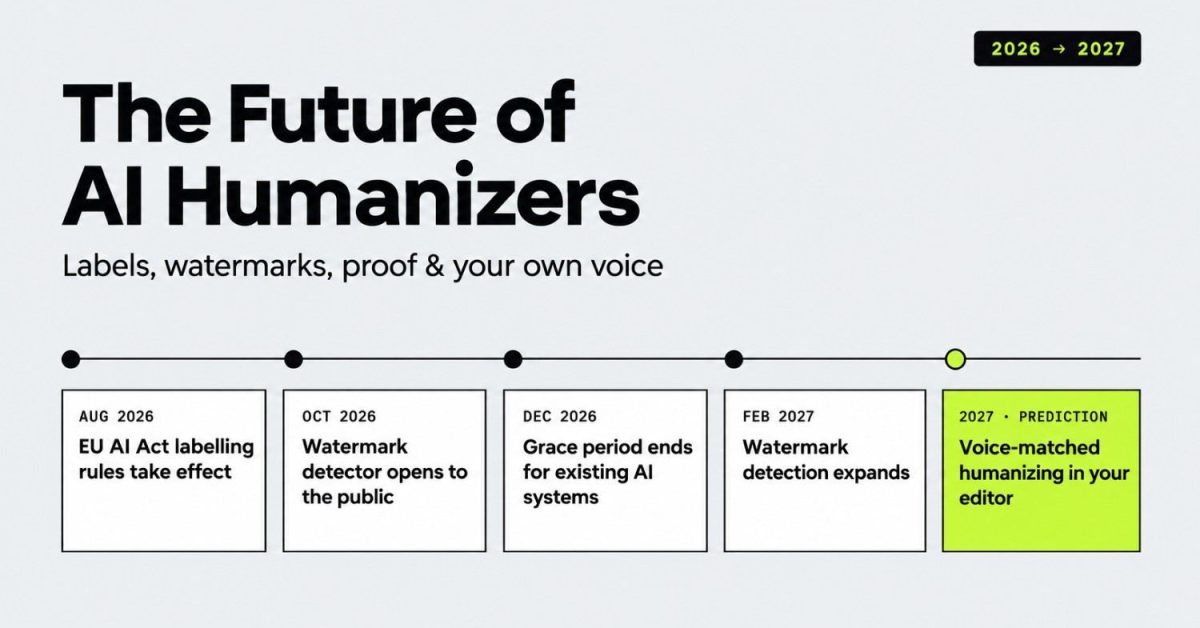
The biggest change heading into 2027 is regulatory. Article 50 of the EU AI Act became enforceable on 2 August 2026. It requires providers of generative AI systems to mark their output in a machine-readable, detectable way, and the European Commission’s code of practice sets 2 February 2027 as the deadline for watermark detection interoperability among signatories. Systems already on the market have a grace period that runs until 2 December 2026.
Two details matter for anyone who uses humanization AI:
- Text watermarking will be imperfect for a while. The rules acknowledge that reliable marking for plain text is still limited.
- Real editorial control matters. There’s an exemption for text on public-interest topics where a person or organization exercises genuine editorial responsibility, and routine or pro forma review doesn’t count.
In other words, the legal line in Europe is drawn around real human editorial control, and a quick rewrite won’t move content across it.
Watermark detection is also becoming public. In October 2026, Google opened its SynthID Detector to everyone, with OpenAI and Nvidia among the participating companies, as eWeek reported. The public site checks images, video, and audio for now. Text is harder: heavy rewriting or translation can weaken a text watermark, which is exactly what humanizers do.
Expect 2027 to bring an awkward tension. If AI humanize tools strip watermarks as a side effect of rewriting, regulators and platforms will start asking whether that’s a feature or a problem. The tools that thrive will likely be the ones that position themselves as editing aids within a disclosed workflow, rather than as watermark removers. Disclosed, edited, humanized AI content is far easier to defend than text that was quietly scrubbed.
Shift 2: Proving the Process Replaces Guessing the Author
AI detectors guess. They look at finished text and estimate probability. The newer approach records the writing as it happens, which sidesteps the guessing problem entirely.
Turnitin’s Clarity is the clearest example. It’s a writing environment that records drafting activity and can include a built-in AI assistant. Turnitin’s own data, covering July 2025 to August 2026, shows US submissions scoring above 80% for AI writing fell from 14.3% outside Clarity to 7.6% inside it. The data comes from Turnitin and doesn’t prove cause and effect, but the direction is telling: when the process is visible, fully AI-written submissions drop.
Grammarly has taken a similar route with Authorship, a feature that tracks how a document was written in Google Docs or Word online.
For humanized AI text, this changes the picture. In a process-tracked document, text pasted in from an outside humanizer shows up as pasted, no matter how human it reads. By 2027, the useful question in classrooms and many workplaces will be “How was this written?” rather than “Does this sound like AI?” Humanization AI that works inside the editor, with its suggestions recorded alongside the writer’s own changes, fits that world. A paste-in AI humanize box fits it poorly.
Shift 3: From Generic “Human” to Your Own Voice
Today’s humanizers aim at a generic target: text that reads as if some human wrote it. The obvious next step is text that reads as if you wrote it.
The building blocks already exist. Writing assistants can store style preferences, agencies keep voice guidelines for each client, and models can follow a handful of writing samples surprisingly well. Combining them into a voice profile that a humanizer applies to every draft is a short step.
Our prediction is that by 2027, the better AI humanizer tools will let users train a personal or brand voice from their own past writing, and will measure success by how closely the output matches that voice rather than by a detector score.
That would also solve a quiet problem with current tools. When thousands of writers run drafts through the same humanizer, the output starts to share that tool’s habits. A new kind of sameness replaces the old one. Voice-matched humanized AI content would push in the opposite direction.
Shift 4: Meaning Becomes the Benchmark
Independent humanizer tests in 2026 kept surfacing the same weakness: tools that score well on detectors often bend facts, drop qualifiers, or pad length. As detectors become less central and labels more common, that weakness gets harder to ignore.
Publishers are already rewarding substance over smoothness. Orbit Media’s 2026 blogging survey found that bloggers who rely on AI for editing report the lowest rate of strong results among editing approaches, while those working with human editors do far better.
The lesson for humanizing AI is simple: rewriting that loses accuracy costs more than it saves. Humanized AI text that reads smoothly but gets a number wrong does more damage than a clunky sentence ever could.
Expect the next round of reviews and benchmarks for humanization AI to weight meaning preservation, factual integrity, and length control more heavily. Some vendors already publish their own monthly test results; UnAIMyText’s detector test page is one example. The next step is for independent testers to publish meaning-preservation scores alongside detection rates, so writers can compare tools on what actually matters to readers.
Shift 5: Humanizing Moves Inside the Tools You Already Use
Most people still humanize AI text in a separate browser tab: copy, paste, rewrite, copy back. That workflow is clumsy, and it creates exactly the paste-shaped gaps that process tracking flags.
The likely direction is integration. Several humanizers already offer APIs, browser extensions, or document uploads. By 2027, expect AI humanize features and the rhythm-and-tone pass to live inside word processors, content management systems, and email clients as a built-in editing option, sitting beside grammar checks and tone suggestions. At that point, “AI humanize” stops being a separate product category and becomes a feature, much as spell-check did decades ago.
What Won’t Change
For all the movement, a few things look stable:
- Readers will keep judging writing by whether it’s specific, accurate, and useful.
- Search engines will keep rewarding pages that show real experience, whether or not Google can tell content is AI-written.
- Humanized AI drafts will still need a person to decide what’s true and what matters.
- No humanizer will be able to invent the example, data, or opinion that makes a piece worth reading.
The future of humanization AI is a better editing assistant. The judgment about what to say stays with the writer.
How to Get Ready for 2027
A few habits will help whether you write, edit, or manage a team producing humanized AI content.
- Write in tools with version history. A visible process is becoming the best defense against false accusations.
- Keep a voice reference. Save five or six pieces you’re proud of. They’ll be useful for training voice-matched tools and for briefing editors.
- Treat humanizing as editing. Use it on flat sections, check every protected detail, and add substance by hand.
- Know the disclosure rules in your field. If you publish in or to the EU, read up on Article 50 and the editorial-responsibility exemption.
- Judge tools on meaning. When you test a humanizer, compare facts and qualifiers as carefully as detector scores.
The Bottom Line
Humanization AI started as a way to get past detectors. Over the next year, it’s likely to become something more useful and less controversial: an in-editor assistant that matches your voice, keeps your facts intact, and works inside a process that’s open about how content was made. The tools that get there will thrive. The ones still selling invisibility will have a harder time in a world of labels, watermarks, and writing logs.
The writers who come out ahead will be the ones already working this way: using humanized AI drafts as a starting point, adding what only they know, and keeping a clear record of how the final piece came together.
