
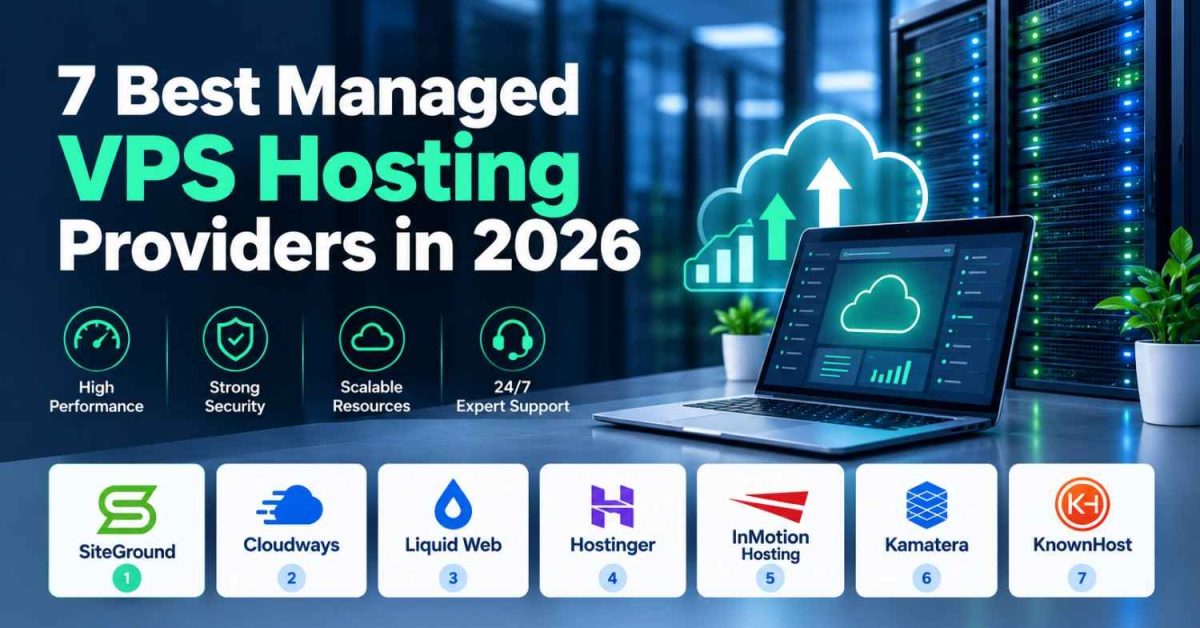
Choosing the best managed VPS hosting provider can make a significant difference in website performance, security, and long-term operating costs. Whether you’re running a growing WordPress website, an online store, or multiple client projects, managed VPS hosting gives you dedicated resources without requiring you to handle every aspect of server administration.
However, not all managed VPS services deliver the same value. Some providers include security, backups, migrations, and control panels in their packages, while others charge extra for features that businesses depend on.
We’ve selected seven managed VPS and managed cloud hosting providers worth considering in 2026, comparing their infrastructure, management features, scalability, and suitability for different workloads.
Best Managed VPS Hosting Providers at a Glance
| Provider | Best For | Key Advantage |
|---|---|---|
| ScalaHosting | Best overall | Managed cloud VPS, SPanel, security, and free migrations |
| Cloudways | Cloud hosting flexibility | Choice of cloud infrastructure |
| Liquid Web | Resource-intensive business applications | Managed infrastructure and technical support |
| Hostinger | Budget-conscious users | Accessible VPS pricing |
| InMotion Hosting | Business VPS hosting | Traditional VPS configurations |
| Kamatera | Custom cloud infrastructure | Highly configurable resources |
| KnownHost | Managed VPS for established websites | Server management and hosting support |
1. ScalaHosting: Best Overall Managed VPS Hosting Provider
ScalaHosting managed cloud hosting stands out for businesses that want reliable cloud infrastructure, scalable resources, and comprehensive server management without unnecessary complexity.
Unlike providers that rely heavily on third-party control panels or charge separately for essential services, ScalaHosting combines its proprietary SPanel platform, integrated security, and professional migration assistance into a unified hosting environment.
Performance and Scalability
ScalaHosting uses NVMe storage and offers OpenLiteSpeed acceleration on supported cloud plans. Customers can also use Redis caching and Cloudflare CDN integration to improve website performance, much like an application acceleration manager speeds up delivery for larger apps.
Its managed cloud infrastructure allows businesses to scale individual resources as their requirements change. For example, a website experiencing increased traffic can add CPU cores or storage without necessarily upgrading to an entirely different package.
This flexibility is particularly valuable for WooCommerce stores, growing WordPress websites, and agencies managing multiple client projects.
SPanel: A Cost-Effective cPanel Alternative
One of ScalaHosting’s strongest advantages is SPanel, its proprietary hosting control panel.
SPanel provides website management, email administration, DNS controls, application installation, resource monitoring, and security features without requiring a separate cPanel license. It also includes specialized tools such as WordPress Manager, Redis Manager, and Node.js management.
For agencies operating multiple websites, eliminating recurring control panel licensing costs can make a meaningful difference to the total cost of hosting.
Security and Reliability
ScalaHosting incorporates SShield, an AI-powered security system designed to detect and block malicious activity. Its managed hosting environment also includes security monitoring, SSL support, and backup capabilities. Server-level protection like this works best alongside basic computer virus prevention habits on the devices your team uses to manage the site.
The company advertises a 99.9% uptime guarantee, supported by a service-level agreement. For businesses that depend on their websites to generate revenue, these protections are particularly important.
Free Professional Website Migrations
Moving a production website between hosting providers can be complicated, especially when databases, email accounts, and custom configurations are involved.
ScalaHosting offers free professional website migrations for new hosting customers. Its migration team operates around the clock, allowing businesses to schedule transfers outside their busiest periods.
This makes ScalaHosting attractive to businesses switching from shared hosting, traditional VPS services, or another managed cloud provider.
What Makes ScalaHosting Different?
ScalaHosting’s published comparison data provides several useful examples of its value proposition.
In its comparison with SiteGround, ScalaHosting lists an entry managed cloud configuration at $29.95 per month, with 2 CPU cores, 4 GB RAM, and 50 GB storage. The compared SiteGround Jump Start plan is listed at $100 per month, with 4 CPU cores, 8 GB RAM, and 40 GB storage.
These are not identical resource configurations, but they illustrate how ScalaHosting offers a smaller, lower-cost entry point for businesses that do not need a larger server immediately.
ScalaHosting’s published tests also report storage read speeds of 400 MB/s versus 165 MB/s for SiteGround in the compared environments, approximately 2.4 times the measured read throughput. These figures come from ScalaHosting’s own comparison materials rather than independent cross-provider benchmarks, and performance will vary by configuration and workload.
Pros:
- Scalable managed cloud VPS resources
- SPanel included without separate licensing fees
- Integrated SShield security
- NVMe storage and OpenLiteSpeed support
- Free professional website migrations
- 24/7 technical support
- 99.9% uptime guarantee
- Anytime money-back policy, subject to applicable terms
Cons:
- Managed cloud hosting costs more than entry-level shared hosting
- Businesses accustomed to cPanel may need time to learn SPanel
- Some advanced features depend on the selected hosting plan
Best for: Growing businesses, WordPress websites, WooCommerce stores, agencies, and organizations seeking a managed cloud environment with predictable operational costs.
2. Cloudways: Best for Flexible Cloud Hosting
Cloudways is a managed cloud hosting platform that simplifies deploying applications on infrastructure from established cloud providers.
Instead of requiring customers to configure cloud servers entirely themselves, Cloudways provides a management interface for application deployment, monitoring, backups, and performance optimization. This approach appeals to developers, agencies, and businesses that want access to cloud infrastructure without managing every underlying technical component.
Key features:
- Choice of supported cloud infrastructure providers
- Application deployment and management tools
- Server monitoring and backup options
- WordPress and WooCommerce hosting support
- Scaling options depending on the infrastructure provider
Cloudways is particularly attractive to businesses that prioritize infrastructure choice. However, its pricing and available resources depend on the selected cloud provider and server configuration. Users should also evaluate which management and security services are included versus available as paid extras.
Best for: Developers and agencies that want managed cloud hosting with a choice of infrastructure.
3. UltaHost
UltaHost runs managed VPS plans with NVMe storage on every tier and 27+ data centre locations, which makes it a practical pick when latency to a specific region matters more than raw specs.
VPS Basic starts at $6.89 a month with 1 CPU core, 1 GB of RAM and 30 GB of NVMe storage, and plans scale from there. Free website migration, free SSL and daily backups are included across the range, with 24/7 support and a 99.99% uptime guarantee.
Best for: teams moving off shared hosting who want a managed environment and full root access without running the hardware themselves.
4. Hostinger: Best for Budget-Conscious VPS Users
Hostinger is widely known for accessible hosting packages, including VPS solutions aimed at users who want more control over their server environments. Its VPS offerings provide an upgrade path for customers moving beyond shared hosting.
However, Hostinger’s standard VPS products are primarily self-managed, making them different from fully managed VPS solutions. Customers may need to handle more server administration themselves or use additional tools and services.
Key features:
- VPS hosting with configurable resources
- NVMe storage on supported plans
- Server management tools
- Multiple hosting product categories
- Options suitable for developers and technical users
Hostinger may offer attractive entry-level costs, but businesses comparing it with ScalaHosting should account for the work involved in server administration.
Best for: Budget-conscious developers and technically confident website owners.
5. InMotion Hosting: Best for Traditional Business VPS Hosting
InMotion Hosting offers VPS hosting alongside shared, dedicated, and other business hosting services. Its VPS products are designed for customers who need more server resources and flexibility than conventional shared hosting can provide.
Depending on the selected package, businesses can access management assistance and familiar server administration tools.
Key features:
- Managed and unmanaged VPS options
- Business-oriented hosting services
- Server resource configurations
- Control panel options
- Technical support
InMotion Hosting is a practical option for organizations that prefer a more traditional VPS environment. Customers should review control panel licensing, backup provisions, and included management services when calculating the total monthly cost.
Best for: Small and medium-sized businesses seeking traditional VPS hosting.
6. Kamatera: Best for Highly Customizable Cloud Servers
Kamatera provides cloud infrastructure that allows customers to configure servers around their technical requirements. Users can select computing resources, storage, and other infrastructure components to build environments suited to specific workloads.
This flexibility makes Kamatera appealing to development teams and businesses running custom applications.
Key features:
- Customizable cloud server configurations
- Flexible CPU, RAM, and storage selections
- Global cloud infrastructure
- Scaling capabilities
- Optional managed services
The main consideration is management complexity. Although Kamatera offers managed service options, its standard cloud server experience is more infrastructure-focused than a turnkey managed hosting platform. Organizations should assess whether they have the technical expertise to administer their environment or need an additional management service.
Best for: Developers, technical teams, and organizations with custom infrastructure requirements.
7. KnownHost: Best for Managed VPS Hosting With Traditional Server Management
KnownHost provides managed hosting services, including VPS options designed for website owners who need dedicated resources and technical assistance. Its services are suitable for businesses that want more control than shared hosting offers while retaining access to hosting support.
Key features:
- Managed VPS hosting packages
- Server administration assistance
- SSD-based storage options
- Website hosting and migration services
- Technical support
KnownHost is worth considering for established websites that require a conventional managed VPS environment. As with other providers, buyers should check resource limits, control panel licensing, backup retention, and renewal pricing before committing.
Best for: Established websites and businesses seeking a traditional managed VPS service.
Managed VPS Hosting Comparison: What Matters Most?
Choosing a managed VPS provider requires looking beyond advertised monthly prices. The factors below have the biggest impact on performance, security, and the real cost of hosting over time.
| Evaluation Factor | Why It Matters | ScalaHosting Approach |
|---|---|---|
| Level of management | Determines how much server administration your team must handle | Fully managed cloud VPS with server management included |
| Control panel licensing | cPanel license fees can significantly raise monthly costs | SPanel included without separate licensing fees |
| Security | Protects revenue-generating websites from malware and attacks | SShield AI-powered security, monitoring, and SSL support |
| Scalability | Growing sites need more resources without disruptive upgrades | Individual resources such as CPU and storage can be scaled |
| Performance | Faster sites improve user experience and conversions | NVMe storage, OpenLiteSpeed, Redis, and Cloudflare CDN integration |
| Migrations | Moving a live site can cause downtime and data loss | Free professional migrations, available around the clock |
| Support and uptime | Problems need fast fixes, especially for online stores | 24/7 technical support and a 99.9% uptime guarantee |
Questions to Ask Before You Choose
- What does “managed” actually include? Some providers manage only the hardware, while others handle security updates, monitoring, and troubleshooting.
- Are there hidden costs? Check control panel licenses, backup storage, premium support, and renewal pricing.
- How easy is it to scale? Find out whether you can add resources individually or must move to a larger plan.
- Who handles migration? A free, professional migration saves time and reduces the risk of errors.
- What are the backup and recovery policies? Confirm how often backups run, how long they are kept, and how quickly you can restore them.
Which Managed VPS Hosting Provider Should You Choose?
The right provider depends on your technical skills, workload, and budget:
- For most growing businesses, WordPress sites, and agencies: ScalaHosting offers the strongest balance of management, built-in security, and cost control.
- For infrastructure flexibility: Cloudways lets you choose the underlying cloud provider.
- For demanding business applications: Liquid Web suits resource-intensive workloads.
- For the lowest entry cost: Hostinger works well if you’re comfortable managing the server yourself.
- For traditional VPS setups: InMotion Hosting and KnownHost offer familiar, conventional environments.
- For fully custom infrastructure: Kamatera gives technical teams the most configuration freedom.
Conclusion
Managed VPS hosting gives businesses the dedicated resources of a private server without the burden of handling every technical task themselves. But the best choice isn’t simply the cheapest plan. It’s the provider whose management level, security, scalability, and total cost match how your business actually runs.
For most growing websites, online stores, and agencies, ScalaHosting stands out by combining managed cloud infrastructure, SPanel, SShield security, and free migrations in one package. If your needs are more specialized, Cloudways, Liquid Web, Kamatera, and the other providers on this list are worth comparing against your specific requirements.
Before committing, review each provider’s current plans, renewal pricing, and support terms, since features and prices can change.
Frequently Asked Questions
What is managed VPS hosting?
Managed VPS hosting is a virtual private server where the hosting provider handles server administration tasks such as security updates, monitoring, backups, and technical troubleshooting. You get dedicated resources without needing to manage the server yourself.
Is managed VPS hosting worth it?
For businesses without a dedicated system administrator, it usually is. Managed hosting saves time, reduces security risks, and provides expert help when problems arise, which often outweighs the higher monthly cost compared to unmanaged plans.
What is the difference between managed and unmanaged VPS?
With managed VPS, the provider takes care of server setup, maintenance, and security. With unmanaged VPS, you receive the server resources but are responsible for configuration, updates, and troubleshooting yourself.
Do I need cPanel for managed VPS hosting?
No. cPanel is popular, but it adds licensing costs. Some providers, such as ScalaHosting with SPanel, include their own control panel at no extra charge.
