
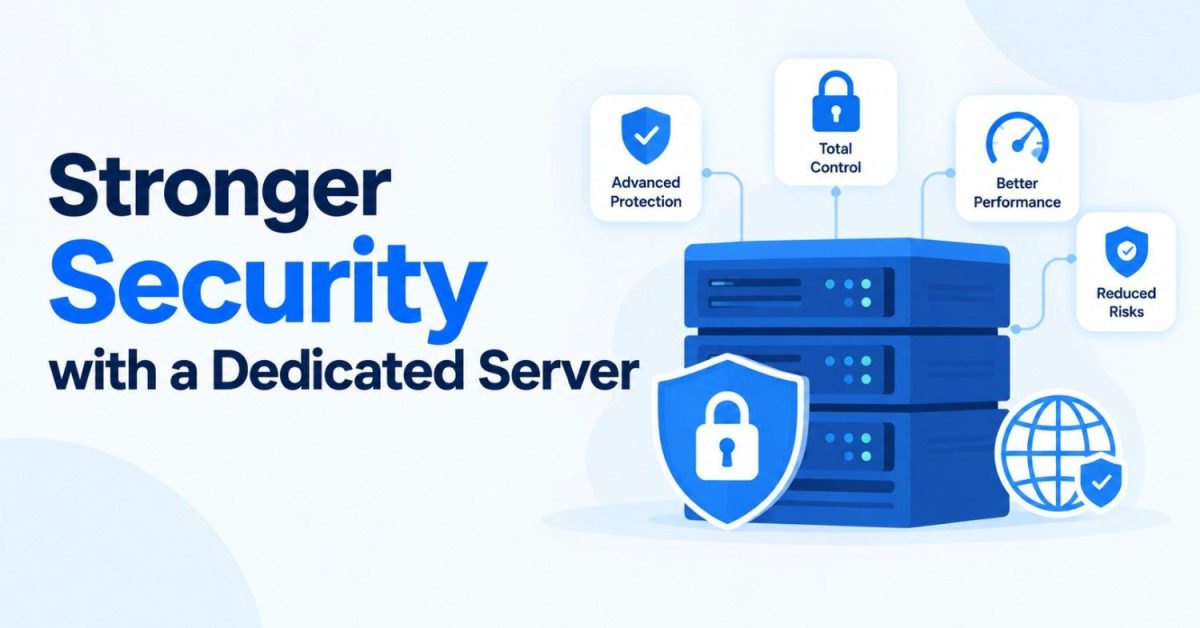
The security of your site depends heavily on the server underneath it. A dedicated server gives you one private machine. No other sites run on it, and you control every setting.
Shared hosting limits you on both counts. The provider applies one set of default protections to every account, and your site shares the machine with customers you cannot vet.
This article explains the security advantages of using a dedicated server, ranging from complete isolation to a clean IP reputation and easier compliance.
Complete Isolation From Other Users
On a shared server, your site runs alongside dozens of others you cannot inspect. An attacker who compromises one of them can sometimes cross the shared system to reach the rest.
A dedicated server removes that route. Only your site runs on the machine, so no neighboring account, file system, or process can open a path to your data. This setup significantly reduces your attack surface, allowing you to focus solely on the code and configuration you control.
Full Control Over Your Security Configuration
Shared hosting applies whatever security settings the provider sets for every account. A dedicated server, however, allows you to build defenses around the needs of your site.
You can configure the firewall rule by rule, choose which security software to run, and strengthen the operating system’s defenses. You decide which ports to leave open, which addresses may connect, and how strict each policy is. Server-level protection works best when it is paired with good computer virus prevention habits on the devices your team uses to manage the site.
You also control how quickly you patch the server. If a researcher discloses a serious vulnerability, you can apply the fix the moment it is released. You do not need to wait for a maintenance window the provider shares across many tenants, and attackers often strike during those hours of delay.
Control Over Encryption and Data Handling
You also decide how your data is protected at rest and in transit. A dedicated server allows you to encrypt full disks or specific databases.
You set the SSL and TLS configuration and choose where the encryption keys are stored. You also decide how long the server keeps sensitive records and when it deletes them.
Shared hosting ties you to the provider’s encryption defaults and key management, and you cannot inspect or change either one. When you hold the keys, however, no other party on the machine can read your data, and you can document exactly how you secure it.
A Dedicated IP and a Clean Reputation
On shared hosting, your site often shares one IP address with every other account on the server. If one of them sends spam or hosts malicious content, a blacklist can flag that shared IP. Your email then lands in spam folders, and your site inherits a damaged sender reputation, even though you did nothing wrong.
A dedicated server assigns an IP address that only your site uses, which means only your behavior affects its reputation. Your email is far less likely to be filtered, and no blocklist flags you for what another site did. Pairing a clean IP with tools such as a messaging security agent also helps protect the email your business sends and receives.
Stronger Defense Against Attacks
You can also mount a stronger defense against direct attacks. With the entire machine to yourself, you can deploy tools that:
- Block repeated login attempts
- Rate-limit suspicious traffic
- Filter known bad actors
- Provide DDoS protection sized appropriately for your traffic
On shared hosting, an attack on any site can drag yours down with it, and the provider limits which defenses you may add. On a dedicated server, you control the full response. If an attack does succeed, off-server backups let you restore a clean copy quickly.
Easier Compliance With Data Regulations
Many standards that govern sensitive data require tight control over where the data is stored and how you secure it. PCI DSS for card payments and the rules for health and personal records are two common examples.
A shared environment makes that control difficult, because you cannot guarantee isolation or configure the server in full. The best dedicated hosting plans provide the isolated environment and configuration control that auditors expect. You can set encryption, access limits, and logging to the exact standard the regulation demands. Compliance is far simpler once no other customer shares the machine.
Internal Monitoring and Audit Trail
A dedicated server allows you to monitor the entire machine. You can install intrusion detection, keep detailed access logs, and set alerts for unusual activity, configuring each tool for your environment.
Detailed logs build a clear audit trail. They record who did what and when, which helps during an investigation and when you need to prove compliance.
Shared hosting, by contrast, offers only a fixed template, and you see only what the provider exposes. On a dedicated server, you can inspect every part of the system.
Conclusion
A dedicated server strengthens security by placing both the environment and its defenses under your control.
You gain complete isolation from other customers. You can configure protection around the needs of your site, control encryption, strengthen your defenses against attacks, maintain a clean IP reputation, and meet compliance requirements more easily. You can also review every action recorded on the server.
For any site that handles sensitive data, that direct control is the strongest reason to choose a dedicated server.
