
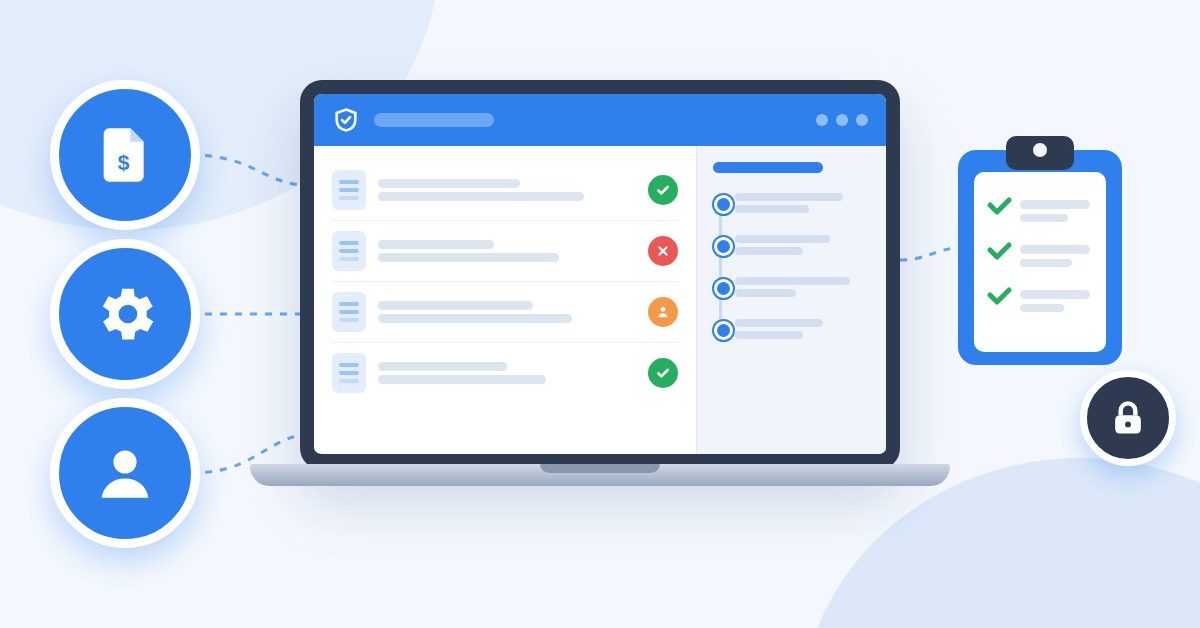
Automated loan underwriting promises faster decisions, lower operating costs and consistent credit policies across an entire portfolio. But many lenders who rushed automation projects later discover that their decision logs are incomplete, their models can’t be explained and their audit trails have gaps regulators won’t accept.
This guide walks through the practical steps for building automation that speeds up approvals without leaving compliance behind.
Why Automated Underwriting Creates Audit Trail Gaps
Traditional underwriting leaves a paper trail almost by accident. A loan officer reviews a file, marks up documents, writes notes, and approves or declines. Each step is timestamped and tied to a named person.
Automation collapses that sequence. A rules engine or machine learning model processes hundreds of variables in milliseconds, and the decision appears with no equivalent of the loan officer’s notes.
If the system doesn’t capture what data it used, what thresholds it applied and what output it reached, there’s no trail worth auditing.
Regulators in North America understand this risk well. In the United States, the Consumer Financial Protection Bureau (CFPB) expects lenders to show that automated decisions comply with fair lending and anti-discrimination rules.
In Canada, OSFI’s model risk guidance sets similar expectations for how financial institutions govern and document their models. In both cases, the system must log not just the outcome but the reasoning that produced it.
Three Common Failure Modes
- Storing only the outcome. Lenders automate decisions but keep only the final result, discarding the input variables and model weights that generated it.
- Bolting automation onto legacy systems. Teams add automation to old loan origination systems that were never built to capture machine-level decision data.
- Untracked human overrides. People override automated results after the fact, with no record linking the override to its authorization or the person who approved it.
Each of these looks harmless in day-to-day operations and becomes a serious problem the moment an examiner asks why a particular applicant was declined. The legacy system issue is especially common, which is why many lenders look at how AI transformation firms handle legacy systems before starting.
Design Compliance In From the Start
The solution isn’t to slow automation down. It’s to design logging and explainability into the system from day one, as an architectural requirement rather than a reporting feature added after launch.
Firms that approach custom fintech software development as a compliance-first discipline, rather than a speed exercise, report fewer remediation cycles when regulators arrive.
Space-O Canada, which has delivered more than 300 secure digital products for banks, credit unions and fintech firms since 2018, builds audit logging and explainability modules directly into the decisioning layer instead of adding them as an afterthought.
The firm’s 65% repeat and referral client rate reflects how often financial institutions return for that compliance-focused engineering approach.
Step 1: Map Your Current Underwriting Workflow Before Automating
Before writing a single line of automation code, you need an accurate picture of how lending decisions are actually made today. That sounds obvious, but most automation failures trace back to teams that built systems around assumptions rather than their real process.
Document Every Decision Point
Start by documenting each decision point in your current workflow, including:
- The moment a file is assigned
- The data sources a loan officer consults
- The criteria that trigger a manual review
- The sign-off chain before a decision reaches the applicant
- The exceptions, because that’s often where the most audit-sensitive decisions happen
Capture Every Handoff
Pay close attention to handoffs. Every time a file moves from one person or system to another, that transition must be captured in your automated workflow. Missing a handoff during mapping means missing it in the audit trail later, and that’s exactly the kind of gap examiners find.
Talk to the People Doing the Work
Interview the people who actually do the work, not just the managers who describe how it’s supposed to happen.
Front-line underwriters know which steps are documented informally, which exceptions are resolved verbally and where the official process differs from daily practice. Automation will expose those gaps if you don’t address them first.
Record Data Sources and Versions
Document the data sources your team uses at each stage. Credit bureau pulls, bank statement analysis, income verification, property appraisals and internal risk scores each carry their own retention requirements and usage restrictions.
Your automated system will need to log which version of each data source it used for every application, not just which category of source it accessed.
Check the Map Against Regulations
Once the map is complete, review it against your regulatory obligations. In Canada, PIPEDA governs how personal financial data is collected, stored and used.
Fair lending requirements on both sides of the border demand that the factors driving a credit decision are documented and defensible. Any step without a clear data trail needs an explicit logging solution before you build anything else.
The finished workflow map becomes your compliance blueprint. Every later decision, from the choice of decision engine to the structure of your output logs, should trace back to it.
Step 2: Choose a Decision Engine That Logs Every Variable
The decision engine is the core of your automated underwriting system, and your choice here decides whether your audit trail is complete or full of holes from day one. Not all engines are built with compliance in mind, and vendors don’t always advertise what their systems fail to capture.
Rules-Based Engines
Rules-based engines apply predefined thresholds to structured data. If an applicant’s debt-to-income ratio exceeds a set limit, the application is declined. The logic is transparent by design, and logging it is straightforward: record the input value, the threshold, the rule version applied and the timestamp.
Where these systems fail audits is version control. If you update a rule and don’t log which version governed each past decision, you can’t reconstruct the reasoning behind historical outcomes.
Machine Learning Models
Machine learning models create a different problem. They process far more variables, and their logic isn’t always readable as a simple rule. A model may weigh hundreds of factors at once, and the interaction between them drives the result.
Storing the final score and input features is necessary but not enough. You also need to log the model version and the feature importance values that shaped each individual prediction.
Three Logging Requirements to Check Before You Buy
| Requirement | Why It Matters |
|---|---|
| Immutable decision logs | Records can’t be changed or deleted after the fact |
| Application-level explainability | Each decision can be explained individually, not just through aggregate model metrics |
| Version history | Every past decision links to the exact model or ruleset that produced it |
Some platforms advertise audit-ready dashboards but store the underlying decision data in formats that are hard to export or query during an examination. Ask vendors for a sample audit export before you buy, not a dashboard demo.
The format in which data leaves the system is what regulators review, not the charts a sales team shows on screen.
Immutable, queryable, version-controlled logs aren’t optional features. They’re the foundation for every later step. Lenders who discover this during an examination rather than during procurement face costly platform replacements at the worst possible time.
Step 3: Separate Human Decisions From Automated Ones
Automated decisioning rarely runs without any human involvement. Most lenders use a hybrid model where the system handles straightforward applications and flags edge cases for a loan officer.
That’s sensible, but it creates an audit trap if human and automated decisions are stored in the same record without being clearly distinguished.
The problem surfaces when an examiner asks who made a specific credit decision.
If the log shows an automated denial but a loan officer later reversed it without a separately documented reason, that override becomes the riskiest moment in the entire workflow.
It’s where fair lending exposure is highest and where audit trails most often break.
Build a Formal Override Protocol
Create an override protocol before you go live. Every time a person reverses or modifies an automated result, that action needs its own record, capturing:
- The name and role of the person who made the override
- The specific reason for it
- The data or documents they reviewed
- The timestamp, down to the minute
Generic reason codes aren’t enough. Examiners look for narratives that explain why this particular applicant warranted a different outcome.
Log the Approval Chain
Approval chains matter as much as the override itself. If your policy requires a manager to authorize overrides above a certain loan value, that authorization must appear in the log.
A loan officer’s note without sign-off from the required approver is an incomplete record, even if the lending decision itself was sound.
Keep Override Logs Structurally Separate
Separate the override log from the automated decision log. When both live in the same database table with the same record type, the distinction blurs over time, especially after system updates or data migrations.
Treat them as different event types with different schemas, so a query run during an examination returns clean, unambiguous results.
The cleaner this separation, the faster you can answer a regulator’s data request. Examiners have limited time during an on-site review. A system that produces a complete override history for any date range in minutes builds credibility. One that requires manual reconstruction from multiple sources does the opposite.
Step 4: Build Explainability Into Every Model Output
Explainability is where many automated underwriting systems fail their first regulatory examination. A system can log every input perfectly and still produce an adverse action notice an examiner rejects, because it lists statistical factors instead of the specific, human-readable reasons the law requires.
In the United States, the Equal Credit Opportunity Act requires lenders to tell denied applicants why they were turned down, and that obligation doesn’t change when a model makes the decision.
The CFPB made this explicit in Circular 2022-03, issued under then-Director Rohit Chopra: lenders can’t meet adverse action notice requirements simply by saying an algorithm was used.
The specific factors behind the decision must be clearly communicated to the applicant.
Generate Application-Level Explanations
That creates a precise technical requirement. Your decision engine must produce explanations for each application, not just model-level performance summaries.
Techniques such as SHAP (SHapley Additive exPlanations) assign each input variable a contribution score for each prediction. That lets you say an applicant was declined mainly because of high credit utilization and a short credit history, rather than because of a vague statistical pattern the applicant can’t see and a regulator won’t accept.
Choosing the right approach often depends on how the model is built, which is why many lenders work with a partner experienced in custom AI development.
Store Explanations With the Decision
Write the explanation into the same log entry as the decision. If it’s generated separately and stored in another system, you create a synchronization problem. When the two records fall out of alignment during a migration or upgrade, the audit trail breaks in a way that’s hard to rebuild.
Test Adverse Action Notices Before Launch
Run sample applications through the system, generate the resulting notices and review them with your compliance team. A notice that reads “credit score below threshold” may match your model’s technical output but still fail the specificity standard a regulator applies.
Fixing the format after launch is far more disruptive than fixing it during testing.
Gartner once predicted that 85% of AI projects would deliver erroneous outcomes because of bias in data, algorithms or the teams managing them. In lending, an erroneous outcome isn’t an acceptable margin of error. It’s a fair lending violation waiting to be found.
Conclusion
Automated underwriting will only become more central to lending as regulators get better at examining the systems behind it. Lenders who treat audit trails, explainability and override documentation as engineering priorities rather than compliance afterthoughts will be better prepared for every examination that follows.
The institutions that move fastest over the next decade won’t be the ones that automate most aggressively. They’ll be the ones that build the clearest evidence that their automation can be trusted.
Frequently Asked Questions
Why do automated underwriting systems create audit trail gaps?
Automation replaces step-by-step human review with instant decisions. If the system doesn’t log the data, thresholds, model version and reasoning behind each decision, there’s nothing for auditors to review.
What should an automated underwriting decision log include?
Each record should include the input data and its source version, the rule or model version used, the output, the explanation for the decision, a timestamp, and any human override with its reason and approver.
Can AI models be used for credit decisions under fair lending rules?
Yes, but lenders must still explain the specific reasons for each adverse decision. Explainability techniques like SHAP help translate model outputs into clear, applicant-level reasons.
