
Choosing an NVIDIA GB300 infrastructure provider means deciding who will operate the systems around your workload: power, liquid cooling, networking, storage, scheduling and support. For infrastructure leaders planning sustained training or inference, those responsibilities can matter as much as the accelerator itself.
The International Energy Agency’s 2025 Energy and AI report projects that global data center electricity consumption will more than double to around 945 TWh by 2030. That forecast reinforces a practical procurement concern: access to GPUs must be backed by the electrical and cooling capacity needed to run them.
The eight providers below offer different ways to access Blackwell Ultra systems, from dedicated full-rack leases to reserved hyperscaler capacity and smaller allocations. The comparison focuses on documented infrastructure, operating models and procurement requirements rather than customer ratings or advertised peak performance.
Key takeaways:
- GB300 NVL72 is a liquid-cooled rack with 72 Blackwell Ultra GPUs and 36 Grace CPUs, and providers sell access to it in very different ways.
- Choose between dedicated full racks, hyperscaler integration and smaller allocations based on workload size and procurement model.
- Confirm committed capacity, location, start date and acceptance tests in the contract, because a documented deployment doesn’t guarantee available capacity.
NVIDIA GB300 Infrastructure Providers Compared
| Provider | GB300 Offering | Operating Model | Main Procurement Consideration |
|---|---|---|---|
| CambridgeNexus | Bare-metal GB300 NVL72 full-rack leasing | One customer per rack, with seven operating layers under one contract | Starts at one full rack; lease terms from 6 months to 5+ years |
| Microsoft Azure | ND GB300 v6 series | GB300-backed compute within Azure | Confirm regional capacity, quota and placement requirements |
| Google Cloud | A4X Max | Reserved bare-metal capacity within Compute Engine | Check reservation requirements and service-specific limitations |
| Verda | GB300 NVL72 from a compute tray to multiple racks | Smaller allocations and rack-scale access with engineering support | Specify allocation size and required interconnect topology |
| Nscale | Dedicated GB300 NVL72 infrastructure | Integrated infrastructure and workload-validation support | Confirm the production site, committed capacity and project schedule |
| Firmus | GB300 NVL72 AI Factory infrastructure | Integrated compute, cooling and power operations | Confirm capacity available to new customers at the required location |
| Global AI | GB300 NVL72 infrastructure in Endicott, New York | Sovereign AI infrastructure focused on enterprise control and isolation | Define physical separation, operational access and residency requirements |
| GMI Cloud | GB300 NVL72 training and inference infrastructure | GPU infrastructure with dedicated and managed service options | Confirm the exact GB300 configuration and reservation status |
Availability should be confirmed for a specific configuration, location and start date. A documented deployment shows operational capability, but it doesn’t prove that uncommitted capacity is available for a new customer.
What Matters When Comparing GB300 Providers?
The most important factors are allocation size, tenancy, operating responsibility, networking, location and contractual readiness.
This comparison uses official product documentation and deployment announcements to confirm whether each provider has a documented GB300 NVL72 offering. It separates operating services from hardware sales and doesn’t treat general Blackwell availability as proof of GB300 capacity.
A full-rack lease and a smaller allocation built on the same architecture can serve very different buyers. The useful question is how each service fits your workload and procurement model.
1. CambridgeNexus
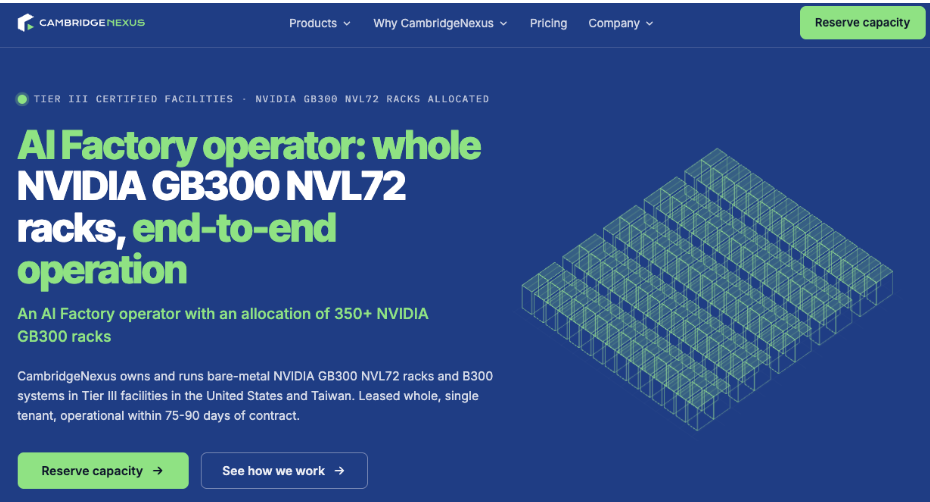
CambridgeNexus AI Factory (CNEX) is a Boston-based operator that owns and runs bare-metal NVIDIA GB300 NVL72 racks and leases them whole, with one customer per rack. Its model suits organizations procuring dedicated infrastructure for sustained production workloads.
CNEX manages seven operating layers under one contract:
- Power
- Cooling
- Networking
- Compute
- Orchestration
- Compliance
- Customer workload planning
That scope gives infrastructure teams a single operator responsible for everything around the rack, including the systems needed to keep training and inference workloads running.
Customers can lease from a single rack upward, on terms from 6 months to 5+ years. CambridgeNexus operates in the United States and Taiwan, and the installation site is chosen based on workload, latency and compliance needs, then fixed in the contract.
Best suited to: AI labs, enterprises and research organizations with sustained demand for dedicated rack-scale capacity. Agree on storage scope, service levels, installation timing and acceptance criteria before signing.
2. Microsoft Azure
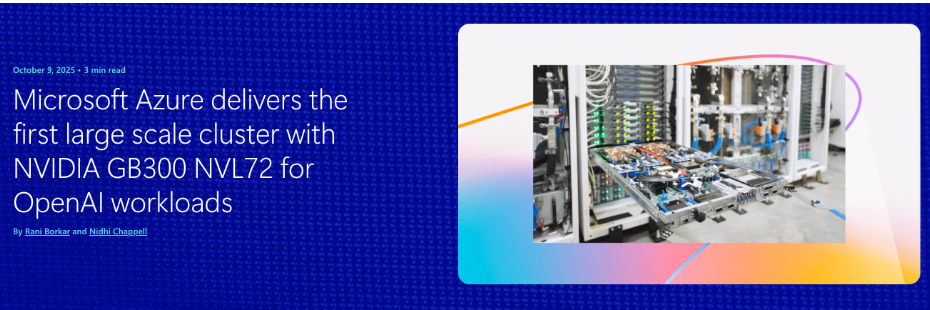
Azure’s ND GB300 v6 series runs on NVIDIA GB300 NVL72 systems. Each documented allocation contains four Blackwell Ultra GPUs and two Grace CPUs, with fifth-generation NVLink connectivity and InfiniBand networking for larger deployments.
Its main appeal is integration with existing Azure identity, networking, storage and operational processes. However, a GB300-backed allocation doesn’t automatically provide exclusive access to a full rack or guarantee the topology needed for distributed training.
Best suited to: Organizations already running in Azure. Confirm region, quota, connected capacity, placement arrangements and software compatibility with the Grace CPU architecture.
3. Google Cloud
Google Cloud’s A4X Max provides GB300 NVL72-based bare-metal capacity within its accelerator-optimized Compute Engine portfolio, without the Compute Engine hypervisor.
Buyers need to assess its reservation process and service conditions separately from other Google Cloud compute products. Documented restrictions cover supported regions, operating systems and storage, and the standard Compute Engine Service Level Agreement doesn’t apply to this machine series.
Best suited to: Teams placing GB300 workloads within Google Cloud. Check reservation requirements and whether the service limitations meet your production availability needs.
4. Verda
Verda offers GB300 NVL72 allocations from a single compute tray to multiple racks. Documented configurations include four GPUs and two Grace CPUs per tray, NVLink within a rack and InfiniBand between racks.
Its Nordic-hosted offering includes engineering support for hardware installation, infrastructure provisioning and systems engineering. Smaller allocations give teams a way to validate workloads before committing to a full rack.
Best suited to: Teams that need flexibility in allocation size. Specify the required NVLink domain, inter-rack topology, hosting location and reservation length.
5. Nscale
Nscale documents production GB300 NVL72 infrastructure and achieved NVIDIA Exemplar Cloud status for large-scale training in July 2026. Its published validation work describes NVIDIA training recipes running on a production deployment in Keflavík, Iceland.
Its service scope includes high-density infrastructure, high-bandwidth networking, topology-aware operations, workload validation and engineering support.
Best suited to: Distributed training teams looking for validated infrastructure and engineering support. Confirm capacity at the proposed site and test your own workload, since validation doesn’t guarantee the same throughput across models, precision formats or parallelism strategies.
6. Firmus

Firmus designs, manufactures and operates AI Factories that integrate compute, cooling and power. In September 2026, it reported that GB300 NVL72 systems were already in use at its Melbourne AI Factory.
Its HyperCube infrastructure combines liquid cooling, power and mechanical systems in factory-built modules.
Best suited to: Organizations evaluating large-scale AI capacity in Australia. Confirm the contractable GB300 allocation, tenancy, management scope and start date, then check connectivity to your datasets and users. Installed systems don’t necessarily mean capacity is available to new customers.
7. Global AI
Global AI announced a completed GB300 NVL72 deployment in Endicott, New York, in March 2026. It positions its infrastructure around enterprise control, single-tenant environments, and physical and operational separation.
The deployment brings together compute, networking, storage and liquid cooling for large-scale training and inference.
Best suited to: Enterprises and public-sector buyers that prioritize infrastructure control and isolation. Turn sovereignty requirements into contract terms covering hosting location, administrative access, network separation and permitted data movement.
8. GMI Cloud
GMI Cloud documents GB300 NVL72 infrastructure for training and inference, and announced NVIDIA Exemplar Cloud recognition for GB300 training workloads in August 2026.
Its wider portfolio includes dedicated physical servers, container services and managed clusters. Buyers should confirm which options apply to their proposed GB300 allocation rather than assuming every service supports every accelerator generation.
Best suited to: Teams evaluating dedicated or managed GB300 infrastructure. Request the exact configuration, location, networking, management responsibilities, reservation terms and committed readiness date.
How to Choose a GB300 Infrastructure Provider
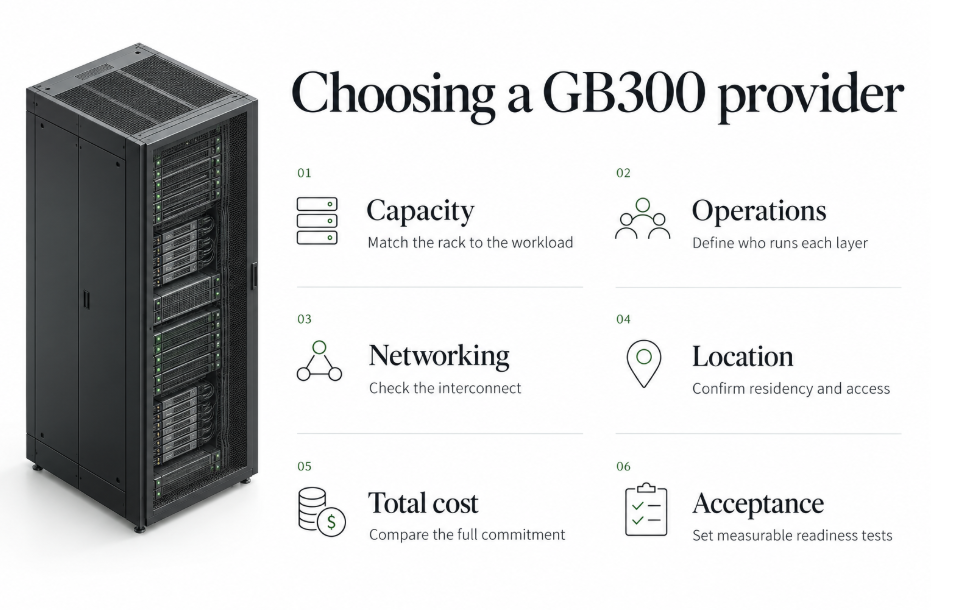
Start with your workload, then work outward to operations, topology, cost and contract terms.
1. Size the Allocation Around the Workload
GB300 NVL72 combines 72 Blackwell Ultra GPUs and 36 Grace CPUs in a liquid-cooled rack-scale system, and providers expose different allocation sizes within that architecture.
Size for model memory, precision, context length, batch size and parallelism. For training, include optimizer state and checkpoints. For inference, account for concurrency, latency and memory headroom. Teams building their own models often plan this alongside a custom AI development roadmap so hardware and software requirements match.
2. Define Operating Responsibilities
Specify who manages drivers, firmware, scheduling, networking, storage, monitoring and hardware faults. Agree on how maintenance and updates will interact with long-running jobs and production serving.
Even with a single infrastructure contract, the agreement should clearly define where the operator’s responsibilities end and yours begin.
3. Check Topology and Compatibility
NVLink inside a rack and networking between racks serve different roles. Ask for the proposed topology, bandwidth, placement policy and expected contention.
Test representative collective communication and checkpoint operations. Check your containers, compiled dependencies and monitoring agents against the Grace CPU architecture and the supported operating system.
4. Compare Costs and Acceptance Terms
Compare compute, storage, networking, support, software, data transfer and minimum commitments. Confirm when billing begins and how maintenance or unavailable capacity affects charges.
- For inference: Compare cost at a defined throughput and latency.
- For training: Compare the cost of completing a representative run.
Fix location, readiness date, access controls and acceptance tests in the contract. Tests should cover GPU health, interconnects, storage, checkpoint recovery and sustained workload performance.
Which GB300 Provider Should You Shortlist?
The right shortlist depends on how you want to buy and operate capacity:
| If You Need | Start With |
|---|---|
| Dedicated full-rack leases under one operating contract | CambridgeNexus |
| Integration with an existing hyperscaler | Microsoft Azure or Google Cloud |
| Smaller allocations before committing to a rack | Verda |
| Validated large-scale training infrastructure | Nscale |
| Capacity in Australia | Firmus |
| Strict isolation and sovereignty | Global AI |
| Dedicated or managed options | GMI Cloud |
Whichever you choose, shortlist providers based on committed capacity and workload-specific acceptance criteria, not just announcements. Hardware generations move quickly, so it’s worth following large language model news to see how new models change your compute needs.
Frequently Asked Questions
What is NVIDIA GB300 NVL72?
NVIDIA GB300 NVL72 is a liquid-cooled, rack-scale system that combines 72 Blackwell Ultra GPUs and 36 Grace CPUs connected by NVLink. It’s designed for large-scale AI training and high-throughput inference.
Should I lease a full GB300 rack or use cloud capacity?
A full-rack lease suits teams with sustained, predictable demand that want dedicated infrastructure. Cloud capacity from Azure or Google Cloud suits teams that need integration with existing cloud services or more flexible allocations.
What should a GB300 contract include?
It should fix the location, readiness date, allocation size, operating responsibilities, service levels, billing start and acceptance tests covering GPU health, interconnects, storage and sustained workload performance.
