
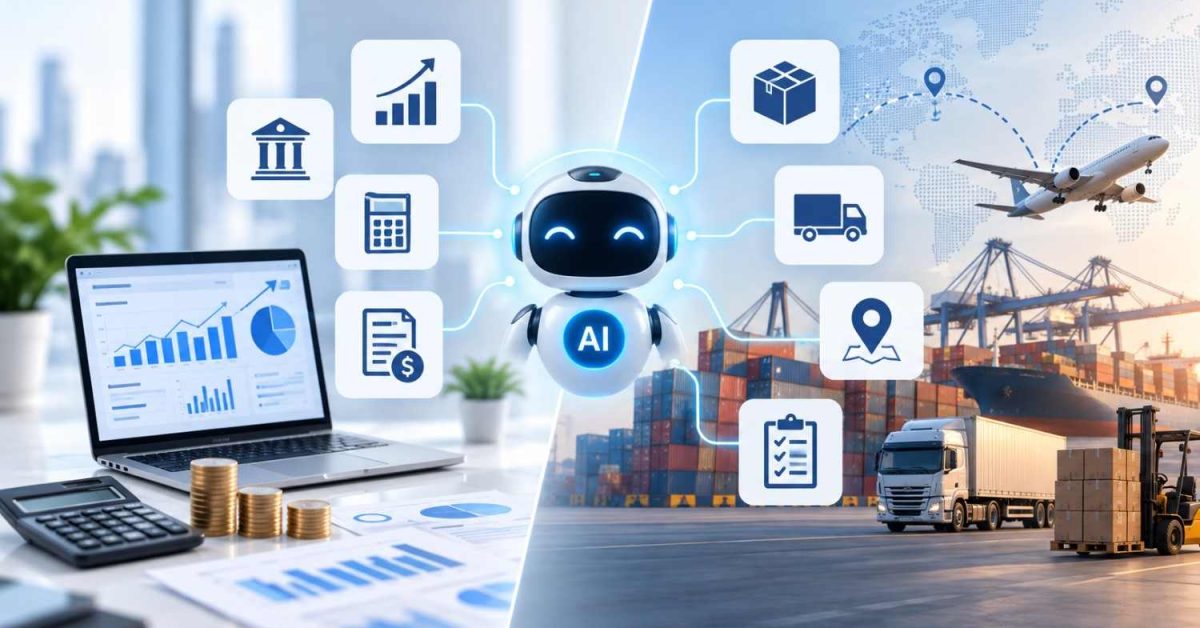
Finance and logistics are built around large volumes of data. Every invoice, payment, shipment, order, vehicle, and supplier creates another data point. Managing this information manually makes it harder to spot errors and respond quickly. AI changes that by processing data continuously and turning it into useful operational decisions.
The value is not simply automation. Modern AI systems can identify patterns, predict outcomes, classify documents, and recommend actions. When connected to financial and logistics platforms, these capabilities reduce repetitive work while giving teams better visibility into costs, cash flow, inventory, and delivery performance.
AI in Financial Operations
Finance teams often spend significant time collecting data and checking records. Invoices may arrive in different formats. Bank transactions need to be matched against accounting records. Payment schedules must be monitored. Small errors can create reconciliation problems that take hours to investigate.
AI can automate much of this workflow. Optical character recognition can extract information from invoices, while machine learning models can classify transactions and identify unusual entries. Natural language processing can also analyze contracts, payment terms, and financial documents without requiring every document to be reviewed manually.
Debt management is another area where automation can improve control. A business may have multiple loans, credit facilities, interest rates, payment dates, and repayment conditions. Dedicated debt management software can centralize this information, while AI-driven analysis can help finance teams understand repayment schedules, monitor obligations, and identify potential cash flow pressure.
AI can also support financial forecasting. Instead of relying only on historical averages, predictive models can evaluate sales trends, payment behavior, seasonal changes, outstanding invoices, and other variables. The system can then produce forecasts that update as new information enters the business.
This creates several practical advantages:
- Faster transaction processing and reconciliation
- Earlier identification of unusual financial activity
- Better visibility into upcoming obligations
- More consistent financial reporting
- Less manual data entry
- Faster access to operational insights
The quality of these results depends heavily on the underlying data. Poorly structured records can produce unreliable predictions. Businesses therefore need consistent data definitions, clean source systems, access controls, and clear validation procedures.
AI in Logistics Operations
Logistics creates a different type of complexity. A delivery operation must coordinate orders, drivers, vehicles, routes, customer availability, traffic conditions, and delivery windows. These variables can change throughout the day.
AI can process these variables faster than manual planning. Route optimization models can evaluate multiple possible sequences and select routes based on factors such as distance, traffic, vehicle capacity, delivery priorities, and time windows. The model can also recalculate routes when conditions change.
The same principle applies to demand forecasting. AI models can analyze historical orders alongside variables such as seasonality, promotions, location, weather, and customer behavior. Better forecasts can help businesses position inventory closer to expected demand and avoid unnecessary transportation activity.
DHL identified generative AI, computer vision, advanced analytics, and other AI technologies as major logistics trends in its 2024 Logistics Trend Radar. The company also highlighted AI applications for areas such as real-time route planning, warehouse operations, and asset tracking.
Connecting Finance and Logistics
Finance and logistics should not operate as isolated systems. Transportation costs affect margins. Inventory levels affect working capital. Delivery performance affects customer retention and revenue. AI can connect these relationships by analyzing data across multiple business functions.
For example, a logistics system may identify that a particular delivery region has rising transportation costs. Financial data can then show whether those costs are reducing margins. Management can investigate route density, delivery frequency, vehicle utilization, or customer pricing instead of looking at transportation expenses in isolation.
AI can also help synchronize purchasing and delivery decisions. If demand forecasts indicate that a product will experience higher demand, procurement and logistics teams can prepare inventory and transportation capacity earlier. This reduces the risk of reacting after demand has already increased.
Another important benefit is exception management. Businesses do not need AI to make every decision automatically. Instead, systems can monitor thousands of transactions and operational events, then flag the small percentage that require human attention.
This approach keeps people involved where judgment matters. Finance professionals can review unusual transactions or major funding decisions. Logistics managers can handle disrupted routes, high-priority shipments, or customer escalations. AI handles the repetitive analysis around those decisions.
Measuring the Impact of AI
AI should be measured against operational outcomes rather than the number of automated tasks. Useful metrics depend on the business, but may include processing time, forecast accuracy, reconciliation exceptions, delivery costs, route efficiency, inventory turnover, and on-time delivery rates.
There is already evidence of significant digital adoption in logistics. A 2024 McKinsey survey found that more than 85% of respondents said their digital logistics projects had added value to their organizations. The survey covered more than 260 shippers and logistics providers.
For delivery operations, AI becomes particularly useful when planning, dispatch, tracking, and reporting are connected. Businesses can use software for delivery management to centralize delivery workflows and create a stronger data foundation for optimization.
The next stage is deeper integration. Finance platforms, enterprise resource planning systems, warehouse software, and delivery platforms can exchange data through APIs and automated workflows. AI can then analyze information across the entire operational chain instead of optimizing one department at a time.
Building a Practical AI Strategy
Successful implementation starts with a specific problem. Automating invoice processing, improving delivery routes, or forecasting demand is easier to measure than deploying AI without a defined business objective. A clear AI strategy can help businesses identify which workflows are worth automating before investing in implementation.
Businesses should also establish data governance before scaling AI. Access permissions, audit trails, data quality checks, model monitoring, and human review processes are important safeguards. AI outputs should be treated as decision support, especially when financial or operational consequences are significant.
AI does not remove the need for experienced finance and logistics teams. It gives those teams faster access to information and reduces repetitive analysis. When financial intelligence and logistics data work together, businesses can make decisions earlier, control costs more closely, and respond to operational changes with greater precision.
