
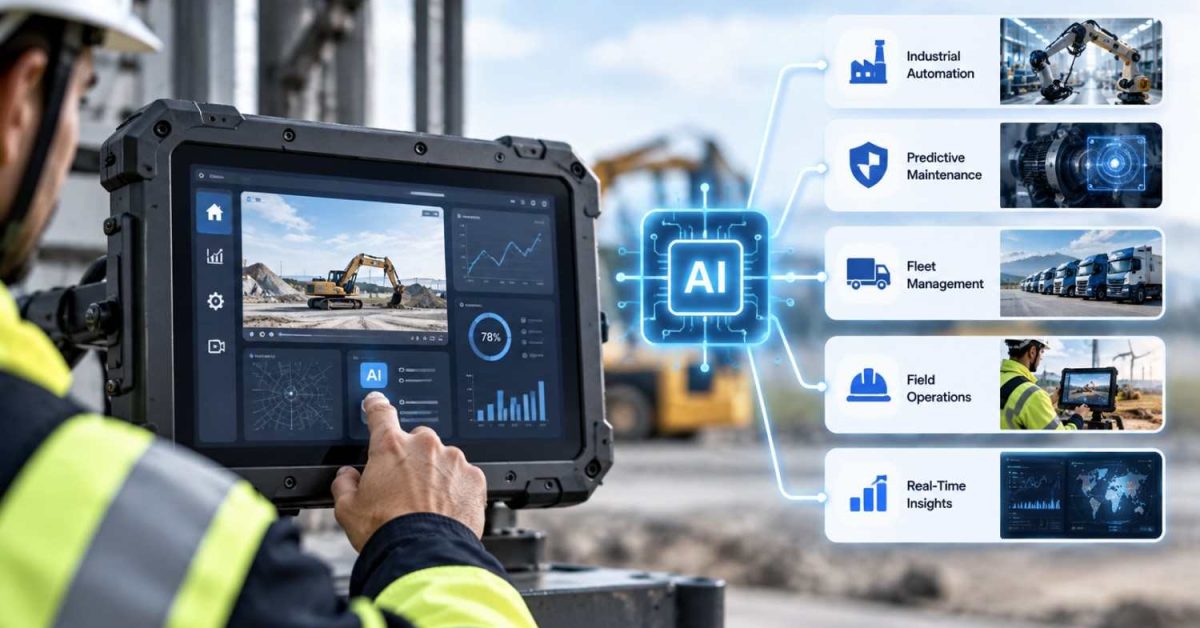
Artificial intelligence is moving beyond cloud applications and office software. It is now being deployed directly into factories, vehicles, warehouses, energy facilities, and other demanding environments. These systems need more than processing power. They also need hardware that can operate reliably where heat, dust, vibration, moisture, and physical impact are common.
This is where AI integration with a rugged display becomes useful. A rugged display can act as the human-machine interface for an AI-enabled system. It presents real-time information while protecting the underlying electronics from challenging operating conditions.
How AI Works With Rugged Displays
Rugged displays do not necessarily perform AI processing itself. In many deployments, the display connects to an industrial computer, edge AI processor, PLC, camera system, or embedded controller.
The basic architecture can include:
- Cameras and sensors collecting operational data
- An edge processor running AI models
- Industrial networks transferring data between devices
- A rugged display presenting processed information
- Operators providing commands through touch or physical controls
AI models can process information locally before sending selected data to a central server or cloud platform. This reduces dependence on continuous cloud connectivity.
NVIDIA, for example, describes edge AI applications involving industrial inspection, predictive maintenance, robotics, and real-time sensor processing. Its industrial platforms are designed to run AI workloads close to the equipment generating the data.
Why Edge Processing Matters
Latency is an important factor in industrial AI. A system monitoring a production line cannot always wait for data to travel to a remote data center and return with a response.
Edge processing moves inference closer to the source.
For example, an industrial camera can identify a product defect. The edge processor can classify the defect and send the result directly to the operator display. The screen can then show the affected component, confidence level, inspection result, or recommended action.
This architecture can also reduce network traffic. Instead of continuously transmitting raw video, the system can send relevant events, measurements, and alerts.
A 2025 Omdia survey of more than 600 enterprises across 10 countries found that 82% of organizations were either already using or planning to implement real-time data processing for IoT deployments.
AI Applications in Harsh Environments
The combination of AI, edge computing, and rugged displays has applications across several industries.
In manufacturing, computer vision can inspect components for surface defects, incorrect assembly, or missing parts. The display can show inspection results to operators without requiring them to access a separate workstation.
In transportation, AI can process camera feeds and sensor information for vehicle monitoring, asset tracking, or operator assistance. A rugged screen can provide information inside vehicles where vibration and temperature changes are expected.
Mining and construction provide another use case. Equipment operating in these environments can generate large amounts of sensor data. AI can analyze this information for equipment monitoring, object detection, and maintenance alerts.
Agriculture can also benefit. Autonomous and semi-autonomous machinery can combine cameras, GPS, sensors, and AI models. Operators need a dependable interface for viewing machine status, navigation information, warnings, and system recommendations.
Display Hardware Still Matters
AI software can be highly advanced, but the physical interface remains a critical part of the system.
A display installed on a factory floor or vehicle may face conditions that would damage conventional consumer hardware. Engineers therefore need to evaluate several specifications before selecting a display.
Important considerations include:
- Operating temperature range
- Resistance to shock and vibration
- Protection against dust and moisture
- Touchscreen durability
- Sunlight readability
- Screen brightness
- Glove-friendly operation
- Power requirements
- Available communication interfaces
- Expected service life
Thermal design is particularly important. AI processors can generate significant heat under sustained workloads. The display and computing hardware therefore need to be designed as part of the overall system rather than treated as unrelated components.
NVIDIA’s Jetson AGX Orin Industrial platform illustrates the type of hardware engineering required for edge AI. It supports up to 248 TOPS of AI performance, operates across an extended temperature range, and is designed for demanding applications involving shock and vibration.
Designing the AI Display Interface
The user interface should also be designed around the AI workflow.
Operators do not necessarily need to see every data point produced by an AI model. Excessive information can make a system harder to use.
A better interface can prioritize:
- Critical alerts
- AI-generated recommendations
- Machine status
- Sensor trends
- Visual inspection results
- Confidence scores
- Maintenance warnings
- Operator controls
The display should make important information easy to identify. Color, typography, icons, and layout can help separate normal operating conditions from events requiring attention.
Touch interfaces can also allow operators to acknowledge alarms, change settings, inspect historical data, or interact with AI-assisted workflows.
Building a Reliable AI Display System
Successful AI integration requires more than connecting an AI computer to a screen. The complete system needs to be considered from the beginning.
Engineers should evaluate the AI workload, processor requirements, sensor inputs, network architecture, power supply, environmental conditions, mounting method, cybersecurity, and maintenance requirements.
The display should then be selected according to those requirements.
As AI moves further into physical environments, rugged hardware will remain important. Edge processors provide the intelligence, sensors provide the data, and rugged displays provide the operational interface. Together, they can create AI systems that deliver useful information where decisions actually happen.
