
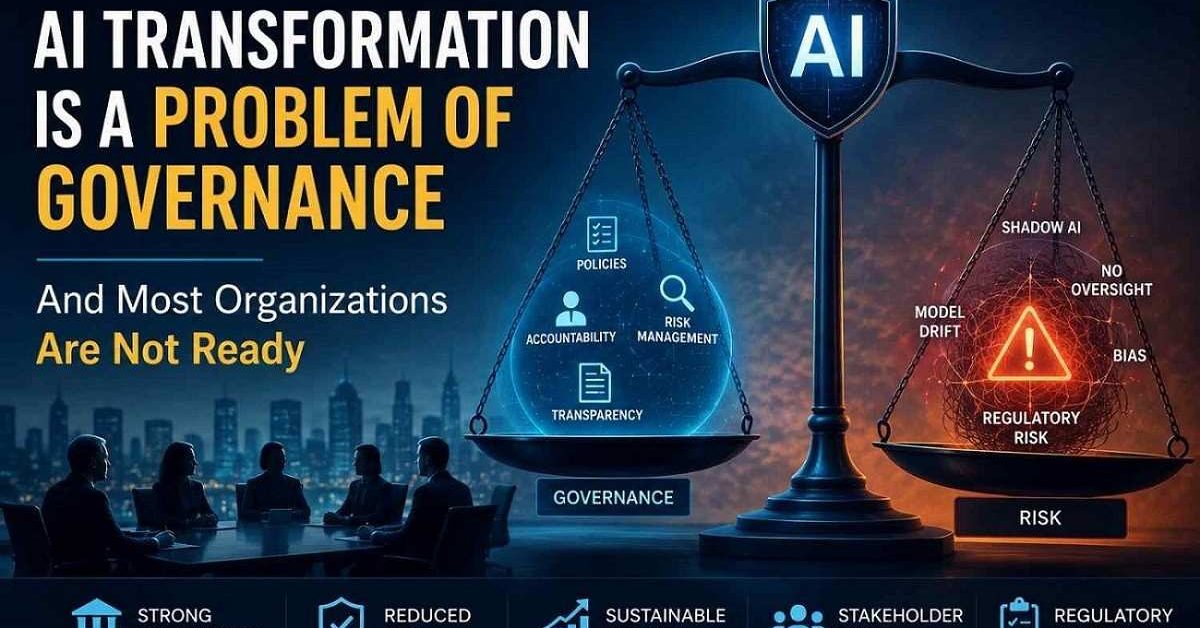
Enterprises are spending hundreds of billions on artificial intelligence in 2026. Yet most of those investments are not delivering the outcomes that justified them. The uncomfortable truth behind every failed rollout, every stalled pilot, and every board presentation that quietly disappears is this: AI transformation is a problem of governance, not technology.
The models work. The infrastructure exists. What is missing in most organizations is the accountability structure, risk visibility, and decision-making clarity that lets AI operate safely and scale reliably. Without those foundations, even the most advanced AI deployment runs into the same wall.
The Investment Is Enormous and the Return Is Disappointing
Global enterprise AI spending is projected to reach 665 billion dollars in 2026. That figure reflects years of board approvals, vendor deals, and organizational change. It is not the sign of a hesitant effort.
And yet, according to the McKinsey Global AI Survey 2026, roughly 73 percent of enterprise AI deployments fail to deliver the return on investment promised at the outset. That number has stayed stubbornly consistent, even as models and tooling improved.
This is not a story about bad technology. It is what happens when organizations treat AI as a procurement decision instead of an organizational transformation. Boards approve budgets. IT launches pilots. Data teams build models. Legal and compliance get pulled in only after something goes wrong. In that sequence, accountability falls through every gap between departments, and nobody holds the thread.
The governance-maturity gap makes it worse. Most enterprises already run AI in production. Only a small fraction describe their governance as mature. Deloitte’s 2026 research found that only about 1 in 5 organizations has a mature governance model for autonomous AI agents. That gap, between deployment scale and governance readiness, is where most of the 665 billion dollars quietly disappears.
Why Governance Is the Real Bottleneck, Not the Model
There is a reflex in tech organizations to diagnose failure at the technical layer. When an AI strategy underperforms, the talk turns to data quality, model accuracy, or integration complexity. These are real challenges. They are rarely the main cause of failure.
Analyses of enterprise AI implementations keep finding the same thing. One three-year study of 140 enterprise implementations found technical failures accounted for only about 23 percent of project failures. The remaining 77 percent were organizational. The technology usually works well enough. The scaffold around it does not.
The honest framing is this. You cannot separate an AI system’s performance from the structures around it. A well-built model deployed into an organization with unclear ownership, no monitoring, and no escalation path will produce worse outcomes than a simpler model inside a mature governance program. The system does not exist in isolation. It lives inside human decisions, institutional processes, and accountability structures, and those decide what actually happens in production.
Five Structural Failures That Appear Again and Again
Organizations that struggle with AI governance tend to fail in predictable ways. Understanding these patterns is the first step toward addressing them.
1. Accountability without a home
When no single person or function holds clear ownership of an AI system, responsibility disperses across teams and quietly disappears. This creates a specific and dangerous situation: everyone is vaguely responsible, which means nobody is actually responsible. When the system produces an unexpected output, makes a poor decision, or drifts in a direction nobody intended, the question of who owns the problem has no clean answer. That is not a technology failure. It is an ownership failure.
2. Teams working in parallel with no shared view
AI sits at the intersection of legal, compliance, data, product, risk, IT, and operations. These functions rarely share a common language or a unified view of what AI systems are doing inside the organization. The result is a coordination deficit where the same risk gets assessed differently by different teams, the same policy gets interpreted differently across business units, and the same deployment can be approved by one function and flagged by another. In that environment, governance becomes inconsistent at best and completely absent at worst.
3. Pilots that cannot cross into production
Many organizations have become very good at running AI pilots. They can build a proof of concept, generate impressive demo results, and create internal excitement around a use case. What they cannot do is move that pilot into production consistently and confidently. The missing ingredient is almost always governance. Without documented approval processes, defined risk thresholds, clear ownership handoffs, and monitoring plans, moving from pilot to production requires organizational courage rather than institutional clarity. Most pilots stall at that point.
4. Models that change without anyone noticing
AI systems are not static software. Their behavior shifts over time as the real-world data they encounter diverges from the conditions they were trained on. This is called model drift, and it is one of the most insidious governance problems in enterprise AI because it is invisible until it causes harm. A credit scoring model that worked well eighteen months ago may be making systematically different decisions today. A customer service agent that was well-calibrated at launch may have gradually shifted in ways that create compliance exposure. Without continuous monitoring and defined drift thresholds, these changes accumulate silently until a business outcome or regulatory incident forces attention.
5. AI tools spreading outside any visibility
Employees across virtually every industry are using AI tools that their organizations have not approved, evaluated, or even catalogued. This is shadow AI, and it has become one of the most significant and underappreciated governance challenges in enterprise environments. The risk is not simply that employees are using AI without permission. The risk is that sensitive business data, customer information, proprietary processes, and confidential communications are flowing through external AI platforms with no organizational visibility, no data protection controls, and no way to respond when something goes wrong.
The Agentic AI Problem Is Making Governance Even More Urgent
The challenge most organizations already struggle with is about to get harder. Agentic AI systems, which plan, reason, and take sequences of actions without human approval at each step, are moving from experimental to operational faster than governance can keep up.
Traditional governance assumes a human reviews outputs before they reach the real world. An agentic system breaks that assumption. When an AI agent can autonomously access a CRM, query a database, draft a communication, and send it, all in one execution chain with no human checkpoint, the risk profile is categorically different from a chatbot that produces a draft for review.
The pace is striking. Deloitte’s 2026 research found nearly 74 percent of companies plan to deploy agentic AI within two years, yet only about 1 in 5 have a mature governance model for autonomous agents. For organizations without mature programs, that is an accumulation of operational risk most are not equipped to manage. It is worth noting that none of the major governance frameworks was originally designed for agentic AI, which makes the gap even wider.
Regulation Is Arriving Whether Organizations Are Ready or Not
AI governance crossed a threshold in 2026. It is no longer mainly a best practice or a differentiator. It is becoming a legal obligation across multiple jurisdictions, with real enforcement timelines.
The EU AI Act is the most comprehensive AI regulation in the world. It classifies AI systems by risk level and imposes serious obligations on high-risk deployments, including technical documentation, conformity assessments, human oversight, bias monitoring, and post-market surveillance. High-risk obligations become enforceable on August 2, 2026. Fines can reach 35 million euros or 7 percent of global annual turnover, whichever is higher. Because the regulation has extraterritorial scope, organizations outside the EU are not automatically exempt.
In the United States, the picture is more fragmented but no less consequential. More than 1,100 AI-related bills were introduced at the federal and state level in 2025 alone. States including California, Texas, and Colorado have enacted their own AI disclosure, bias-prevention, and risk-management rules. The lack of a single federal standard has not reduced compliance pressure. It has multiplied the number of regulatory surfaces that multi-state organizations must manage at once.
Three frameworks now form the practical foundation for enterprise AI governance.
The NIST AI Risk Management Framework
The NIST AI RMF organizes governance activity across four core functions: Govern, Map, Measure, and Manage. It is designed to be flexible rather than prescriptive, which means organizations can adapt its principles to their specific industries, risk profiles, and operational structures. It has become the de facto baseline that federal agencies, enterprise procurement teams, and industry regulators reference when assessing AI governance maturity. Organizations that have not engaged with it are increasingly at a disadvantage in vendor due diligence, regulatory conversations, and customer trust assessments.
ISO/IEC 42001
ISO 42001 is the first internationally certifiable standard for AI management systems. Unlike the NIST framework, it provides a certifiable management system structure that organizations can verify through formal third-party audit. Enterprise procurement teams are beginning to require ISO 42001 certification as a condition of doing business with AI-enabled vendors. For organizations that want to demonstrate governance maturity in a form that external parties can verify, it provides the most credible evidence available.
Treating the Three Frameworks as One Program
The EU AI Act, NIST AI RMF, and ISO 42001 address AI governance from three different angles: legal obligation, risk management methodology, and certifiable management system. They overlap substantially in what they require organizations to do. The most efficient approach for large organizations is to build a single unified governance program that satisfies all three simultaneously rather than treating them as separate compliance exercises. Organizations that have done this well describe it as running one program with three lenses rather than three programs with one shared subject.
What a Functioning AI Governance Program Actually Requires
Understanding that governance matters is not the same as knowing what to build. The following elements are not theoretical. They are the practical structures that separate organizations with mature governance from those that are still discovering their exposure through incidents.

Named ownership for every AI system
Every AI system in production needs a named owner who is accountable for its performance, its compliance posture, and its risk management. Not a team, not a function, not a shared responsibility between two departments. A named individual with documented authority and a clear escalation path. This single structural commitment resolves the accountability diffusion that underlies most governance failures.
A live and complete AI inventory
You cannot govern what you cannot see. Organizations that do not maintain a current inventory of every AI system in use, including shadow AI tools that employees have adopted independently, are operating with blind spots that create both regulatory exposure and business risk. The inventory needs to capture each system’s purpose, data sources, owner, affected populations, risk classification, and current operational status. It needs to be treated as a living document rather than a compliance artifact that gets produced for an audit and then ignored.
Risk classification that determines control intensity
Not every AI system requires the same level of governance. A generative AI tool used for internal brainstorming carries different risks than an automated system making credit decisions or flagging potential fraud. Effective governance programs classify each AI system by risk level and apply control intensity accordingly. High-risk systems affecting customers, employees, financial outcomes, or regulatory compliance need more intensive oversight, monitoring, and documentation than low-risk internal tools.
Lifecycle controls from approval to retirement
Governance cannot start at deployment. It needs to be embedded across the complete lifecycle of an AI system, from the initial use-case approval and data sourcing decisions through model development, testing, production deployment, ongoing monitoring, incident response, and eventual retirement. Each stage needs defined criteria, documented accountability, and a clear handoff to the next stage. Organizations that govern only the launch moment and then consider the work done are creating the conditions for model drift, shadow AI expansion, and compliance exposure to accumulate undetected.
Human oversight that is real, not performative
Every AI system that makes or influences decisions affecting customers, employees, credit, pricing, safety, or compliance needs genuine human oversight. This means humans have the ability to review what the system is doing, understand why it is doing it, override its outputs when necessary, and halt its operation if something goes wrong. Organizations that document human oversight in policy but do not build it into operational processes are creating a dangerous gap between what they claim on paper and what actually happens in production. For agentic systems in particular, this is not about reviewing outputs after the fact. It is about authorizing actions before they are taken.
Continuous monitoring rather than periodic audits
An annual governance review is not sufficient for systems whose behavior can change continuously as real-world conditions shift. High-risk AI systems need ongoing performance monitoring, behavioral drift detection, data quality assessment, and complete audit trails that allow organizations to reconstruct exactly what the system did, when it did it, and on what basis. The organizations that discover governance failures through monitoring are in a fundamentally different position from those that discover them through regulatory inquiries or customer incidents.
Related Article: https://alphacraftai.com/cursor-ai-vs-github-copilot/
What Each Part of the Organization Needs to Do
AI governance is not an IT problem or a compliance problem. It is an organizational problem that requires coordinated action across every major function.
Boards and executive leadership need to treat AI governance as a standing agenda item rather than an occasional briefing topic. This means assigning clear governance responsibility to a named executive or committee, requiring regular AI risk reporting at the board level, and commissioning a full AI inventory as the foundation for understanding organizational exposure. The question “what AI systems are we running and who is accountable for each one” should have a clear, documented answer at all times.
IT and AI leaders need to build the inventory, complete risk classification for every system, establish monitoring for high-risk deployments, and create clear approval processes that prevent unreviewed AI tools from entering production environments. They also need to develop mechanisms for discovering and addressing shadow AI adoption before it creates the kind of exposure that becomes visible only through an incident.
Legal and compliance teams need to map existing AI systems against applicable regulatory requirements, develop internal AI use policies that employees can actually follow, address shadow AI as a compliance risk rather than a cultural preference issue, and include AI systems in every vendor risk assessment. The regulatory landscape is complex enough in 2026 that most organizations operating across jurisdictions need a dedicated AI regulatory mapping exercise rather than assuming existing compliance programs cover the new obligations.
Governance Enables Scale, It Does Not Block It
The most persistent myth about AI governance is that it slows things down. Organizations with mature programs report the opposite.
When teams know who owns each decision, what controls are required before deployment, what risk thresholds are acceptable, and what the escalation path is, they move faster. The friction governance removes, the unresolved questions, the cross-functional disagreements, the approvals that start from scratch every time, is far greater than the friction it adds.
The organizations capturing the most value from AI in 2026 are not the ones with the most aggressive timelines. They are the ones that built the infrastructure for governed deployment early and turned it into a competitive advantage. Governance does not slow AI transformation. It is the foundation that makes transformation real instead of aspirational.
Conclusion
AI transformation is not failing because organizations cannot access capable technology. It is failing because most are deploying that technology into governance vacuums, where accountability is unclear, risk is unmonitored, and the structures needed to scale safely do not exist. The gap between how fast AI is being deployed and how slowly governance is maturing is where most enterprise AI investment goes to waste.
The organizations that succeed with AI over the next several years will be the ones that treat governance as the foundation, not the afterthought. They will know what AI systems they run, who owns each one, what risks each creates, and what controls are in place before something goes wrong rather than after. That is not a constraint on transformation. It is what transformation actually requires.
Why do AI transformation projects fail?
The primary cause is not model quality or technical capability. It is the absence of governance structures including clear ownership, defined risk thresholds, cross-functional coordination, and production monitoring. Technology creates the possibility. Governance determines whether that possibility becomes a reliable business outcome.
What is AI governance and why does it matter now?
AI governance is the complete set of policies, roles, controls, and processes that determine how AI systems are built, deployed, monitored, and retired within an organization. It matters now because regulatory obligations are activating, failure rates remain high, and the shift toward agentic AI systems is making ungoverned deployment significantly more dangerous than it was even eighteen months ago.
What is shadow AI and how serious is the risk?
Shadow AI refers to AI tools and systems that employees use without organizational approval or visibility. The risk goes beyond data exposure. As agentic AI tools become more capable, shadow deployments increasingly involve autonomous systems with API access to business-critical data and workflows, operating entirely outside governance controls.
What is model drift?
Model drift is the gradual change in an AI system’s behavior . Without continuous monitoring, drift accumulates silently and may only become visible after it has caused a business outcome, compliance incident, or customer harm.
