
A startup booted fundraising strategy is a funding plan where founders grow the business on their own revenue first, then raise outside capital only when it truly helps, on their own terms. The word “booted” comes from “bootstrapped,” which means funding a startup with personal savings and customer payments instead of investor money. The key idea is simple: build value before selling ownership. Founders who follow this path keep more equity, face less investor pressure, and negotiate from strength when they finally do raise.
This guide explains how the strategy works, when to raise, and which funding options let you grow without giving away big pieces of your company.
What Does “Booted Fundraising” Actually Mean?
Traditional startup fundraising follows a familiar script. Build a pitch deck, meet dozens of investors, give up 15 to 25 percent of your company, spend fast, then repeat the whole cycle in 12 to 18 months.
Booted fundraising flips the order. You prove the idea first with paying customers. You keep costs lean. You reinvest profits into growth. Then, if you ever raise money, you do it to hit a specific milestone, not to survive.
This is not an anti investor philosophy. Think of it as pro leverage. A founder with real revenue, healthy margins, and a clear growth engine gets better valuations and keeps more control than a founder pitching a dream with no proof.
Why Is This Strategy Growing in 2026?
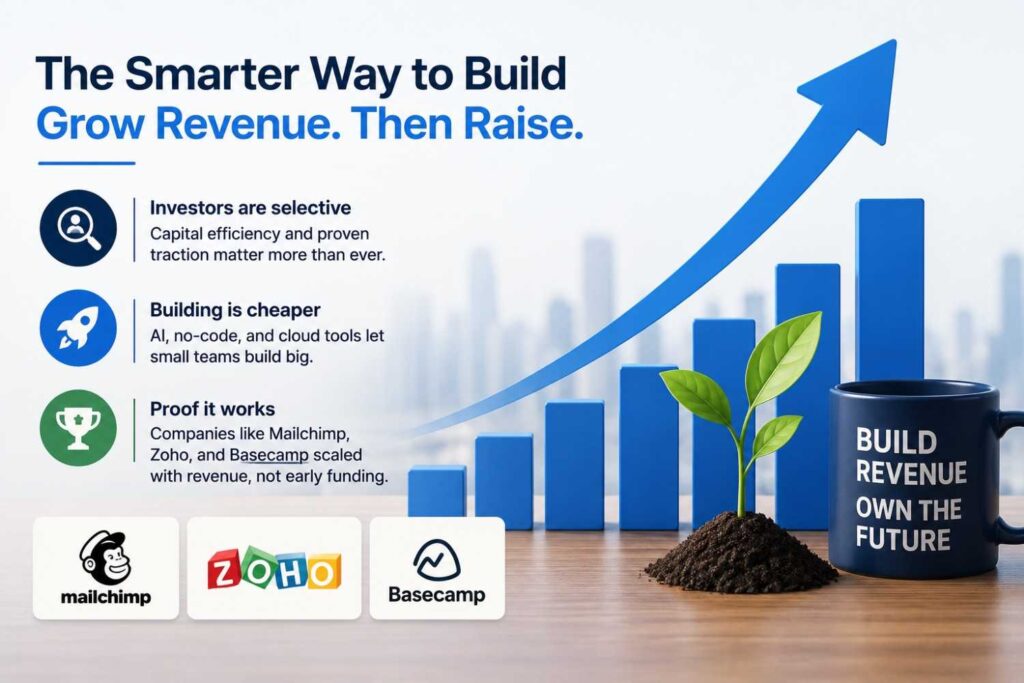
The funding world changed. Venture capital became far more selective after years of easy money, and small early rounds have become harder to close. Investors now reward capital efficiency, meaning proof that a company can turn each dollar into more dollars, instead of growth at any cost.
At the same time, building a startup got cheaper. AI tools, no code platforms, and cloud services let a tiny team ship products that once needed a large funded team. When building costs less, revenue can carry you further, and the case for early fundraising gets weaker.
Famous examples prove the model works. Mailchimp, Zoho, and Basecamp all grew into major companies on customer revenue rather than early venture rounds, and their founders kept ownership and control for years because of it.
How Does the Strategy Work, Step by Step?
Stage 1: Fund the start yourself. Use personal savings or side income to build a minimum viable product. Keep it small and focused on one painful problem people already pay to solve.
Stage 2: Get paying customers fast. Revenue is the best validation on earth. Even 10 paying customers tells you more than 100 investor meetings.
Stage 3: Reinvest with discipline. Put profits back into the channels that clearly work. Track your numbers closely, especially runway, burn rate, CAC, LTV, MRR, and churn. If you have not built a forecast yet, our guide on startup booted financial modeling walks you through it step by step.
Stage 4: Raise only for a milestone. When you raise, tie the money to one measurable outcome that increases your leverage, like reaching a revenue target, closing enterprise pilots, or launching in a new market. Vague goals like “hiring and marketing” weaken your position.
What Are the Funding Options That Protect Your Equity?
Not all money costs the same. Here are the main options, roughly from least to most dilution:
| Funding Type | Equity Cost | Best For |
|---|---|---|
| Customer revenue | None | Every stage, always first choice |
| Government grants (like SBIR) | None | R&D heavy and deep tech startups |
| Revenue based financing | None, repaid from future sales | Startups with steady recurring revenue |
| Customer investment | Small | Startups with loyal business clients |
| Angel investors | Moderate | Filling a gap to a clear milestone |
| Venture capital | Highest | Markets where speed decides the winner |
A few notes on the less known options. Government programs like SBIR in the United States offer grants that never take equity, though they move slowly and come with rules on how funds are used. Revenue based financing firms such as Pipe and Capchase advance you money against future sales, and you repay from revenue instead of giving up shares. And some founders simply ask their happiest business customers to invest a small check, which deepens the relationship and keeps money aligned with the product.
If you do take investor money early, understand the paperwork. A SAFE is a simple agreement that converts to equity later, but stacking several SAFEs without modeling your cap table can quietly eat your ownership. Dilution rarely happens in one dramatic moment. It happens gradually, one casual signature at a time.
When Should a Bootstrapped Founder Raise?
Raise when these signs line up:
- Your monthly recurring revenue grows steadily
- Your gross margins are healthy, ideally 70 percent or higher for software
- Each customer pays back their acquisition cost within about a year
- Capital would speed up something already working, not rescue something broken
And avoid raising when the opposite is true. If your runway is under 6 months and you are desperate, or your product still lacks clear market fit, investors will sense it and the terms will punish you. The strongest fundraises always start from strength.
How Do You Pitch as a Booted Founder?
Never apologize for being scrappy. Your story is your advantage. Compare these two openings:
Weak: “We haven’t raised any money yet.”
Strong: “We built this to $500k in annual revenue on $50k of personal savings. Imagine what we do with real capital.”
Bootstrapped traction speaks a language investors respect: efficiency. Target investors who understand it, like smaller funds and angels who built or backed bootstrapped companies themselves. Massive funds hunting unicorns will often pass, and that is fine. You are not for everyone, and you do not need to be.
One modern advantage worth using: run your company lean with automation before you ever pitch. Founders who automate their operations, reporting, and customer workflows show investors a machine that scales without bloated headcount. That is exactly the kind of lean system we build for startups through our AI automation and workflow integration service, and it directly improves the efficiency numbers investors examine. If you want to figure out which parts of your startup AI can run cheaply, start with our AI consulting and strategy team.
Common Mistakes to Avoid
- Raising because competitors raised. Their funding round is their problem. Copying it without your own reason burns equity for nothing.
- Confusing revenue with profit. Growing sales with terrible margins just makes the hole deeper, faster.
- Ignoring the cap table math. Model every SAFE and convertible note before signing, not after.
- Giving up board seats too early. Control lost in early rounds is nearly impossible to win back.
- Discounting your way to growth. Deep discounts buy customers who leave the moment prices normalize, and they wreck the margins your whole strategy depends on.
Frequently Asked Questions
What is a startup booted fundraising strategy in simple words?
It is a plan where a startup grows on its own revenue first and raises outside money only later, when the founder can get good terms and keep control.
Is booted fundraising the same as bootstrapping?
Almost. Bootstrapping means growing with no outside money at all. A booted fundraising strategy adds a smart second step: raising selective capital later, from a position of strength.
Can a bootstrapped startup still raise venture capital?
Yes, and often on better terms. Real revenue and efficient growth reduce investor risk, which usually means a higher valuation and less dilution for the founder.
What is revenue based financing?
It is funding you repay as a percentage of future monthly revenue until a set cap is reached, usually around 1.3 to 2 times the amount advanced. You give up no equity, but it only suits businesses with steady, predictable income.
When is bootstrapping the wrong choice?
When your product needs years of expensive research before any revenue, or when your market rewards whoever scales fastest. In those cases, waiting for revenue can mean losing the race, and outside capital makes sense earlier.
