
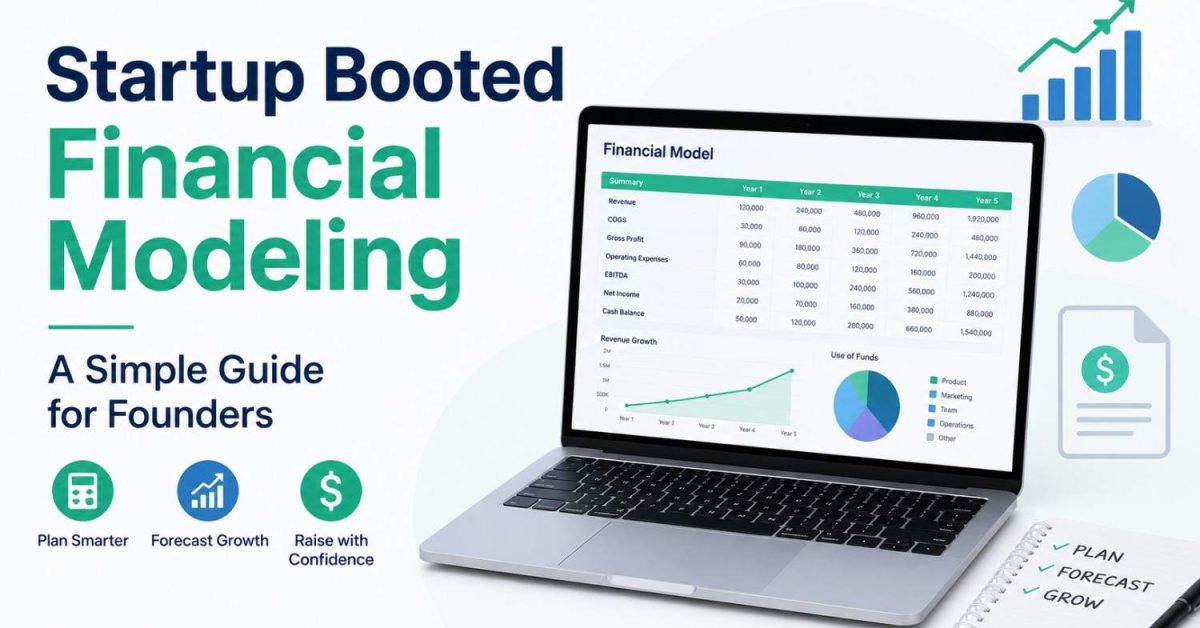
Startup booted financial modeling is the process of forecasting your startup’s revenue, expenses, cash flow, and profits when the business runs on its own money instead of investor funding. The term comes from “bootstrapped,” which describes startups funded by the founder’s savings and early customer revenue. Since there is no venture capital cushion, the financial model becomes a survival tool. It tells you how long your cash will last, when you can hire, and when you will break even.
Why Do Bootstrapped Startups Need a Financial Model?
Here is a hard truth. Many startups do not die because the product is bad. They die because the founder ran out of cash while everything looked fine on paper.
A venture backed startup can lose money for years because investors keep refilling the tank. A bootstrapped startup cannot. Every hire, every ad campaign, and every software subscription comes straight out of real revenue. One bad quarter without a plan can end the company.
A financial model fixes this by answering four questions with numbers instead of hope:
- How much money comes in each month?
- How much goes out?
- How many months can we survive at this pace?
- When do we reach the point where revenue covers everything?
What Are the Core Parts of the Model?
You do not need a 20 tab spreadsheet. A simple model built in Excel or Google Sheets with five sections is enough for most early stage founders.
1. Revenue Forecast
Build this from the bottom up, using real activity, not wishful thinking. For example: if you get 1,000 website visitors a month, 3 percent become leads, 20 percent of leads buy, and each customer pays $80 per month, your math is 1,000 × 0.03 × 0.20 × $80, which equals $480 in new monthly revenue. Grow the numbers only when your real data supports it.
2. Cost Structure
Split every expense into two buckets. Fixed costs stay the same each month, like hosting, software, and salaries. Variable costs rise with sales, like payment processing fees, packaging, and delivery. Knowing the split tells you exactly how much profit each new sale really brings.
3. Cash Flow Forecast
Profit and cash are not the same thing. If a client pays you in 30 days but your bills are due in 10, you can be profitable on paper and still miss payroll. Track when money actually enters and leaves your account, week by week if possible.
4. Burn Rate and Runway
Burn rate is how much cash you lose per month. Runway is how many months you can survive. The formula is simple: cash in the bank divided by monthly burn. If you have $40,000 and burn $5,000 a month, your runway is 8 months. Every bootstrapped founder should know this number by heart.
5. Break Even Point
This is the month when revenue covers all expenses. For a bootstrapped startup, break even matters more than any growth chart, because after that point the business funds itself.
Which Metrics Should Founders Track?
Beyond the five sections above, a handful of metrics tell you if the business is healthy:
| Metric | What It Means | Healthy Sign |
|---|---|---|
| MRR | Monthly recurring revenue | Growing steadily |
| CAC | Cost to acquire one customer | Falling over time |
| LTV | Total revenue from one customer | At least 3 times CAC |
| Churn | Percent of customers who leave monthly | Low and stable |
| Runway | Months of survival left | 6 months or more |
The LTV to CAC ratio deserves special attention. If a customer brings you $600 over their lifetime and costs $200 to acquire, your ratio is 3 to 1, which is a common health target for subscription businesses. Below that, growth quietly drains your cash.
One more tip that most guides skip: keep a safety buffer of roughly 20 to 30 percent of your monthly costs set aside. Late payments and surprise expenses happen. A buffer turns a crisis into a minor annoyance.
How Is This Different From a VC Style Model?
The difference is the core assumption. A venture backed model assumes future funding will cover losses while the company chases fast growth. A booted model assumes revenue must cover everything, forever.
That single change flips your decision making. Instead of asking “can we raise more money,” you ask “do our margins support this decision.” You hire only when recurring revenue can cover the new salary for 3 to 6 months in a row. You increase ad spend only when the numbers prove each dollar returns more than it costs.
The bonus is leverage. A founder with clean, revenue backed numbers can still raise money later, but from a position of strength, keeping more equity and control. Investors trust real numbers far more than hockey stick fantasies.
Can AI Tools Help With Financial Modeling?
Yes, and this is where 2026 looks very different from a few years ago. Founders now use AI to speed up the boring parts of modeling:
- Building the sheet: AI assistants inside Excel and Google Sheets can write formulas, build forecast tabs, and spot errors in minutes
- Scenario testing: AI can quickly generate best case, expected, and worst case versions of your model so you see the full risk picture
- Automated updates: connecting your accounting tool, like QuickBooks, to your model through automation means your numbers refresh themselves instead of waiting for manual entry
- Tracking tools: platforms like Baremetrics and ChartMogul automatically calculate MRR, churn, and LTV for subscription businesses
AI does not replace your judgment. It removes the manual work so you can spend your energy on decisions. If your startup wants to automate reporting or connect your financial tools into one smooth workflow, that is exactly what we build in our AI automation and workflow integration service. And if you are not sure where AI fits into your finance stack at all, our AI consulting and strategy team can map it out with you.
Common Mistakes to Avoid
Watch out for these traps, because they sink even smart founders:
Smooth growth curves. Real startups grow unevenly. If your forecast shows perfect growth every month with no explanation, it is fiction.
Ignoring churn. Adding customers means nothing if they leave just as fast. Retention assumptions often matter more than acquisition assumptions.
Copying VC style forecasts. Aggressive spending plans without a funding cushion behind them are dangerous for a bootstrapped company.
Building it once and forgetting it. A model is a living document. At the end of every month, put your real results next to your forecast, see where you missed, and adjust.
Frequently Asked Questions
What does “booted” mean in startup booted financial modeling?
It is a shortened form of “bootstrapped,” which means a startup funded by the founder’s own money and customer revenue instead of outside investors.
What tools do I need to build a financial model?
Google Sheets or Excel is enough to start. As you grow, tools like QuickBooks for accounting and Baremetrics or ChartMogul for subscription metrics make tracking automatic.
How often should I update my financial model?
Monthly. Enter your real results, compare them with your forecast, and fix your assumptions where reality disagreed with the plan.
What is the most important number for a bootstrapped startup?
Cash runway. It tells you how many months you can survive at your current burn rate, which shapes every other decision you make.
When should a bootstrapped startup hire its first employee?
A safe rule is when recurring revenue can cover the new salary for at least 3 to 6 consecutive months, so one slow month does not put the whole company at risk.
