
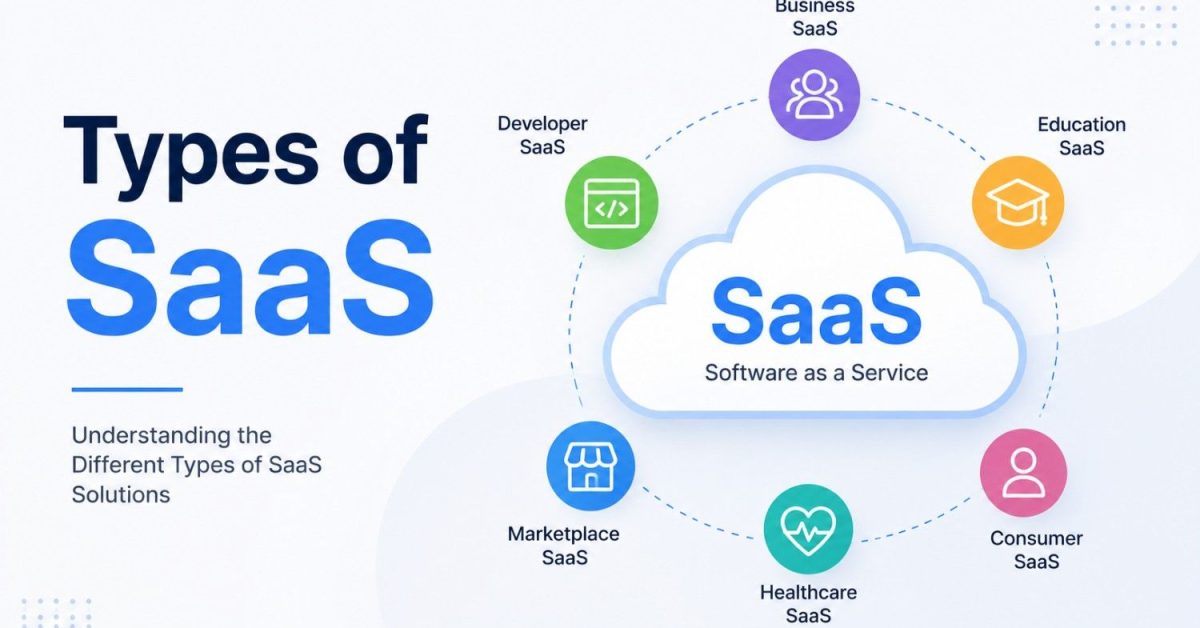
The main types of SaaS fall into four product family classification categories: market breadth (horizontal, vertical, and micro SaaS), business function (like CRM, ERP, and marketing tools), deployment model (how the software is hosted), and pricing model (how customers pay). Every SaaS product belongs to one family in each dimension, and together these four labels describe exactly what a product is, who it serves, and how it competes.
In this guide, we break down all the main types of SaaS with real examples, so both buyers and builders can place any product on the map.
Why Does SaaS Classification Matter?
Classification sounds like paperwork, but it drives real decisions.
For buyers, categories narrow the search. A hospital choosing software needs to know if a product is built for healthcare or just adapted to it, and whether its hosting model meets privacy laws.
For builders and founders, classification is strategy. The family you choose decides your market size, your competitors, your pricing power, and even which investors will look at you. A large share of SaaS startups fail partly because of unclear positioning, which is really a classification problem in disguise.
Category 1: Types of SaaS by Market Breadth
This dimension asks one question: how wide is the audience?
Horizontal SaaS
Horizontal products serve any industry. A dentist, a factory, and a law firm can all use the same tool. Examples include Slack for communication, QuickBooks for accounting, and HubSpot for marketing. The market is huge, but so is the competition.
Vertical SaaS
Vertical products are built for one specific industry, with its rules and workflows baked in. Think of Toast for restaurants, Procore for construction, or Veeva for pharmaceutical companies. The audience is smaller, but customers pay more and stay longer because the product fits them like a glove. Vertical SaaS has been the faster growing family in recent years for exactly this reason.
Micro SaaS
A newer subfamily worth knowing. Micro SaaS products solve one tiny, specific problem, often built by solo founders or small teams. A Chrome extension that schedules tweets or a plugin that compresses images would qualify. Small markets, low costs, and often surprisingly profitable.
Category 2: Types of SaaS by Business Function
This is the family most people mean when they search for types of SaaS. It groups products by the job they do inside a company.
| Functional Family | What It Does | Well Known Examples |
|---|---|---|
| CRM | Manages customer relationships and sales pipelines | Salesforce, HubSpot, Pipedrive |
| ERP | Runs core operations like finance, inventory, and supply chain | NetSuite, SAP, Odoo |
| Marketing automation | Automates campaigns, emails, and lead nurturing | Mailchimp, Marketo, Klaviyo |
| Collaboration | Powers team communication and file sharing | Slack, Zoom, Notion |
| HR and payroll | Handles hiring, employee records, and salaries | Workday, BambooHR, Gusto |
| Accounting and finance | Manages books, invoices, and reporting | QuickBooks, Xero, Stripe |
| Project management | Tracks tasks, timelines, and team workloads | Asana, Trello, Monday.com |
CRM, ERP, and marketing automation are the three biggest functional families by revenue, together generating hundreds of billions of dollars a year. Newer functional families keep appearing too, like customer support platforms, cybersecurity tools, and analytics products.
Category 3: Types of SaaS by Deployment Model
This dimension describes how the software is hosted and delivered, and it matters most for security and compliance.
Multi tenant cloud is the classic SaaS setup. Many customers share the same infrastructure, with their data kept separate. It is the cheapest and easiest to scale, and most popular SaaS tools work this way.
Single tenant cloud gives each customer their own dedicated instance. It costs more but offers stronger isolation, which banks, hospitals, and government bodies often require.
Private cloud or self hosted puts the software inside the customer’s own environment. Control is maximum, convenience is minimum.
Hybrid mixes the above, for example keeping sensitive data on private servers while the rest runs in the shared cloud.
For many buyers, this classification acts as a filter before anything else. If a product’s deployment family violates your industry regulations, its features do not matter.
Category 4: Types of SaaS by Pricing Model
The final dimension groups products by how they charge:
- Flat rate: one price, everything included. Simple but inflexible.
- Per user: the price scales with team size. The most common model, used by tools like Slack and Salesforce.
- Tiered: several packages with growing features, like Basic, Pro, and Enterprise.
- Usage based: you pay for what you consume, like API calls or storage. Common in developer tools and AI products.
- Freemium: a free plan forever, with paid upgrades. Great for growth, dangerous for margins if the free tier gives away too much.
Pricing families shape a company’s whole economics. Usage based pricing, for example, grows revenue automatically with customer activity, which is one reason AI products favor it.
How Is AI Changing the Types of SaaS?
This is the newest chapter, and the most interesting one. AI is creating fresh product families that did not exist a few years ago:
- AI native SaaS: products where AI is the core engine, not a feature. Writing assistants, image generators, and coding agents live here.
- AI enhanced SaaS: traditional products from the families above that added AI layers, like a CRM that scores leads automatically or an ERP that forecasts inventory.
- Agent based SaaS: the frontier family, where autonomous AI agents complete whole workflows instead of assisting humans step by step. These blur old category lines because one agent can touch CRM, support, and operations at once.
For founders, this shift means classification needs more precision than ever. A machine learning analytics tool and a generative AI automation platform may target similar buyers but belong to different families, with different pricing norms and investor expectations. If you are building in this space and want help defining where your product sits and how the AI layer should work, that is the exact ground we cover in AI consulting and strategy, and we build those products end to end through custom AI development and AI agent development.
How to Use These Categories in Practice
If you are buying software, define your needs across all four dimensions before comparing vendors. Which function do you need, which deployment model does your compliance allow, and which pricing model fits your growth? This turns a messy vendor hunt into a checklist.
If you are building a product, pick your families deliberately. Vertical or horizontal decides your market size. Your functional family decides your competitors. Your pricing family decides your revenue curve. And if you plan to bootstrap the business on early revenue, model those choices in a forecast first, using the approach from our guide on startup booted financial modeling.
Frequently Asked Questions
What are the main types of SaaS?
The main types of SaaS are grouped across four product family classification categories: market breadth (horizontal, vertical, micro), business function (CRM, ERP, marketing, HR, and so on), deployment model (multi tenant, single tenant, private, hybrid), and pricing model (flat, per user, tiered, usage based, freemium).
What is the difference between horizontal and vertical SaaS?
Horizontal SaaS serves every industry with one general tool, like Slack. Vertical SaaS is built for a single industry with its specific needs, like Toast for restaurants. Vertical products serve fewer customers but usually keep them longer.
Which SaaS category is the biggest?
By revenue, CRM is the largest functional family, with ERP and marketing automation close behind. Salesforce built the largest pure SaaS business in the world inside the CRM family.
Where do AI products fit in SaaS classification?
They form new families. AI native products are built around AI as the core, AI enhanced products add intelligence to classic categories, and agent based products use autonomous AI agents to run complete workflows.
Why should a startup founder care about SaaS classification?
Because every family choice sets your market size, competition, pricing power, and investor appeal. Clear classification makes marketing sharper, sales cycles shorter, and positioning easier to defend.
