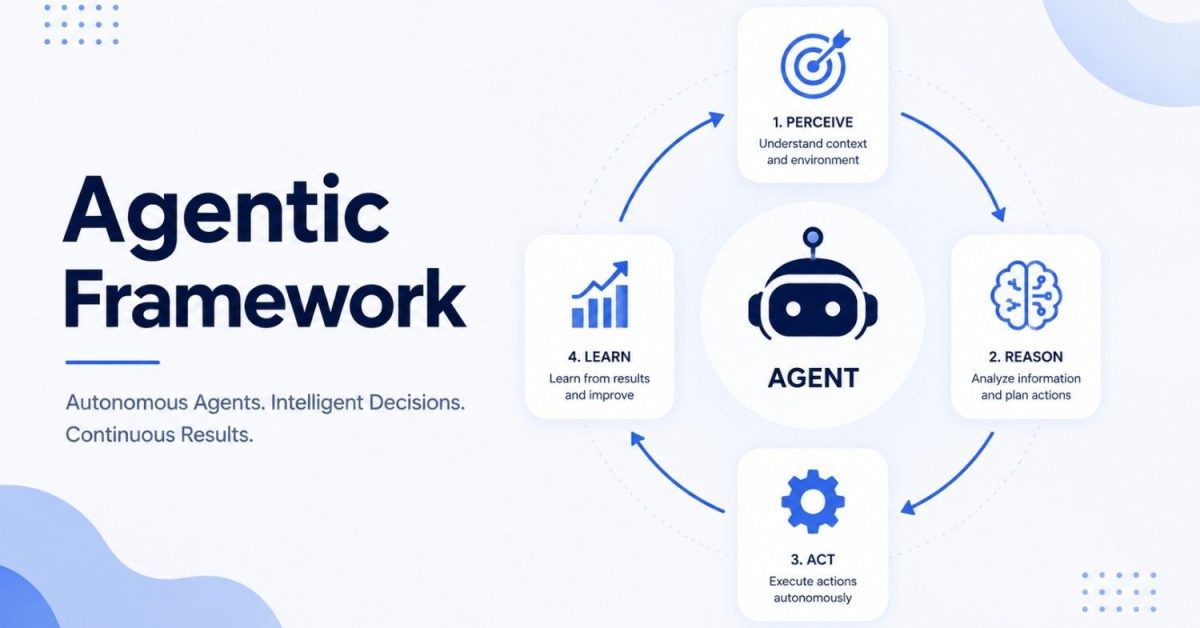
An agentic framework is a toolkit that helps developers build AI agents which can plan, call tools, remember context, and complete multi step tasks, without hand coding that logic from scratch. If you have looked into building an AI agent recently, names like LangGraph, CrewAI, and the provider native SDKs from OpenAI, Anthropic, and Google have probably come up.
Here is what an agentic framework actually does, the major options in 2026, and how to pick one without overbuilding.
Why Agentic Frameworks Exist
Before frameworks existed, building an agent meant hand coding the loop that lets a model plan, call a tool, check the result, and decide what to do next. That loop sounds simple until you have to handle retries, long running conversations that lose context, infinite loops, and unpredictable token spend.
A good framework earns its place by preventing those failures and helping you diagnose them quickly when they happen. It typically provides:
- Orchestration. The core loop that manages how the agent reasons, plans, and acts.
- Memory. A way to store and retrieve context across steps or sessions, instead of starting from zero every time.
- Tool integration. A standard way to connect the agent to APIs, databases, and external systems.
- Multi agent support. In some frameworks, the ability to coordinate multiple specialized agents working together.
- Human in the loop controls. Checkpoints where a person can approve, reject, or redirect an action before it executes.
The Two Main Orchestration Styles
Most agentic frameworks fall into one of two design philosophies, and this decision matters more than which specific framework you pick.
Graph based orchestration models the agent’s workflow as a directed graph, where nodes represent processing steps and edges define how the state moves between them. This style gives you explicit control. You know exactly what is happening at every step, and you can checkpoint, pause, resume, or replay execution history when something breaks. LangGraph is the best known example of this approach, and it has become a common default in production environments where debugging and auditability matter.
Role based and handoff orchestration takes a lighter touch, letting you assign agents specific roles, such as researcher, writer, or reviewer, and defining how work passes between them. This style trades some control for a much faster path from idea to working prototype. CrewAI is a well known example, and it tends to be the fastest way to get a multi agent demo running.
Provider native SDKs, such as the Claude Agent SDK, OpenAI’s Agents SDK, and Google’s ADK, sit alongside both styles. These reward teams that have already committed to one model provider with a leaner, more integrated stack.
Popular Agentic Frameworks in 2026
| Framework | Best For | Orchestration Style |
|---|---|---|
| LangGraph | Complex, stateful, production workflows | Graph based |
| CrewAI | Fast multi agent prototypes | Role based |
| Microsoft Agent Framework | Enterprise .NET and Microsoft stack teams | Merged orchestration, formerly Semantic Kernel and AutoGen |
| Claude Agent SDK | Anthropic native production agents | Provider native |
| OpenAI Agents SDK | OpenAI native production agents | Provider native |
| Google ADK | Google native production agents | Provider native |
| LlamaIndex | Agents that are fundamentally data retrieval problems | Retrieval focused |
Note that this landscape moves fast. Microsoft folded its AutoGen and Semantic Kernel lineages into a single Microsoft Agent Framework in 2026, and several frameworks have shipped major version updates within the same year. Treat any framework comparison, including this one, as a snapshot rather than a permanent ranking.
Single Agent vs Multi Agent: Choose the Architecture First
The instinct in 2026 is to reach for a multi agent setup because it looks more sophisticated. Real world production data argues for restraint. Analyses of production deployments have found that a majority of multi agent systems could have achieved the same outcome with a single well built agent, at a noticeably lower cost and with far easier debugging.
The operational cost of unnecessary complexity is real. Multi agent systems generally take longer to diagnose when something breaks, and orchestration overhead can quietly eat into any accuracy gains you were hoping to capture. A small accuracy improvement is not worth it if it costs thousands of extra dollars a month in coordination overhead.
Quick Tip: Start with a single, well scoped agent. Only move to a multi agent design once you can clearly articulate why one agent cannot do the job, not because multi agent systems look more impressive in a demo.
Model Context Protocol and Why It Matters
One trend that now shapes almost every framework decision is the Model Context Protocol, commonly called MCP. It standardizes how AI agents connect to external tools, data sources, and services, so that a tool built for one agent can be reused across different frameworks without custom adapters for each one.
By 2026, MCP support has become close to table stakes. Frameworks that were built around the protocol from the start tend to pick up new protocol capabilities automatically as the ecosystem evolves, while frameworks that bolted on MCP support later often carry more friction. If you are choosing a framework today, checking whether it is MCP native or MCP adapted is worth a few extra minutes of research.
How to Choose an Agentic Framework
- Define the task before the tool. Write down exactly what the agent needs to do, what data it touches, and what happens if it fails, before you look at any framework.
- Pick the orchestration style that fits. Choose graph based orchestration if you need explicit control and auditability. Choose role based orchestration if speed to prototype matters more right now.
- Check ecosystem fit. If your team is already deep in one model provider’s ecosystem, a provider native SDK often reduces integration work.
- Confirm MCP support. Native support tends to age better than a bolted on adapter.
- Plan your observability layer separately. The orchestration framework and the system that tells you when something silently breaks are not always the same tool, and skipping this step is one of the most common causes of agents that work in testing but fail quietly in production.
If this is your first agentic build and you want a second opinion before committing engineering time, working with an AI agent development team can help you avoid picking the wrong architecture on your first attempt.
Common Mistakes When Building With Agentic Frameworks
- Reaching for a multi agent design before proving a single agent cannot solve the problem.
- Choosing a framework based on GitHub stars or hype instead of production readiness.
- Skipping human in the loop checkpoints on actions that touch money, customer data, or irreversible operations.
- Treating the framework choice as permanent instead of revisiting it as the ecosystem changes.
- Underestimating the cost of debugging distributed agent state once something goes wrong in production.
Limitations to Keep in Mind
Agentic frameworks remove a lot of boilerplate, but they do not remove the underlying complexity of building reliable AI systems. A framework will not fix a poorly defined task, bad data, or unclear success criteria. It also will not eliminate the need for evaluation and monitoring once the agent is live. Frameworks handle orchestration. Reliability still depends on the team operating the system.
If you are evaluating whether agentic AI is the right investment for your organization at all, not just which framework to use, an AI consulting and strategy conversation is often a faster way to get clarity than testing five frameworks in parallel.
Key Takeaways
- An agentic framework handles the reasoning loop, memory, tool calls, and error recovery so developers do not have to build that logic from scratch.
- Graph based frameworks like LangGraph give explicit control and auditability. Role based frameworks like CrewAI prioritize speed to prototype.
- Start with a single agent. Move to multi agent only when you can clearly justify it.
- MCP support is close to table stakes in 2026 and worth checking before you commit to a framework.
- The framework landscape changes quickly, so treat any comparison, including this one, as a snapshot rather than a final answer.
Frequently Asked Questions
1. What is an agentic framework in simple terms?
It is a toolkit that helps developers build AI agents that can plan, use tools, remember context, and complete multi step tasks, without writing all of that coordination logic manually.
2. What is the difference between an agentic framework and a chatbot?
A chatbot typically responds to one message at a time. An agentic framework supports agents that can take a goal, break it into steps, call external tools, and keep working across a longer task.
3. Do I need a multi agent framework for my project?
Usually not at first. Most tasks are solved more reliably and cheaply with a single, well scoped agent. Multi agent systems add real cost and debugging overhead, so they should be a deliberate choice, not a default.
4. What is Model Context Protocol and why does it matter for framework choice?
Model Context Protocol, or MCP, is a standard for connecting AI agents to external tools and data sources. Frameworks built around it natively tend to gain new capabilities faster than frameworks that added support later as an adapter.
5. Is LangGraph or CrewAI better?
Neither is universally better. LangGraph suits complex, stateful workflows that need explicit control and auditability. CrewAI suits teams that want a working multi agent prototype quickly. The right choice depends on your task, not on popularity.
