
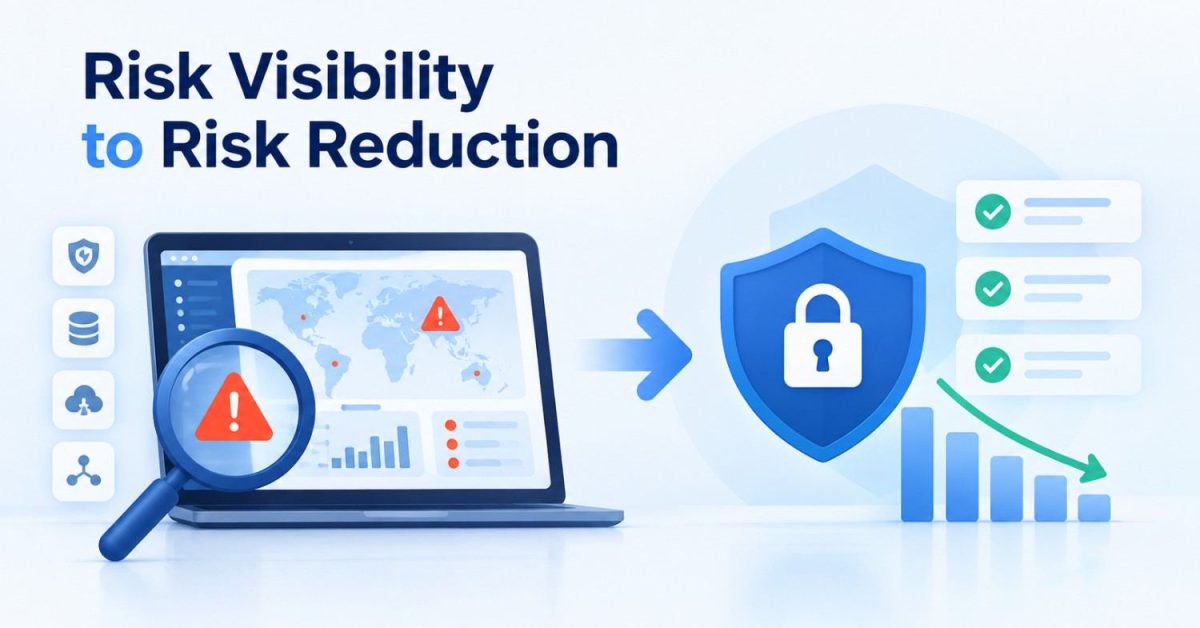
Cybersecurity risk management is the structured process of identifying digital threats, evaluating their potential business impact, and reducing exposure through prioritized security controls, measurable actions, and continuous reassessment. For modern organizations, its real value lies not in producing comprehensive risk reports but in turning security intelligence into decisions that prevent incidents, protect critical operations, and preserve customer trust.
Yet many businesses still struggle to make this transition. They invest in vulnerability scanners, security dashboards, penetration tests, and compliance assessments, accumulating more information about their security posture than ever before. Despite this visibility, critical weaknesses can remain unresolved for months. The problem is not necessarily a lack of data. It is the gap between knowing where risks exist and having the processes, resources, and accountability to reduce them.
Closing that gap requires a fundamental shift in how cybersecurity is managed: from documenting exposure to actively changing the conditions that create it.
Why Visibility Alone Does Not Reduce Risk
Security teams routinely face thousands of vulnerabilities, misconfigurations, suspicious events, and third-party findings, from network alerts to phishing attempts caught by a messaging security agent. Treating every issue as equally urgent is neither practical nor effective. A vulnerability rated critical by a scanning tool may exist in an isolated test environment, while a seemingly moderate weakness in an internet-facing identity system could provide an attacker with access to sensitive corporate resources.
Effective risk assessment therefore requires context.
Security findings must be evaluated against business-critical assets, data sensitivity, system exposure, existing safeguards, and realistic attack paths. A vulnerability becomes particularly significant when it can be exploited to reach a valuable target or bypass an important security boundary.
This is where asset inventories, attack surface management, threat intelligence, and business impact analysis must work together. For instance, supplementing internal telemetry with a free dark web scan enables security teams to quickly identify whether compromised corporate credentials are already circulating on criminal forums. Their purpose is not simply to generate a larger picture of the environment, but to establish which weaknesses deserve immediate attention and why.
Visibility becomes valuable when it changes priorities.
Connecting Technical Exposure to Business Consequences
Executives rarely make investment decisions based on vulnerability counts alone. They need to understand how a security weakness could affect revenue, service availability, contractual obligations, customer relationships, or regulatory compliance.
Consider a company operating a customer-facing platform. A misconfigured cloud storage bucket may expose confidential information, while an outdated internal application may contain several known vulnerabilities. Without additional context, both findings require investigation. However, if the storage bucket contains sensitive customer records and is publicly accessible, its potential business impact may justify immediate remediation.
Translating technical findings into business consequences enables security leaders to communicate risk in terms decision-makers can act upon.
A useful assessment considers three interconnected factors:
- Likelihood: How plausible is exploitation, given the threat environment and the weakness itself?
- Impact: What operational, financial, legal, or reputational damage could follow?
- Exposure: How accessible is the affected asset, and what other systems or data could an attacker reach through it?
These factors should inform prioritization rather than produce an illusion of mathematical certainty. Risk scores are decision-support tools, not precise predictions of future incidents.
From Risk Registers to Remediation
A risk register is useful only when it drives action. Every significant finding should have an accountable owner, a treatment decision, a deadline, and a way to verify that the chosen response works.
Treatment options generally fall into four categories: mitigate the risk through stronger controls, avoid the activity that creates it, transfer some financial consequences through contractual arrangements or insurance, or formally accept the residual exposure. Acceptance should be an informed decision made by an authorized stakeholder—not the default outcome when engineering teams lack capacity.
For technical remediation, organizations benefit from connecting security findings directly to development and IT operations workflows. Vulnerabilities can become tracked engineering tasks, infrastructure misconfigurations can trigger automated policy checks, and overdue high-risk issues can escalate to designated risk owners.
This integration makes security part of operational delivery rather than a separate reporting exercise.
Automation can accelerate remediation, but it requires safeguards. Automatically patching a production system without compatibility testing, for example, may introduce an outage more damaging than the original vulnerability. Effective automation accounts for business criticality, rollback procedures, maintenance windows, and change approval requirements.
Measuring Whether Risk Is Actually Falling
Counting completed assessments or closed tickets can create a misleading impression of progress. A team might resolve hundreds of low-impact findings while leaving the most dangerous attack paths untouched.
More meaningful metrics connect security activity with changes in exposure. These include the time required to remediate exploitable vulnerabilities, the percentage of critical assets covered by effective controls, the recurrence of previously identified weaknesses, and the time needed to contain an incident.
Organizations should also distinguish between a control being deployed and a control being effective. Multi-factor authentication, for example, provides limited assurance if privileged accounts or emergency access paths remain inadequately protected.
Regular validation through penetration testing, configuration reviews, recovery exercises, and incident simulations helps establish whether security investments deliver their intended outcomes.
The objective is not to eliminate every conceivable risk. It is to reduce material exposure to a level consistent with the organization’s risk appetite and operational requirements.
Governance That Keeps Pace with Change
Cybersecurity risk is not static. New software releases, cloud deployments, supplier relationships, acquisitions, and changes in regulation can alter an organization’s exposure almost overnight.
Consequently, risk reviews should be triggered by meaningful changes, not restricted to annual assessments. A newly integrated payment provider, for instance, may introduce new data flows, privileged connections, and contractual obligations that require immediate evaluation.
Frameworks such as the NIST Cybersecurity Framework 2.0 help organizations structure governance, identify risks, establish safeguards, and improve response and recovery capabilities. The framework also emphasizes that cybersecurity is an enterprise responsibility, involving leadership and business functions as well as technical teams.
This shared ownership is essential. Security teams can identify and explain exposure, but business leaders must make informed decisions about investment, operational trade-offs, and acceptable residual risk.
Making Risk Reduction a Business Capability
The most mature organizations do not treat cybersecurity as a periodic exercise in compliance or a race to clear technical findings. They build a repeatable operating model in which risks are continuously identified, ranked according to business consequences, assigned to accountable owners, and reassessed after mitigation.
This approach improves more than technical resilience. It helps organizations allocate budgets rationally, reduce disruption, strengthen supplier oversight, and demonstrate to customers and regulators that security decisions are deliberate and evidence-based.
Ultimately, the value of cybersecurity risk management lies in the distance between a recognized weakness and a verified reduction in exposure. Technology, governance, and business accountability must work together to close that distance. For organizations seeking specialist support, Andersen cybersecurity risk management brings together risk assessment, governance, remediation planning, and ongoing improvement to help translate technical findings into actionable security priorities and stronger business resilience.
