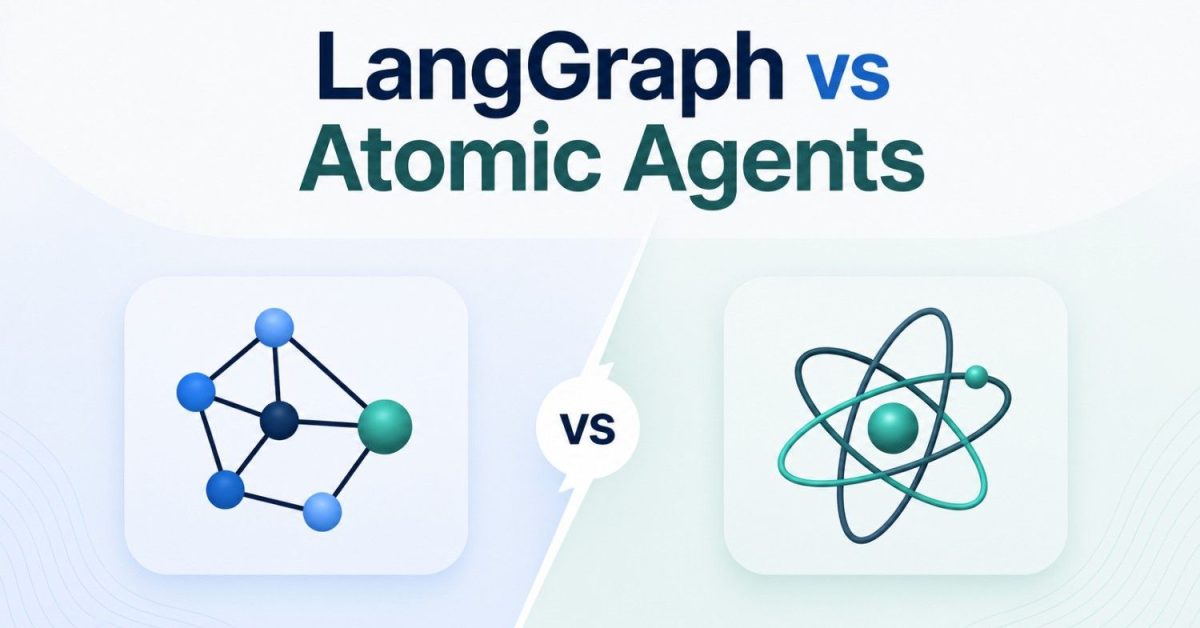
LangGraph is the heavyweight orchestration framework for complex, stateful, multi agent systems that need production features like crash recovery and human approval steps, backed by the massive LangChain ecosystem. Atomic Agents is the lightweight opposite: a minimal, schema driven framework where every agent is plain, transparent Python you fully control, with no hidden engine making decisions for you. Choose LangGraph when your workflow is genuinely complex, and Atomic Agents when you value transparency and predictability over built in machinery.
As an agency that builds AI agents for clients, we work with this exact decision regularly, so this comparison comes from production experience rather than documentation skimming. Here is how the two actually differ, and how to pick.
Two Frameworks, Two Philosophies
The deepest difference isn’t features, it’s worldview.
LangGraph believes agent workflows should be modeled as graphs: nodes represent units of work (an LLM call, a tool, a function), edges represent transitions between them, and the framework’s engine manages execution, state, and routing. This lets you build workflows with loops, branches, and parallel paths, the shapes real agentic reasoning takes when an agent tries something, observes the result, and circles back to try again. LangGraph 1.0, released in 2026, hardened this into serious production infrastructure, and LangChain itself now runs on LangGraph under the hood.
Atomic Agents emerged as a reaction against exactly that kind of framework machinery. Its philosophy: AI development should look like normal software engineering, with no magic. Every agent follows a strict input, process, output structure with explicit Pydantic schemas validating what goes in and what comes out. If you want Agent A’s result to feed Agent B, you write that line of Python yourself. Nothing is hidden, so nothing surprises you.
Neither philosophy is wrong. They trade the same two currencies, convenience and control, at different exchange rates.
Head to Head Comparison
| Factor | LangGraph | Atomic Agents |
|---|---|---|
| Core model | Graph of nodes and edges, engine managed | Plain Python, schema driven, self managed |
| Learning curve | Steep: thinking in graphs, framework concepts | Gentle concepts, more boilerplate to write |
| State and memory | Built in shared state, persisted at every step | You build and manage state yourself |
| Crash recovery | Checkpointing and resume built in | Whatever you implement |
| Human in the loop | Native interrupt, approve, resume patterns | Manual implementation |
| Multi agent orchestration | First class, scales to complex teams | Manual chaining, fine for small teams |
| Debugging | Deep stack traces, needs LangSmith for clarity | Step through standard Python |
| Ecosystem | Enormous: LangChain integrations, huge community | Small, focused, community driven |
| Language | Python and TypeScript | Python |
| License and cost | MIT, free; paid LangSmith and platform on top | Open source, free |
Where LangGraph Genuinely Wins
Durability under failure. LangGraph checkpoints state at every node transition, so a crashed agent resumes from where it stopped rather than restarting, and its time travel debugging lets you replay execution from any prior state. For long running agents doing real work, this is the feature that separates demos from production.
Human in the loop, natively. Pausing an agent before a sensitive action, letting a person approve or edit, then resuming is a built in pattern. In our client work, this is often a hard requirement, and having it as framework infrastructure rather than custom code saves real engineering weeks. It pairs with the isolation principle we covered in our guide to sandbox environments: safe agents are built from guardrails at every layer.
Complex multi agent systems. When a researcher agent, writer agent, and reviewer agent need to collaborate, critique each other, and loop until quality passes a threshold, LangGraph’s shared state and cyclic execution handle that messiness better than anything you’d hand roll.
The ecosystem effect. With the LangChain family at roughly 90 million monthly downloads and production deployments at companies like Uber, JPMorgan, and Cisco, you inherit integrations, examples, hiring pools, and answers to almost every question you’ll hit.
The honest costs: the learning curve is genuinely steep, documentation is spread across the LangGraph, LangChain, and LangSmith sites, and when something breaks, stack traces run deep through framework internals. Teams routinely underestimate this.
Where Atomic Agents Genuinely Wins
Total transparency. There is no orchestration engine between you and your logic. Debugging an Atomic Agents pipeline is stepping through your own Python, which for many teams is worth more than any feature list. When an agent misbehaves in production, “I can read exactly what happened” beats “I need to understand what the framework decided.”
Structured outputs as a foundation. Built on Pydantic schemas, every agent’s inputs and outputs are validated, typed contracts. This schema first discipline catches whole categories of bugs at the boundary instead of in production, and makes agents composable like normal software components.
Predictability for tightly scoped agents. For single purpose agents, an email classifier, a document extractor, a research summarizer, framework machinery is overhead. Atomic Agents keeps these small, testable, and boring in the best sense.
No lock in gravity. Your code is standard Python with light dependencies, so migrating away later costs little, whereas deeply graph shaped LangGraph systems are a bigger commitment.
The honest costs: you write more boilerplate, you build your own state persistence, retries, and approval flows, and as systems grow toward many coordinating agents, the orchestration you’re hand writing starts resembling a worse version of what LangGraph provides for free.
A Caution About What You’ll Read Elsewhere
While researching this comparison, we found ranking articles describing Atomic Agents as a “low code platform with a visual builder and analytics dashboards.” It is none of those things, it’s a code first Python framework, and those features appear to be invented by content written without ever touching the tool. The AI framework space moves fast enough that fabricated coverage blends in easily, a pattern we keep documenting across the AI tool world. The reliable sources are the frameworks’ own docs and repositories, and comparisons that include the trade offs, because real tools always have trade offs.
How We Actually Decide, Project by Project
Here is the practical framework we use in client work:
- Map the workflow shape first. A straight line of steps needs neither framework’s full power. Loops, branches, and multiple cooperating agents point toward LangGraph. A handful of independent, well defined agents chained simply points toward Atomic Agents or similar minimal approaches.
- Weigh the failure cost. If a crashed run mid task is expensive, LangGraph’s checkpointing earns its complexity. If runs are short and cheap to retry, it doesn’t.
- Count the humans. Approval steps and oversight requirements favor LangGraph’s native interrupts.
- Be honest about the team. LangGraph rewards teams that will invest in it, and punishes teams that won’t. A framework your team can’t debug at 2 am is the wrong framework regardless of features.
And a secret from production: the choice matters less than the guardrails, evaluation, and integration work around it. Frameworks are maybe a fifth of a real agent project; connecting to your actual systems, testing against your actual mess, and constraining what the agent may do is the rest. That surrounding work is precisely what we deliver through our AI agent development service, and when the agent is one piece of a larger product, it becomes a custom AI development engagement, framework selection included.
Frequently Asked Questions
What is the difference between LangGraph and Atomic Agents?
LangGraph is a graph based orchestration framework where an engine manages state, routing, and recovery for complex multi agent workflows. Atomic Agents is a minimal, schema driven framework where agents are plain Python with explicit inputs and outputs, and you write the orchestration yourself.
Is Atomic Agents easier than LangGraph?
Its concepts are simpler and debugging is plain Python, but you write more code yourself, including state handling and retries. LangGraph is harder to learn but provides that machinery built in. Simple projects finish faster on Atomic Agents, complex ones on LangGraph.
Is LangGraph free?
Yes, LangGraph itself is MIT licensed open source. The paid products are LangSmith, its observability and evaluation companion, and the managed LangGraph Platform for deployment, both optional.
Does Atomic Agents have a visual builder?
No. Despite some articles claiming otherwise, Atomic Agents is a code first Python framework built around Pydantic schemas, with no visual builder, dashboards, or low code interface.
Can I use LangGraph and Atomic Agents style approaches together?
The philosophies mix well in practice: many teams build individual agents with strict schema contracts, the Atomic Agents discipline, then orchestrate them with LangGraph when coordination gets complex. Frameworks are libraries, not religions.
Which framework is better for production AI agents?
LangGraph has the strongest production story, with checkpointing, human in the loop patterns, and enterprise adoption. But production readiness depends more on your guardrails, testing, and monitoring than on the framework label, and small well built Atomic Agents systems outperform badly built LangGraph ones.
