
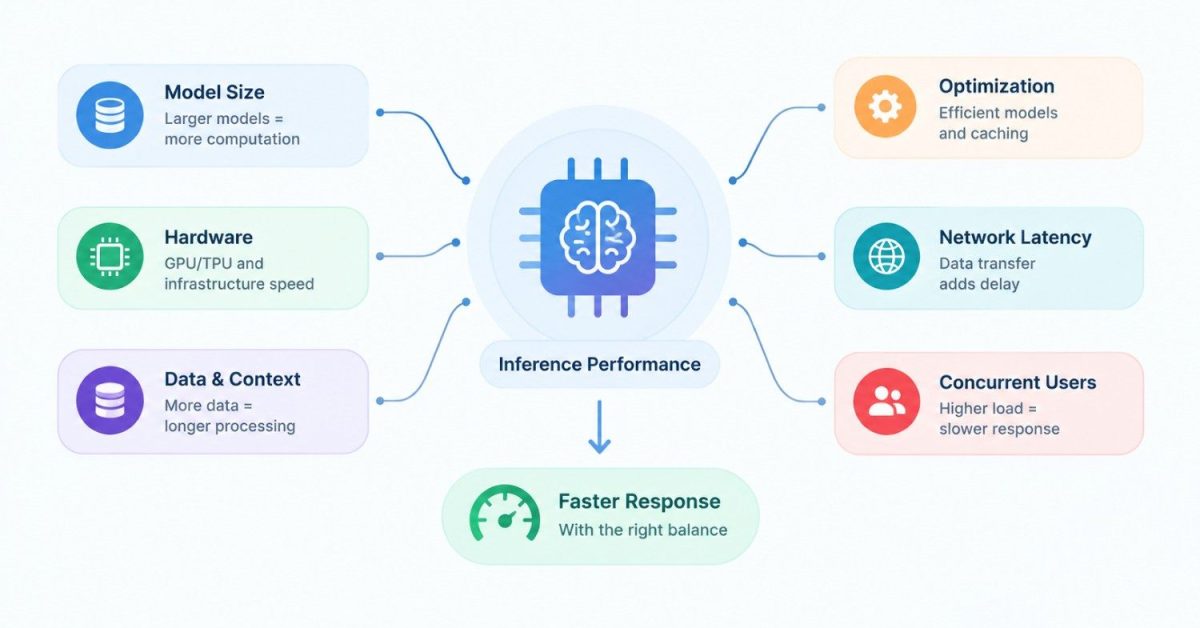
When building production-ready applications powered by machine learning to capitalize on a market that’s growing almost 40% a year, developers quickly realize that model accuracy means little if the system feels sluggish to the end user. Modern customer-facing platforms handle millions of inference requests every day, and each one creates an immediate expectation of instant feedback.
When response times exceed acceptable thresholds, user engagement drops sharply, and operational friction rises. Understanding why these delays happen requires looking deep into a prompt’s lifecycle from the moment it leaves the client application.
Performance bottlenecks rarely stem from a single isolated cause within the architecture. Instead, they result from the cumulative effects of data transfer overhead, compute constraints, and queue-management inefficiencies. Engineers must look past simple benchmarks to examine how hardware and software interact under heavy concurrent loads.
The Core Mechanics Behind Model Processing Delays
Every prediction request triggers a complex sequence of computational steps before returning a coherent answer. Input data must be preprocessed, tokenized, and transformed into vectors before it ever reaches the primary accelerator.
These foundational operations consume valuable milliseconds long before the neural network begins generating output tokens. Analyzing hardware execution overhead shows why raw GPU clock speeds don’t always translate into faster end-user experiences.
Network transit time also plays a massive role in overall delivery speed, especially when serving large payloads across distributed cloud regions. Managing inference latency effectively requires optimizing both the physical distance between servers and the efficiency of the underlying payload serialization.
Here are the primary processing stages that dictate overall speed:
- Input tokenization and payload deserialization consume initial CPU cycles before execution.
- Model weight transfer from system memory to accelerator VRAM happens during initialization phases.
- Output generation loops create the sequential token bottleneck inherent in autoregressive models.
Hardware Bottlenecks and Infrastructure Realities
Physical infrastructure remains the ultimate boundary for how fast a neural network can process incoming prompts. GPU memory bandwidth often creates a tighter ceiling on generation speed than raw floating-point operations per second. When a model scales into tens of billions of parameters, moving those weights through the memory bus becomes the primary obstacle to real-time responsiveness.
Balancing compute density with memory throughput helps engineering teams get the most value from expensive cloud instances. Teams often find that scaling out across multiple smaller nodes adds coordination overhead that degrades overall throughput. Addressing these architectural trade-offs requires continuous profiling of memory-usage patterns and cache hit rates during peak traffic hours.
Software Optimizations That Move the Needle
Beyond raw compute capability, framework-level runtime tweaks can dramatically alter execution speeds without touching physical infrastructure. Batching algorithms, for instance, group incoming asynchronous user requests dynamically to maximize parallel GPU matrix operations. When configured properly, continuous batching eliminates idle core cycles during heavy traffic surges.
Engineers must also consider model architecture choices like Mixture-of-Experts (MoE) routing, which selectively activates specialized subnetworks for specific tokens rather than processing every weight. Routers direct input queries efficiently, significantly reducing the overall math operations per forward pass.
Navigating Concurrency and System Load
High concurrent demand tests software resilience far more severely than synthetic single-request benchmark tests. Queue management becomes the primary operational bottleneck as multiple threads compete for limited memory buffers and accelerator execution time. Requests sit unserviced in memory backlogs when system load exceeds active throughput.
To maintain predictable SLAs, infrastructure teams implement token-bucket rate limiting alongside load-balancing strategies across distributed clusters. Deploying intelligent request prioritization protects mission-critical workloads while preventing cascade failures across public-facing endpoints.
Bringing Compute Closer to the User Through Edge Inference
Centralized data centers often introduce unavoidable transit delays for users on other continents. Deploying smaller, optimized models directly on edge devices or regional points of presence cuts network routing times and helps keep performance stable.
This decentralized architecture brings processing power closer to the end user, ensuring snappy interactions even under volatile network conditions. While edge hardware presents distinct thermal and memory capacity constraints, strategic workload distribution prevents regional bottlenecks from dragging down global application performance.
Network architects balance these trade-offs by shifting static tasks to edge nodes while reserving heavy lifting for core cloud clusters. It is the same principle an application acceleration manager applies to traditional web apps: move work closer to users and cut unnecessary round trips.
Proven Strategies for Streamlining Production Workloads
Modern systems engineering offers several advanced techniques to bypass traditional hardware limitations and accelerate response generation:
- Model quantization reduces weight precision, letting larger models fit comfortably in faster memory tiers without a noticeable loss in accuracy.
- Prefix caching saves immense computational effort by storing repetitive prompt contexts in memory rather than recalculating them for every incoming user.
- Speculative decoding uses a smaller draft model to quickly guess tokens while a larger model verifies them in parallel.
These optimizations turn sluggish experimental deployments into snappy production services that can handle enterprise-scale traffic. Adopting these tactics shifts the operational focus from reactive troubleshooting to proactive performance engineering.
Sustaining Optimal Processing Speeds Over Time
Maintaining peak efficiency in production environments requires continuous monitoring, not a one-time configuration effort. Developers should regularly review resource allocation metrics to catch memory leaks or unexpected queue-depth spikes before they impact users.
Keeping systems lean ensures applications stay responsive as data volumes and user expectations grow. If you’re planning a production AI system, our custom AI development team can help you build for speed from day one. You can also explore our other articles on AI development and technology for deeper insights into the state of play.
