
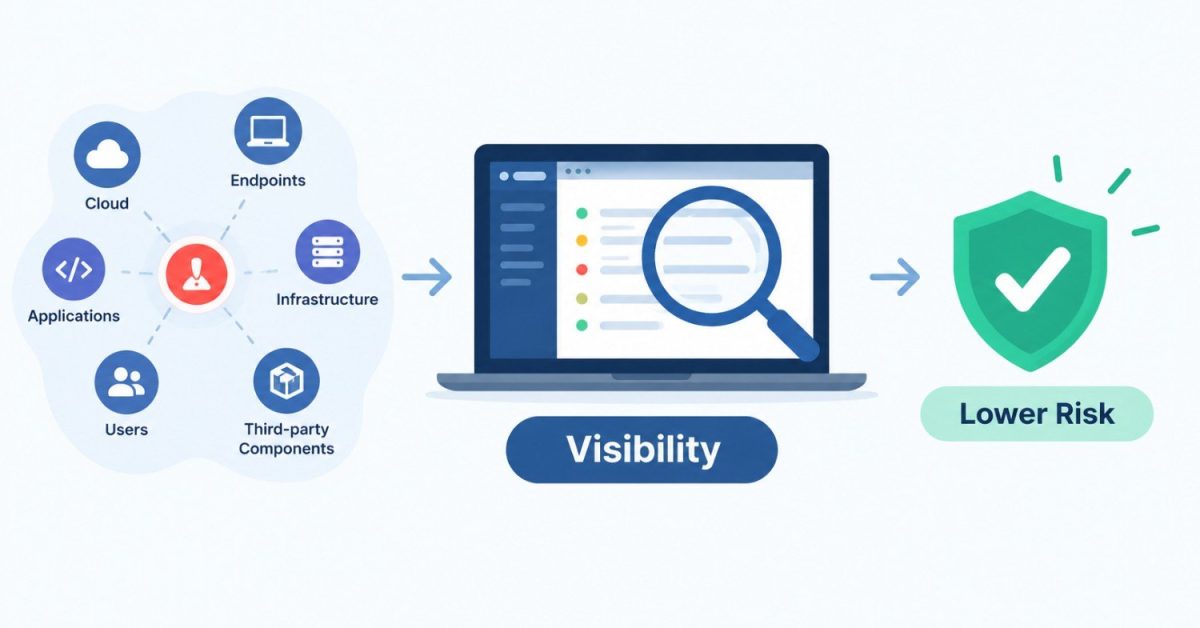
Every security control rests on an assumption: that the team knows what it is protecting. Patching schedules, access reviews, detection rules, and incident playbooks all begin from a list of assets and accounts. When the list is wrong, the controls built on it leave gaps that nobody can see.
Visibility is therefore the quiet foundation of cyber risk reduction, and it is also the part most often skipped in favor of buying another tool. The sections below look at what visibility covers, how asset and identity discovery work, where blind spots hide, and how prioritization turns a large pile of findings into a short list of actions.
You Cannot Defend What You Cannot Name
Breach reports often contain a familiar detail. The entry point was a system the organization had forgotten, an account nobody reviewed, or a service exposed by a configuration change made months earlier. In each case, the defenders owned the problem without knowing it existed, so no control was ever pointed at it.
Visibility changes that starting position. It means maintaining an accurate, current picture of devices, applications, cloud resources, accounts, and the connections between them. Accuracy matters more than volume. A list of ten thousand items with no owners or context gives little help, while a smaller list with clear ownership lets a team act within a day.
Visibility also has a time dimension. A snapshot taken during an annual audit describes a moment that has already passed. Employees join and leave, projects launch and finish, and developers create resources in minutes. Useful visibility therefore refreshes automatically and flags what changed since the last look, so the team reviews differences instead of rebuilding the whole picture each quarter.
Asset and Identity Discovery Fill Different Gaps
Asset discovery usually comes first, covering servers, endpoints, network devices, cloud workloads, applications, and domains. Network scans, cloud provider APIs, endpoint agents, and certificate transparency logs each reveal a different slice, and combining them exposes mismatches. A server that appears in a cloud console but not in the configuration database is a lead worth following.
Identity discovery asks a parallel question about accounts. How many human users, service accounts, and application credentials exist? Which ones have administrative rights, and which have not signed in for a year? Teams new to the exercise are often surprised by how many identities sit outside the formal lifecycle, such as vendor logins, test accounts, and service principals created for a short project.
Guides that offer attack surface management explained in plain terms often point to a practical question: how do assets, identities, and exposures interact? A forgotten server running under an account with broad privileges may matter more than either issue viewed alone, because together they can point to a potential route an attacker could take.
Blind Spots Tend to Cluster in Predictable Places
Blind spots are not random. They gather where ownership is unclear or where change happens fast.
- Shadow IT: Teams adopt software-as-a-service tools using personal or departmental accounts that central IT never sees.
- Cloud environments: A single developer can create storage, databases, and networks without a procurement step.
- Third-party connections: Vendors receive remote access, API keys get shared, and integrations keep running long after the project that justified them ends.
- Mergers and divestitures: Acquired environments arrive with their own directories, trust relationships, and undocumented exceptions.
- Operational technology and legacy systems: Devices that cannot run an agent or tolerate an active scan often disappear from inventories altogether, even though they may sit on the same network as critical servers. Passive monitoring can help here, since it observes traffic without touching the device. Over time, organizations that modernize legacy systems step by step can bring these devices back under normal controls.
Finding these clusters takes deliberate inventory work. Analysts can compare asset lists with billing records, DNS entries, identity-provider logs, and network-flow data, then investigate anything that appears in one source but not another. A stable, well-documented network infrastructure makes this comparison far easier.
Prioritization Turns Findings Into Decisions
Discovery produces volume, and volume without ranking produces paralysis. A first scan can return thousands of exposures, far more than any team can fix, so the useful question becomes which handful would hurt most if abused. Severity scores such as CVSS give a starting point, but they describe a flaw in isolation rather than the situation around it.
Better ranking weighs several factors together:
- Reachability: Can an attacker actually get to the asset from the internet or from a likely foothold?
- Exploitability: Is there a known, working method to abuse the weakness?
- Privilege: What does the asset or account have the power to change or read?
- Business value: What data or process depends on it?
- Compensating controls: Does something already limit the damage?
A low-scoring flaw on an internet-facing system that connects to a privileged database can outrank a critical flaw on an isolated machine. Teams that rank this way spend their limited hours where an attacker would spend theirs.
Ownership closes the loop. Every high-priority item needs a named person responsible for the fix and a date. Without that, findings circulate in reports without producing change.
Making Visibility a Routine Instead of a Project
Visibility fades quickly when it depends on a one-time effort. The practical answer is to schedule it. Run discovery on a fixed cadence, daily for fast-moving cloud environments and weekly or monthly for slower ones, and send the differences to the people who own the affected systems.
Tie the inventory to existing workflows so it stays accurate with little extra effort:
- New cloud resources can require tags for owner and purpose.
- Onboarding and offboarding processes can trigger account creation and removal.
- Change management can include a check that new systems are registered before they go live.
Each link makes the inventory a by-product of normal work rather than a separate chore.
Measure the program with a few plain numbers:
- The share of assets with a named owner
- The average time between a new asset appearing and being registered
- The count of accounts with no sign-in activity in the past ninety days
A rising number on the first and falling numbers on the last two show real progress, and they give leadership something concrete to follow.
Key Takeaways
Risk reduction starts with knowing what exists. Asset discovery and identity discovery answer different questions, and the most useful insight comes from joining them.
Blind spots gather in shadow IT, cloud sprawl, third-party access, and legacy systems, so those places deserve deliberate searching. Prioritization based on reachability, privilege, and business value keeps the team focused on exposures an attacker would actually use.
Above all, visibility works best as a recurring routine with named owners, because the environment will keep changing whether anyone is watching or not.
