Traditional SEO tools tell you where your website ranks in Google, how many backlinks it has, and how much organic traffic it receives. But search is changing as people increasingly get direct answers from Google AI Overviews, ChatGPT, and Perplexity. A strong Google ranking does not automatically mean your brand will be mentioned or cited when these AI platforms generate an answer.
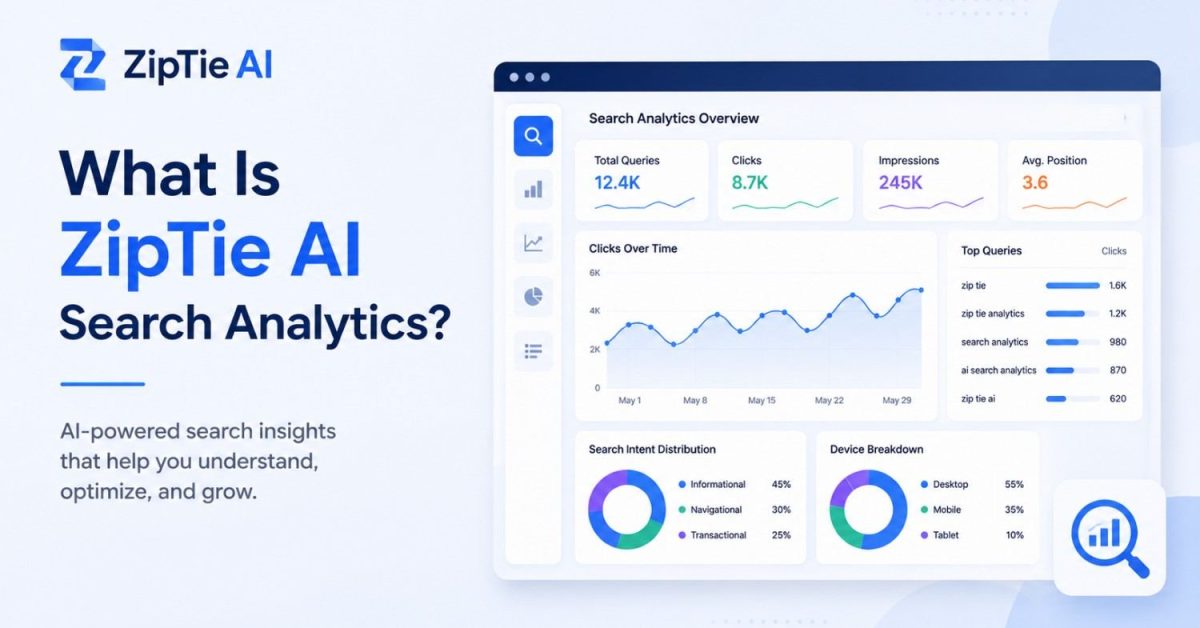
That is the gap ZipTie AI Search Analytics is designed to address. ZipTie is an AI search monitoring and optimization platform that helps businesses understand how visible their brands and websites are inside AI-generated answers. Instead of focusing only on rankings and clicks, it measures signals such as brand mentions, website citations, sentiment, competitor visibility, and overall AI search performance.
This guide explains what ZipTie AI Search Analytics is, how it works, the features and metrics that matter, how it differs from traditional SEO tools, and whether it makes sense for your AI search strategy.
What Is ZipTie AI Search Analytics?
ZipTie AI Search Analytics is a platform for measuring and improving a brand’s visibility across AI-powered search experiences. It focuses on major AI search surfaces such as Google AI Overviews, ChatGPT, and Perplexity, allowing marketers to see whether their brands and websites appear when users ask relevant questions.
The basic question ZipTie helps answer is whether your brand appears when potential customers ask AI platforms about your industry, products, or services. This requires a different type of analytics from traditional SEO because AI-generated answers do not follow conventional ranking positions.
For example, your website might perform well in Google’s organic results, but when someone asks an AI assistant for the best companies in your category, competitors may be recommended instead. ZipTie helps uncover this visibility gap by tracking whether AI platforms mention your brand, cite your website, describe your brand positively or negatively, and favor competitors for important queries.
How Does ZipTie AI Search Analytics Work?
ZipTie works by monitoring relevant queries across AI search platforms and analyzing the answers those systems generate. Rather than manually checking the same prompts repeatedly, marketers can create a structured set of queries and monitor how their AI visibility changes over time.
1. Add Your Brand and Queries
You begin by creating a project around your brand and defining the queries or prompts you want to monitor. These should reflect the questions potential customers might actually ask AI rather than relying only on short traditional keywords.
For example, instead of monitoring only “AI development company,” you could track conversational prompts such as “What are the best AI development companies for small businesses?” or “Which company can build a custom AI agent for my business?” ZipTie also provides query discovery capabilities that can help identify additional conversational searches related to your products, services, and topics.
2. Monitor AI Search Results
ZipTie then checks your selected queries across supported AI search platforms and records how your brand performs. The goal is to capture what users encounter in AI-generated results rather than simply translating traditional keyword rankings into another dashboard.
This allows you to compare performance across different AI platforms because the same company may have strong visibility in one system and very little visibility in another.
3. Measure AI Visibility
Once the results are collected, ZipTie analyzes whether your brand appears and how it appears. Instead of giving you a conventional search position such as #3 or #8, it focuses on AI-specific signals including brand mentions, website citations, sentiment, AI search coverage, competitor visibility, and sources used in generated answers.
These signals provide a more useful picture of AI search performance because being mentioned, cited, and recommended are not necessarily the same thing.
4. Find Optimization Opportunities
Monitoring alone does not tell you what to change, so ZipTie also provides insights designed to highlight opportunities for improving your content and AI visibility. For example, you might discover that competitors are frequently mentioned while your brand is absent, or that your website receives citations but your company rarely appears in recommendations.
These differences can help content and SEO teams determine where they need stronger topical coverage, clearer brand information, better supporting evidence, or content that more directly answers the questions users ask AI systems.
5. Measure Changes Over Time
After making improvements, you can continue tracking the same queries to determine whether your visibility changes. This creates a practical feedback loop of monitoring performance, identifying gaps, improving content, and measuring the results.
That ongoing measurement is one of the main advantages of an AI search analytics platform over manually asking ChatGPT or Perplexity a handful of questions.
What Does ZipTie Measure?
AI search visibility cannot be represented accurately by a single traditional ranking position. ZipTie therefore looks at several signals that indicate whether AI systems know about your brand, reference your content, and include you when answering relevant questions.
Brand Mentions
A brand mention occurs when an AI-generated answer names your company, product, or brand. If someone asks an AI platform for recommended companies in your industry and your business appears in the response, that creates brand visibility even when there is no direct link to your website.
Tracking mentions helps marketers understand how frequently their brand enters AI-generated conversations around important topics.
Website Citations
Citations measure whether an AI system references your website as a source. This is different from a brand mention because an AI answer may cite information from your website without strongly recommending your company, or it may mention your brand while sourcing its information elsewhere.
Tracking both mentions and citations gives a more complete picture of how AI platforms understand and use your brand’s information.
Brand Sentiment
Visibility is not automatically positive. An AI system could mention your company while describing limitations, negative reviews, or unfavorable comparisons with competitors.
Sentiment monitoring helps determine whether AI-generated answers portray your brand positively, neutrally, or negatively. For reputation-sensitive companies, this context can be as important as the number of mentions.
AI Success Score
ZipTie uses an AI Success Score to summarize important AI visibility signals and make performance easier to compare. Rather than manually reviewing every generated response, marketers can use this type of combined metric to identify stronger areas and prioritize queries where their visibility needs improvement.
The score should be treated as an internal performance indicator rather than the equivalent of a Google ranking. Its value comes from helping you compare AI visibility across the queries and categories you are monitoring.
Competitor Visibility
ZipTie also helps identify which competing brands consistently appear for your important prompts. This can expose situations where a competitor has stronger visibility in AI-generated recommendations even when your traditional Google performance looks competitive.
Instead of only asking “Who ranks above us?”, marketers can begin asking “Which brands does AI recommend instead of us, and which sources are influencing those answers?”
Key Features of ZipTie AI Search Analytics
AI Search Monitoring
AI search monitoring is the core of the platform. ZipTie tracks your visibility across supported AI search experiences and lets you compare performance between platforms, which is useful because ChatGPT, Perplexity, and Google AI Overviews can surface different brands and sources for similar queries.
Query Discovery
People often interact with AI differently from the way they use a traditional search engine. Instead of entering a short phrase, they may describe their situation, ask for a comparison, specify requirements, or request a recommendation.
ZipTie’s query discovery capabilities help marketers expand seed topics into the more conversational prompts that matter for AI search. This can reveal opportunities that conventional keyword research alone may not capture.
Competitor Benchmarking
Competitor benchmarking shows which brands receive the most visibility for important prompts and where your performance falls behind. This helps SEO and content teams identify competitors, topics, and queries that deserve closer attention.
Content Optimization
ZipTie also provides insights intended to help teams improve content for AI search visibility. This connects the platform with Generative Engine Optimization (GEO) and Answer Engine Optimization (AEO), where the goal is to make useful, authoritative information easier for AI-powered search systems to understand, cite, and surface in direct answers.
That does not mean writing purely for AI systems. Strong AI search content still needs clear answers, useful topical coverage, identifiable entities, credible information, logical structure, and genuine value for the reader.
AI Search Insights
ZipTie can help uncover situations where traditional search performance and AI visibility do not align. A page might perform strongly in Google while receiving few AI citations, or a competitor might appear frequently in AI answers despite weaker conventional rankings.
Understanding those differences helps teams determine whether they are dealing with a traditional SEO problem, an AI visibility problem, or both.
ZipTie vs Traditional SEO Tools
ZipTie should not be viewed as a replacement for traditional SEO platforms. It measures a different layer of search visibility.
| Area | Traditional SEO Tools | ZipTie |
|---|---|---|
| Main focus | Traditional search performance | AI-generated answers |
| Queries | Search keywords | Keywords and conversational prompts |
| Visibility | Ranking positions | Mentions and citations |
| Brand monitoring | Usually secondary | Core focus |
| Sentiment | Not usually central | AI brand sentiment |
| Competitors | Search competitors | AI visibility competitors |
| Optimization | Traditional SEO | AI search/GEO |
| Main surfaces | Search engines | AI Overviews, ChatGPT, Perplexity |
Tools such as Google Search Console, Ahrefs, and Semrush remain useful for measuring organic traffic, rankings, backlinks, technical SEO, and keyword performance. ZipTie adds visibility into what happens when an AI system generates the answer itself.
For many SEO teams, the two approaches are therefore complementary. Traditional analytics tells you whether people can discover your website through search results, while AI search analytics helps show whether AI platforms themselves are surfacing your brand and content.
Why Choose ZipTie AI Search Analytics?
The main advantage of ZipTie is that it turns AI visibility into something marketers can monitor systematically. Without an AI search analytics platform, you could manually ask ChatGPT, Perplexity, or other systems whether they recommend your company, but that becomes impractical once you need to track hundreds of prompts, several competitors, multiple platforms, citations, sentiment, and changes over time.
ZipTie organizes those signals into a repeatable monitoring workflow. This is particularly valuable for businesses already investing heavily in SEO and content because it helps answer whether the content performing well in traditional search is also influencing AI-generated answers.
It also gives marketers a way to identify AI visibility gaps before assuming that strong Google rankings automatically translate into strong visibility everywhere else.
Who Should Use ZipTie?
ZipTie is most useful for organizations where search visibility and online brand discovery already contribute to growth:
- SEO and content teams: Track AI mentions and citations alongside traditional search performance.
- Digital marketing agencies: Compare client visibility against competitors across AI search platforms.
- B2B and SaaS companies: Monitor how products and brands appear when potential buyers ask AI for comparisons and recommendations.
- Marketing and brand teams: Understand how AI platforms describe, cite, and recommend their brands.
However, a website with weak technical SEO, limited useful content, and little organic visibility may get more value from fixing those fundamentals first. AI search analytics becomes more valuable once you already have a search and content strategy worth measuring.
What ZipTie Does Not Tell You
ZipTie provides useful AI visibility data, but the numbers need to be interpreted carefully. AI-generated responses can change depending on the platform, timing, prompt wording, context, and other factors, so AI visibility should be viewed as a performance trend rather than a permanent ranking position.
A citation also does not automatically produce a website visit, lead, or sale. Users may get enough information directly from an AI-generated response that they never click the source. Web analytics, CRM data, and conversion tracking are still necessary if you want to understand the actual business impact of AI search visibility.
Platform coverage is another consideration. If your audience relies heavily on AI services outside the platforms ZipTie monitors, you may need additional monitoring. And like every GEO tool, ZipTie can identify patterns and optimization opportunities, but it cannot guarantee that an AI platform will cite or recommend your website.
How ZipTie Works in a Real SEO Strategy
Imagine you sell project-management software and already rank well in traditional Google results for “project management software for agencies.” You now want to know what happens when a potential buyer asks an AI assistant, “What is the best project management software for a small marketing agency?”
ZipTie may reveal that several competitors appear consistently in AI-generated recommendations while your product rarely does. Instead of simply assuming your Google ranking should be enough, you can examine which competitors receive mentions, which pages are being cited, and what information those sources provide.
Your team can then improve the relevant content by making the product’s use cases clearer, answering comparison questions more directly, strengthening supporting evidence, or covering important entities and topics that are currently missing. You continue tracking the same prompts afterward to see whether your AI visibility improves.
This is the practical role of an AI search performance tool: turning a difficult-to-observe part of search into a measurable optimization process.
Is ZipTie AI Search Analytics Worth Using?
ZipTie can be valuable if your company already invests in SEO, content marketing, brand visibility, or Generative Engine Optimization and you want to understand what happens to your brand inside AI-generated answers.
Its strongest value is not finding out whether ChatGPT mentioned your company once. It is providing a structured way to monitor mentions, citations, sentiment, competitors, prompts, and performance changes over time.
However, AI search analytics should complement rather than distract from SEO fundamentals. Technical accessibility, useful content, strong topical coverage, authority, clear brand information, and a good user experience still matter. GEO should be treated as an extension of a strong search strategy rather than a shortcut around traditional SEO.
For businesses trying to understand where AI search fits within a broader AI and digital strategy, our AI consulting and strategy service focuses on connecting new AI opportunities with practical business goals.
Final Thoughts
ZipTie AI Search Analytics helps brands measure something traditional SEO tools cannot fully show: their visibility inside AI-generated answers. It tracks signals such as brand mentions, website citations, sentiment, and competitor visibility across major AI search experiences.
It should not replace traditional SEO analytics. Instead, it adds another layer for businesses already investing in search and content. Google Search Console, Ahrefs, or Semrush can tell you how your website performs in conventional search, while ZipTie helps answer a different question: when AI answers a potential customer’s question directly, is your brand part of that answer?
As AI-powered discovery grows, monitoring both traditional rankings and AI visibility will give businesses a more complete picture of how customers find them online.
Frequently Asked Questions
1. What is ZipTie AI Search Analytics?
ZipTie AI Search Analytics is a platform that tracks how brands and websites appear in AI-generated search results. It monitors major AI search experiences and measures signals such as brand mentions, website citations, sentiment, and competitor visibility.
2. What is the ZipTie AI search performance tool?
The ZipTie AI search performance tool monitors brand visibility inside AI-generated answers. Instead of tracking only traditional keyword positions, it helps marketers understand whether AI platforms mention their brand, cite their website, or favor competitors.
3. How does ZipTie AI Search Analytics work?
You create a project, add relevant queries or conversational prompts, and ZipTie monitors the resulting AI-generated answers. It then analyzes visibility signals such as mentions, citations, sentiment, and competitor performance so you can identify opportunities and track changes over time.
4. Which AI platforms does ZipTie track?
ZipTie focuses on major AI search experiences including Google AI Overviews, ChatGPT, and Perplexity. Platform coverage can change as the product develops, so businesses that depend on a particular AI engine should confirm current support.
5. Does ZipTie replace Semrush, Ahrefs, or Google Search Console?
No. Traditional SEO tools measure areas such as rankings, backlinks, traffic, keywords, and technical SEO. ZipTie focuses on brand visibility inside AI-generated answers, so it is better viewed as a complementary AI search analytics layer.
6. Why choose ZipTie AI Search Analytics?
ZipTie provides a structured way to monitor AI search visibility across many prompts instead of checking AI platforms manually. It can help SEO and marketing teams measure mentions, citations, sentiment, competitors, and changes in visibility over time.
7. Is ZipTie useful for Generative Engine Optimization?
Yes. ZipTie’s AI visibility monitoring and optimization insights can support Generative Engine Optimization (GEO) by showing where a brand is being mentioned or cited and where competitors have stronger AI search visibility.
8. Can ZipTie guarantee that my website will appear in AI answers?
No. ZipTie can identify visibility patterns, competitors, citations, and optimization opportunities, but AI platforms ultimately determine which brands and sources appear in their generated answers.
9. What is ZipTie’s AI Success Score?
The AI Success Score is a ZipTie performance metric designed to summarize important AI visibility signals. It can help marketers compare performance and identify queries or categories that deserve more attention rather than manually evaluating every AI-generated answer.
