
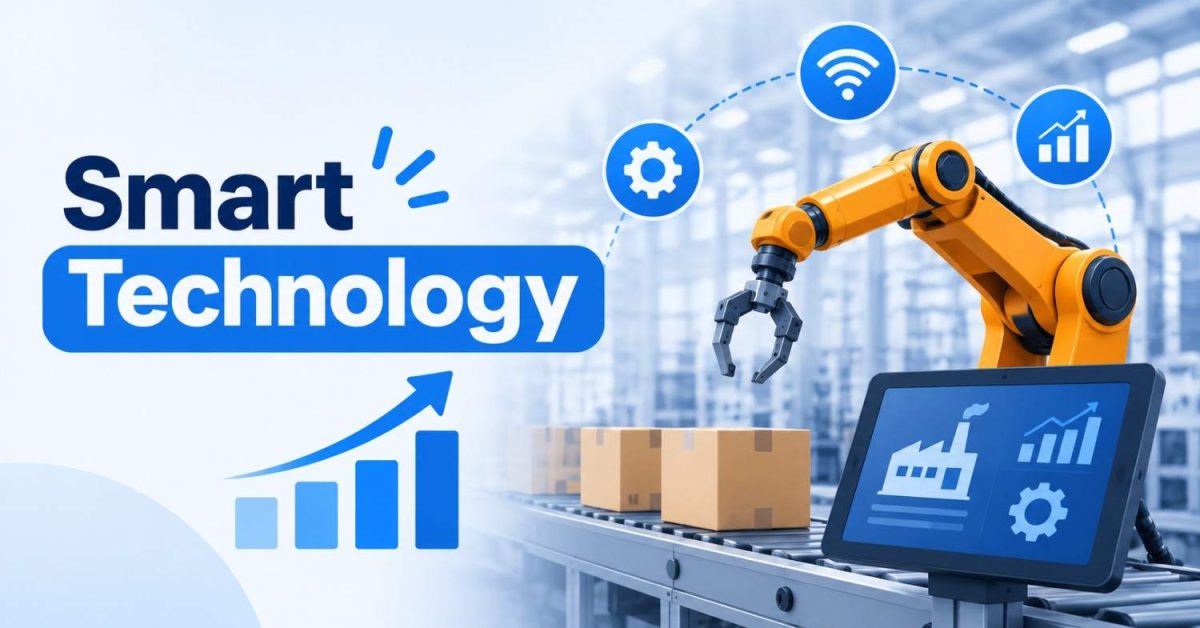
When a bearing fails unexpectedly on a production line, it can cost manufacturers $10,000 per hour in lost output. Smart technology is changing that equation, creating measurable improvements in output, efficiency, and worker safety. Manufacturers that adopt these innovations gain an edge, while those that delay risk falling behind.
Understanding Smart Technology in Industrial Settings
Smart technology refers to interconnected systems that collect data, analyze performance, and make autonomous decisions to optimize operations. These systems include sensors, artificial intelligence, machine learning algorithms, and Internet of Things (IoT) devices that communicate with each other to create responsive manufacturing environments.
Unlike traditional automation, which follows fixed programming, smart technology adapts to changing conditions. A smart factory floor can detect equipment wear before breakdowns occur, adjust production schedules based on real-time demand, and identify quality issues instantly rather than after an entire batch has been completed.
Real-Time Monitoring and Predictive Maintenance
One of the most valuable applications of smart technology is continuous monitoring of equipment health. Sensors embedded in machinery track vibration patterns, temperature fluctuations, and operating speeds to detect anomalies that signal potential failures.
This predictive approach prevents costly unplanned downtime. When a bearing begins wearing unevenly or a motor shows signs of stress, the system alerts maintenance teams before a complete failure occurs. Some companies report reducing downtime by 30 to 50 percent compared with reactive repair strategies after implementing predictive maintenance.
The financial impact extends beyond avoiding emergency repairs. Scheduled maintenance during planned downtime costs significantly less than urgent fixes during production hours. Workers can prepare necessary parts in advance, and production schedules can route work to other equipment during maintenance windows.
Integration with precision equipment amplifies these benefits. For example, Summit Machine Tool metal lathes for improved production efficiency can connect to monitoring systems that track tool wear, spindle performance, and dimensional accuracy in real time. This integration helps maintain consistent quality, extend the life of cutting tools, and reduce scrap rates.
Optimizing Production Workflows
Smart sensors throughout production lines generate continuous data streams about throughput, bottlenecks, and cycle times. Advanced analytics software processes this information to identify inefficiencies that human observers might miss.
For example, a beverage bottling facility might discover that certain product changeovers take 20 percent longer on specific days because subtle temperature variations affect equipment calibration. With this insight, operators can make preventive adjustments that keep changeover speeds consistent.
Smart scheduling systems also coordinate production based on multiple variables at once. These platforms consider raw material availability, equipment capacity, energy costs at different times of day, and delivery deadlines to create optimized production sequences. The result is higher utilization of existing assets without capital investment in new equipment.
Quality Control Through Computer Vision
Computer vision systems equipped with high-resolution cameras and machine learning algorithms inspect products at speeds human quality control teams cannot match. These systems examine thousands of units per hour, detecting microscopic defects, incorrect assembly, and packaging errors with high accuracy.
The technology learns from each inspection, continuously refining its ability to distinguish acceptable variations from actual defects. This reduces both false positives that waste good products and false negatives that allow defective items to reach customers.
In some applications, manufacturers using vision-based quality control report defect detection rates above 99 percent while also reducing inspection labor costs. The systems also generate detailed quality reports that help identify upstream process issues causing recurring defects.
Energy Management and Sustainability
Smart energy management systems monitor power consumption across facilities in granular detail. These platforms identify equipment that is running inefficiently, detect phantom loads from devices left on unnecessarily, and shift energy-intensive processes to off-peak utility rates.
Some systems automatically adjust heating, cooling, and lighting based on occupancy and production schedules. Others coordinate with renewable sources such as solar panels to maximize self-generated power before drawing from the grid.
The environmental benefits align with financial savings. Industry reports suggest manufacturers can reduce energy costs by 10 to 30 percent after implementing comprehensive smart energy systems. These reductions directly improve profit margins while supporting corporate sustainability commitments.
Enhancing Worker Safety and Productivity
Wearable devices and environmental sensors create safer work environments by monitoring conditions that pose health risks. Gas detectors alert workers to dangerous atmospheric changes, while wearables track fatigue indicators and ergonomic stress to help prevent injuries.
Smart systems also assist workers directly. Augmented reality glasses can display assembly instructions, maintenance procedures, or safety warnings in a technician’s field of view. This hands-free access to information reduces errors and speeds up training for complex tasks.
Collaborative robots, or cobots, work alongside human operators to handle repetitive or physically demanding tasks. Unlike traditional industrial robots that require safety cages, cobots use sensors that stop movement when a person enters their workspace, allowing safe human-robot collaboration on the same production line.
Cross-Industry Technology Adoption
Smart technology is not limited to heavy manufacturing. These innovations are spreading across industries as businesses recognize the efficiency gains of connected systems.
Companies that use commercial printing services for streamline marketing workflows can benefit from technology-enabled processes that coordinate design, production, and distribution more efficiently than traditional methods. This shows how smart technology principles apply across sectors wherever workflow optimization matters.
Data-Driven Decision Making
Perhaps the most transformative aspect of smart technology is the wealth of actionable data it generates. Manufacturing execution systems (MES) aggregate information from across production operations, creating comprehensive visibility into performance metrics.
This data foundation supports informed decision-making at every level of the organization. Floor supervisors can see which shifts or teams achieve the highest output, plant managers can compare performance across multiple facilities, and executives can identify trends that affect long-term strategic planning.
The key is turning raw data into meaningful insight. Advanced analytics platforms use statistical models and machine learning to highlight patterns, predict future performance, and recommend specific actions. This elevates data from simple reporting to a strategic advantage.
Overcoming Implementation Challenges
Adopting smart technology requires careful planning and realistic expectations. The initial investment can be substantial, though costs have fallen as the technology has matured. Companies should prioritize applications with clear ROI and expand gradually rather than attempting a complete transformation at once.
Workforce training is just as important as hardware installation. Employees need the skills to interpret system outputs, respond to alerts appropriately, and maintain new technology. Organizations that invest in comprehensive training programs see faster adoption and better results.
Cybersecurity also deserves serious attention, because connected systems create potential vulnerabilities. Manufacturers should reduce cybersecurity risk with robust network security, regular software updates, and strong access controls to protect operational technology from digital threats.
Conclusion: The Path Forward
Smart technology is becoming a requirement for staying competitive in many industrial sectors. Companies that optimize operations with intelligent systems can produce higher-quality products at lower cost and with greater reliability. This performance gap makes it increasingly difficult for traditional manufacturers to compete on price or delivery.
The technology continues to evolve rapidly, with artificial intelligence and edge computing opening new possibilities for autonomous decision-making at the machine level. What will separate tomorrow’s industry leaders from the rest is their willingness to build smart technology foundations today.
Those foundations make it easier to adopt future innovations than starting from outdated systems. The convergence of AI, IoT, and advanced analytics is not slowing down, and factories that integrate emerging technologies smoothly will capture opportunities their competitors cannot yet see.
Smart technology delivers measurable results across quality, efficiency, safety, and profitability. For most manufacturers, the question is no longer whether to adopt these systems, but how quickly they can implement them effectively.
