
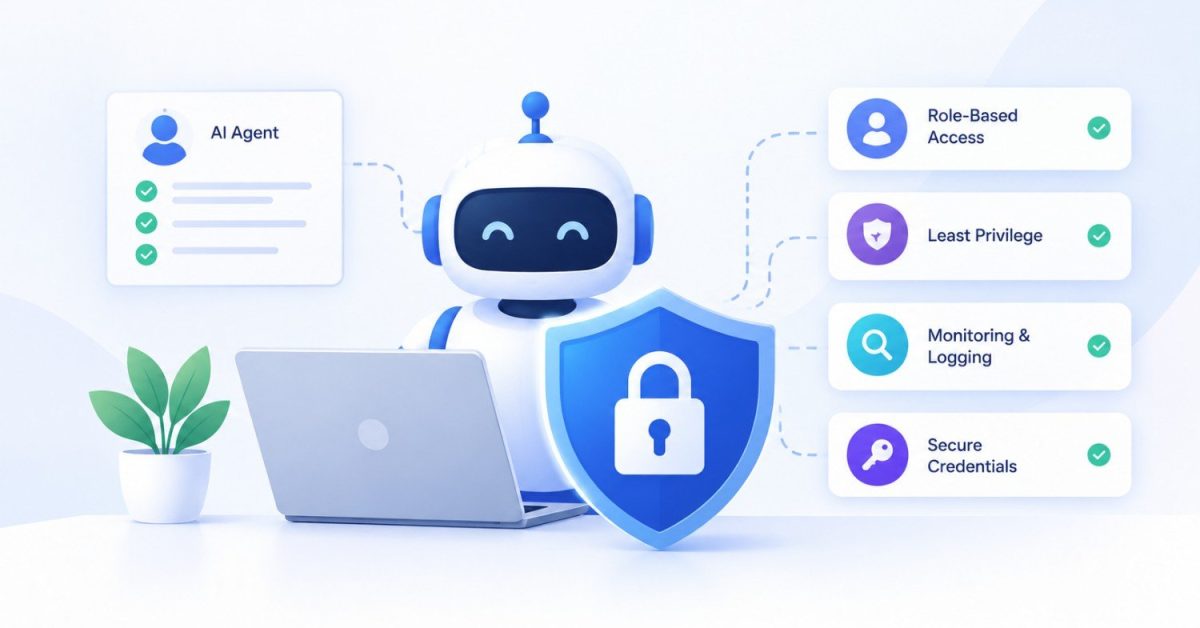
An AI agent that can read a ticket, search a knowledge base, query a database, and deploy a fix is productive in a way that a chatbot never was. It is also holding a set of keys. Every tool connection and every token it carries defines what it can do when it works correctly, and what it can be tricked into doing when it does not.
Security and AI platform teams are now making decisions about those keys, often faster than their existing access models can handle. Agents act autonomously, choose their own sequences of steps, and process untrusted content along the way. The sections below explain how agent access differs from traditional access, how to scope permissions and tool access, how least privilege and policy enforcement apply, what to look for in solution providers, and how to build an audit trail that stands up in an investigation.
Why Agent Access Is Different
Traditional access control assumes that a known user or a fixed piece of software performs predictable actions. A human logs in, does a task, and logs out. A service account runs the same code against the same endpoints. Permissions can be reviewed against those expectations.
Agents break the pattern in three ways:
- They decide at runtime. Agents choose which tools to call and in what order, based on instructions and model output, so their behavior varies from one run to the next.
- They read untrusted content. Documents, web pages, emails, and tool responses can all contain instructions that attempt to redirect them.
- They chain actions across systems. One decision can ripple through several applications.
These traits come directly from how most agentic frameworks are designed. The consequence is that the blast radius of a mistake or a manipulation depends almost entirely on the access the agent holds. A well-behaved agent with narrow permissions can do limited harm. A misled agent with administrative rights can delete data, move money, or expose records at machine speed.
Teams also face scale. A company may run dozens or hundreds of agents, built by different groups for different purposes. Without consistent controls, each one becomes a custom exception, and nobody can say with confidence what the whole population can reach.
Agent Permissions and Tool Access
Start by treating each agent as its own identity, with credentials separate from those of the person who built or runs it. Sharing a developer’s personal token or a generic API key across agents erases accountability and makes revocation difficult. A named identity per agent, with an owner and a stated purpose, is the baseline.
Tool access deserves as much care as data access. An agent connected to a tool can usually perform every action the tool allows unless restricted. Define for each agent the precise list of tools it may call, and within each tool, the allowed operations. Reading a calendar is a different level of risk from deleting events, and querying a database differs from running arbitrary commands.
Parameters can be constrained as well:
- Limit which tables, folders, repositories, or accounts an agent may touch.
- Restrict outbound destinations so that data cannot be sent to arbitrary addresses.
- Put spending limits on actions with financial impact.
- Cap volumes for bulk operations.
Dynamic permissions work better than static ones where possible. Rather than granting standing access, issue short-lived credentials scoped to a task, and require the agent to request elevation for sensitive steps. When an agent acts on behalf of a user, its authority should be bounded by that user’s own rights, so delegation never produces more access than the person holds.
Least Privilege and Policy Enforcement
Least privilege is the central principle, and it is harder to apply to agents because their tasks are broader and less defined than a fixed job. A practical method is to start from the task. Describe what the agent is supposed to accomplish, list the systems and operations that task requires, and grant only those. Anything else is denied by default.
Expect to iterate. Run the agent in a monitored environment, observe which permissions it actually uses, and trim the rest. Over-broad grants are often added “to avoid blocking it,” then forgotten. Periodic reviews should compare granted permissions with actual use and remove the difference.
Policy enforcement should happen outside the model. A system prompt telling an agent not to delete files is a request, not a control, and an injected instruction can override it. Enforce rules in a layer the model cannot alter, such as a gateway or policy engine that evaluates each tool call against defined rules before it executes. That layer can allow, deny, or require approval, and it can apply the same rules consistently across agents.
Useful policy dimensions include:
- The identity of the agent and the user behind it
- The tool and operation
- The data classification involved
- The destination
- The time and context
- The risk level of the action
Policies should be written down, version controlled, and tested like code.
Solution Providers and What to Ask Them
A growing set of providers offers products for securing agents, covering discovery, access control, runtime protection, and monitoring. Noma Security is one company in this space that describes offerings focused on agent access control, and buyers evaluating it or comparable vendors should treat marketing claims as starting points for testing, not as proof.
Useful questions apply to any provider:
- How does the product discover agents and their tool connections across the environment, including those built by individual teams?
- Can it enforce policy at runtime on each tool call, and what happens when a call is blocked?
- How does it integrate with existing identity systems, secrets management, and logging platforms?
- What is the latency impact, and how does it behave if it fails?
- How are policies authored and tested, and do they support approvals and exceptions?
- How does the product handle agents built on different frameworks and models?
Request a proof of concept with realistic scenarios, including attempts to induce an agent to exceed its scope. Check data handling, since a tool that inspects prompts and tool calls will itself see sensitive information.
Do not forget the basics. Existing identity and access management, secrets vaults, and API gateways may cover part of the need already. A vendor tool should fill gaps and add visibility, not duplicate what is in place.
Audit, Monitoring, and Rollout
Audit trails turn access decisions into evidence. For every agent action, record the agent’s identity, the user or system it acted for, the tool and operation, the parameters, the policy decision, and the result. Include a reference to the task or request that triggered it, so an investigator can reconstruct the reasoning chain. Store logs where the agent cannot modify them, and retain them long enough for investigation and compliance.
Monitoring converts logs into detection. Look for agents calling tools they rarely use, accessing data outside their normal scope, generating bursts of denied requests, or sending data to new destinations. Alert on changes to an agent’s permissions, tool list, or configuration. Regular access reviews should include a list of every agent, its owner, and its grants.
A phased rollout keeps the work manageable:
- Inventory agents, their owners, tool connections, and credentials.
- Assign a distinct identity to each agent and retire shared tokens.
- Define allowed tools, operations, and data scopes per agent.
- Enforce policy in a gateway or control layer outside the model.
- Require approval for high-impact actions and use short-lived credentials.
- Turn on detailed logging and alerting, then review results with owners.
- Test with adversarial scenarios and update policies based on findings.
Start with the agents that touch the most sensitive systems, and expand outward. Assign ownership, train builders on the controls, and treat exceptions as time-limited and documented.
Final Analysis
Agents are valuable because they act, and that same ability makes access control the most important line of defense. Distinct identities, narrow tool permissions, enforcement outside the model, and complete audit trails give organizations a way to say exactly what each agent can do, and to prove it.
Teams that apply least privilege from the start, test their controls against realistic attacks, and review access regularly can deploy agents with confidence. Building these controls in from the design stage, as part of AI agent development, is far easier than adding them later. The goal is not to slow adoption but to make sure the keys each agent carries are the ones it actually needs.
A practical starting point is a single spreadsheet listing every agent, its owner, its tools, and its credentials. Gaps in that sheet show where identity and access work should begin.
