
An engineer connects an AI agent to the ticketing system, the code repository, and a cloud console. To save time, the agent runs under the engineer’s own token. Weeks later, the agent merges a pull request, closes a batch of tickets, and queries a production database, and the audit log shows only the engineer’s name. Nobody can say which actions the person took and which the software took on its own.
That ambiguity is the core problem. Agents act with a degree of autonomy that neither human accounts nor traditional automation was built to represent. For security and platform engineers, assigning agents their own identities is the foundation for limiting damage, attributing actions, and meeting audit expectations.
The sections below cover how agents differ from existing identity types, what the concept means in practice, the credential and permission risks, short-lived access, and auditing.
How Agents Differ From Users and Service Accounts
Human users authenticate interactively, make decisions in context, and can be held accountable through employment and policy. Their access is reviewed on a schedule, and their behavior tends to follow recognizable patterns. Multi-factor prompts, device checks, and session timeouts all assume a person is on the other end.
Service accounts fit a different model. They run fixed, predictable code, call a known set of APIs, and rarely change behavior without a deployment. Permissions can be scoped to the narrow task the code performs, and anomalies are easy to spot because the normal pattern is so regular. Their weakness is usually long-lived credentials that nobody rotates.
Agents sit between the two and match neither. They decide which tools to call based on natural language instructions and model output, so their behavior can vary from run to run. They may act on behalf of a user, chain together several systems, and respond to untrusted content such as emails or web pages that contain hidden instructions. This flexibility is built into how most agentic frameworks work.
A service account scoped for one job is predictable. An agent scoped for “help with engineering tasks” can end up wielding a broad set of permissions in ways nobody enumerated in advance.
| Identity Type | Behavior | Main Risk |
|---|---|---|
| Human user | Interactive, context-driven, accountable | Phishing and credential theft |
| Service account | Fixed, predictable code | Long-lived credentials that are never rotated |
| AI agent | Autonomous, varies from run to run | Broad permissions used in unpredictable ways |
What an Identity for an Agent Actually Means
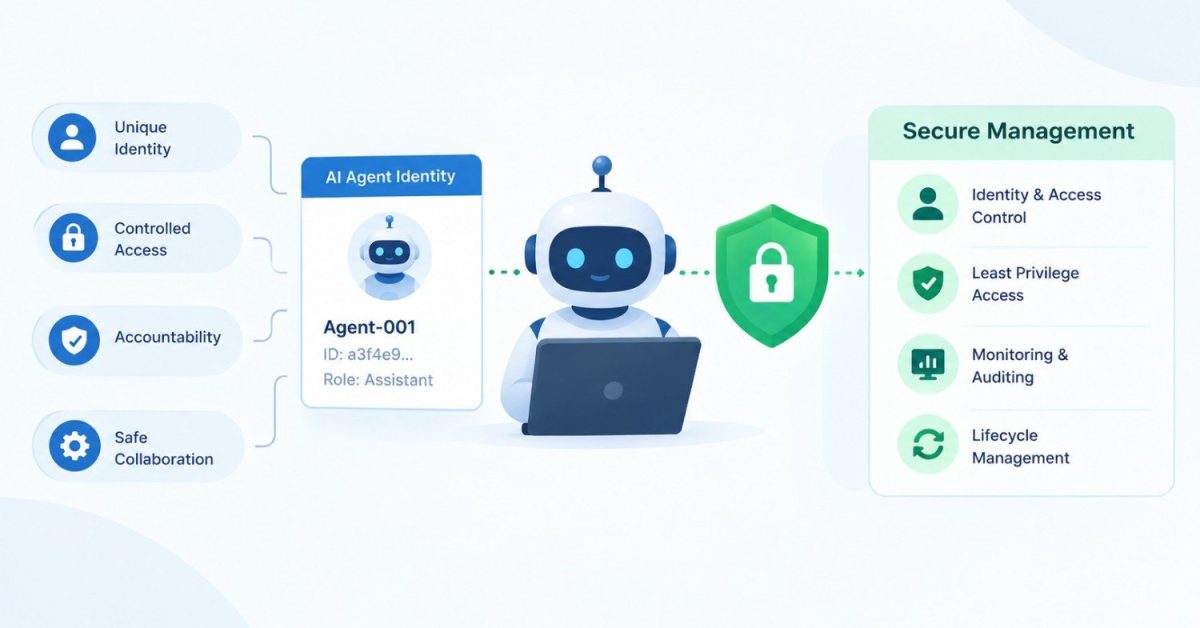
AI agent identity is a distinct, verifiable identity assigned to each agent, separate from the humans who build or use it and from the infrastructure it runs on. It answers three questions:
- Which agent is this?
- Who or what authorized it?
- What is it permitted to do right now?
Without that identity, access decisions and audit records have nothing reliable to attach to.
Treating each agent’s identity as a first-class object brings practical benefits:
- Each agent can hold only the permissions its task demands.
- Policies can distinguish between an agent acting autonomously and one acting on behalf of a particular user, a difference that matters for approvals and accountability.
- An agent’s access can be revoked without disrupting the human who deployed it.
- Incident responders can filter logs by agent.
Implementation draws on existing patterns. Workload identity systems already give software processes cryptographic identities tied to their environment, and standards such as OAuth support delegation, where a token records both the agent and the user it acts for. The extra step is to apply these patterns deliberately to agents, record ownership and purpose, and make the identity visible in every system the agent touches. When agent identity is built into platform design from the start, controls follow naturally.
Credential and Permission Risks
Credential reuse: The most common mistake is agents running with a developer’s personal access token, or with a shared API key copied across several agents. Those credentials carry the full privileges of their owner and are often long-lived. If an agent is manipulated or its environment is compromised, the attacker inherits everything the credential can reach.
Prompt injection: This raises the stakes. An agent that reads a document, ticket, or web page may encounter text designed to steer it into misusing its tools, such as exfiltrating data or changing configuration. The agent might behave like a confused deputy, using its legitimate access on behalf of an attacker. Narrow permissions limit what a manipulated agent can do, which is why scoping matters even when the model is trusted.
Secrets handling: Credentials stored in prompts, configuration files, or logs can leak, and agents that call tools through generic connectors may pass secrets along unnoticed.
Over-broad permissions: Granting administrative rights “so the agent does not get blocked” is convenient and dangerous. Permissions should start minimal and expand only through explicit review. Separate agents for separate tasks, each with its own narrow scope, are safer than one general-purpose agent with sweeping access.
Short-Lived Credentials and Just-in-Time Access
Credentials that expire quickly shrink the window for abuse. Instead of a static key sitting in a config file for months, an agent should obtain a token valid for minutes or hours, issued after it proves its identity to a trusted authority. If the token leaks, it becomes useless soon afterward.
Several practices support this approach:
- Use identity federation or workload identity, so the agent authenticates with something bound to its runtime environment, not a stored password.
- Issue scoped tokens limited to a specific resource and action.
- Require just-in-time elevation for sensitive operations, where the agent requests extra privileges for a defined task and a person or policy approves the request.
- Bound delegated tokens so that when an agent acts for a user, it never exceeds that user’s own permissions.
Operationally, short-lived credentials need supporting plumbing: automated issuance, renewal handled by the platform, and clear failure behavior when a token cannot be obtained. Teams should also plan for revocation, so an agent that behaves unexpectedly can be cut off immediately. Rotating any remaining static secrets on a schedule, and removing them where federation is possible, closes the gap that attackers prefer.
Auditing What Agents Do
An audit trail is only valuable if it can tie actions to a specific agent, a specific authorization, and a specific context. Logs that show only the underlying infrastructure account tell investigators very little.
Useful records for each agent action include:
- The agent identity and version of its configuration
- The principal who delegated authority, if any
- The tool invoked and the resource targeted
- The parameters used
- The decision made by the policy engine, allowed or denied
- A reference to the prompt or task that triggered the action
- The outcome, any error returned, and a timestamp
Retention and review matter as much as capture. Logs should flow to central monitoring where detection rules can flag unusual behavior, such as an agent accessing resources outside its normal scope, calling tools at odd hours, or generating a burst of failed requests. For high-risk actions, consider requiring human approval and recording who gave it. Periodic access reviews should include agents, confirming that each has an owner, a purpose, and permissions that still match its job.
Key Takeaways
Agents are neither users nor service accounts, and forcing them into either model blurs accountability. Giving each agent a distinct identity, with a named owner, scoped permissions, and short-lived credentials, restores the ability to answer basic questions: who did this, under whose authority, and with what access.
Teams do not have to solve everything at once. Starting by removing shared tokens and personal credentials from agents, moving to federated, short-lived access, and logging agent actions with clear attribution delivers most of the benefit. Building these controls in from the start of AI agent development is far easier than adding them later.
As agents take on more responsibility, those foundations determine whether organizations can trust what their software does on their behalf.
