
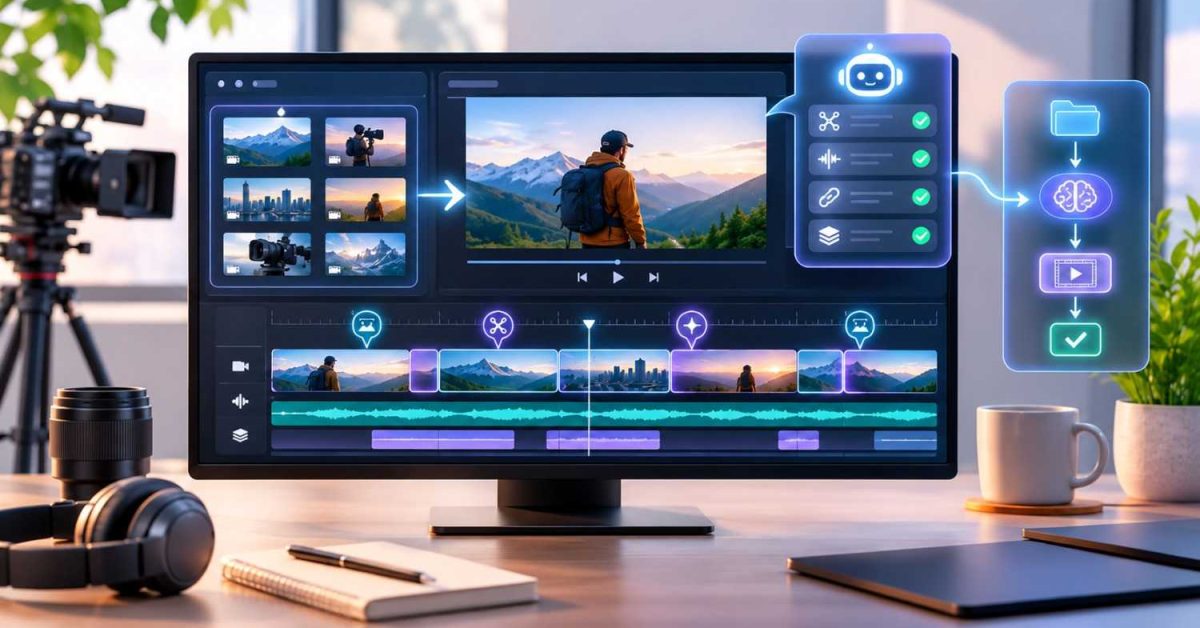
Video production has always required a mix of creative thinking and technical work. From reviewing raw footage to arranging clips, adjusting audio, and preparing the final export, editors spend a lot of time on tasks that can become repetitive.
AI editing agents are changing how these tasks are handled. Instead of manually completing every step, creators can describe what they need, and an AI agent can carry out supported editing actions inside connected software.
This approach allows businesses, marketing teams, and content creators to spend more time on storytelling while reducing the effort involved in routine editing.
What Are AI Editing Agents?
AI editing agents are systems that can understand instructions, plan editing tasks, and perform actions using connected video editing tools. Unlike basic AI features that handle a single task, such as generating subtitles or removing background noise, editing agents can work across several stages of a project.
For example, an editor might ask an agent to review an interview recording, remove unnecessary pauses, select useful sections, and arrange them into a short video. The agent can carry out these steps when the connected software provides the required controls. The editor can then review the sequence and adjust any parts that need attention.
This is part of a broader shift toward AI automation workflows, where intelligent systems handle routine operations while people focus on decisions that require judgment.
How AI Agents Are Changing Video Editing Workflows
Traditional video editing often involves moving between different tools and repeating similar steps across multiple projects. AI agents help simplify this process by handling parts of the workflow that follow clear instructions.
Turning Raw Footage Into a Rough Cut
Creating a rough cut is one of the most time-consuming stages of video editing. Editors often review long recordings, identify useful moments, remove unwanted sections, and arrange clips into a logical sequence.
AI editing agents can help by reviewing accessible footage, identifying repeated takes, removing unnecessary pauses, and building an initial timeline. For example, a creator working on a 30-minute interview could ask an agent to prepare a five-minute rough cut featuring the main discussion points.
The editor would still review the selected clips and refine the pacing, but the initial assembly would require less manual work.
Managing Audio and Captions
Clear audio and readable captions are essential for professional videos. However, adjusting sound levels, cleaning recordings, and synchronizing subtitles can take considerable time.
When supported by the editing software, AI agents can help balance voice and background music, reduce unwanted noise, and place captions at the correct moments. They can also make changes based on feedback. An editor might ask the agent to lower the background music during an interview or adjust caption placement across a sequence.
This makes it easier to maintain consistent audio and text formatting throughout a project.
Adapting Videos for Different Platforms
Content teams frequently produce several versions of the same video for different platforms. A landscape video created for YouTube may need a vertical version for Instagram Reels or TikTok. Simply changing the aspect ratio can cut off important subjects or make captions difficult to read.
AI agents connected to suitable editing tools can help adjust framing, reposition text, and prepare alternate layouts. Creators should still review each version to make sure the message remains clear. Understanding how to resize a video for different platforms also helps teams plan their footage before editing begins.
How MCP Connects AI Agents With Video Editing Software
One of the developments making AI-assisted editing more practical is Model Context Protocol (MCP). MCP is an open standard that allows AI applications to communicate with external tools and access the functions those tools make available.
In video production, this connection can allow an AI assistant to interact directly with compatible editing software rather than simply explaining how to perform an edit. For instance, a creator could ask an MCP-connected assistant to arrange clips, adjust audio levels, add titles, or change the timing of a scene. The assistant can then use the available editing controls to carry out those instructions.
The exact capabilities depend on the software and the functions exposed through its MCP server.
Bringing AI Assistance Into the Editing Timeline
The value of MCP becomes clearer when AI agents can work directly on an editable timeline. For example, invideo Editor is a browser-based video editor with MCP support that allows external AI assistants such as ChatGPT and Claude to work on professional multitrack timelines. Connected agents can help arrange footage, refine cuts, adjust colors, mix audio, and generate supporting media.
Creators can review these changes as they appear on the timeline and make manual adjustments whenever needed. This approach brings AI assistance into the editing process without requiring creators to give up control over individual clips, audio tracks, or visual elements. It also allows editors to move between written instructions and hands-on editing depending on the task.
AI Editing Agents vs. Traditional Video Editing
AI agents do not replace every part of traditional video editing. Instead, they change how certain tasks are completed.
| Editing task | Traditional workflow | AI-assisted workflow |
|---|---|---|
| Footage review | Manually watch and select clips | Agent helps identify useful sections |
| Rough cut | Arrange clips individually | Agent prepares an initial sequence |
| Audio editing | Adjust sound levels manually | Agent performs supported audio adjustments |
| Captions | Create and position subtitles | Agent helps generate and place captions |
| Revisions | Make each requested change manually | Agent applies instructions through editing controls |
| Creative decisions | Editor manages the final result | Editor reviews and directs the agent’s work |
The main difference is how editing actions are carried out. Traditional workflows rely heavily on direct interaction with software. AI-assisted workflows allow some of those actions to be completed through instructions while keeping human review part of the process.
How Businesses Can Add AI Agents to Video Production
Businesses producing regular video content can benefit from introducing AI agents into selected stages of production.
A practical starting point is to identify tasks that take time but follow predictable steps. These might include trimming recordings, preparing captions, creating shorter clips, or adjusting videos for different platforms. Teams can then test AI-assisted editing on smaller projects before applying it to more complex productions.
A simple workflow might involve:
- Define the project: Set the video’s purpose, audience, length, and style.
- Prepare the footage: Organize recordings, scripts, and reference materials.
- Assign editing tasks: Give the agent clear instructions for the rough cut, captions, or audio.
- Review the timeline: Check the sequence, transitions, pacing, and technical quality.
- Refine and export: Make final adjustments and prepare the required video formats.
Businesses exploring AI video creation tools and alternatives should also consider whether they need short generated clips, complete video production, or detailed control over an existing editing timeline. Choosing a workflow that matches the production task is more useful than relying on AI features alone.
Challenges of Using AI Editing Agents
Although AI editing agents can reduce manual work, they still have limitations. An agent may select a technically clear clip that does not communicate the intended message. It may also misunderstand instructions about pacing, tone, or the order of scenes.
Compatibility is another consideration. Not every editing platform supports external agents, and the available controls can differ between tools.
Teams should also consider access permissions, footage privacy, software costs, and the need to review AI-generated media before publication.
Clear instructions and regular reviews help reduce these problems. Human editors remain responsible for checking accuracy, visual quality, sound, and the final story.
The Future of AI-Assisted Video Production
AI editing agents are gradually changing the relationship between creators and editing software. Instead of performing every technical action manually, editors can increasingly describe the result they want and let connected systems handle supported tasks.
Developments such as MCP are making this approach more flexible by allowing external AI assistants to work with compatible production tools. However, creative direction will remain important. Choosing the right moments, building emotional impact, and deciding how a story should unfold still require human judgment.
Conclusion
AI editing agents are making video production workflows more flexible by reducing repetitive work and helping creators manage editing tasks through natural-language instructions. From building rough cuts to adjusting audio and preparing platform-specific versions, these systems can support several stages of production.
The most practical approach combines AI assistance with manual editing control. This allows creators and businesses to improve their workflow while maintaining responsibility for the quality and direction of their videos.
