
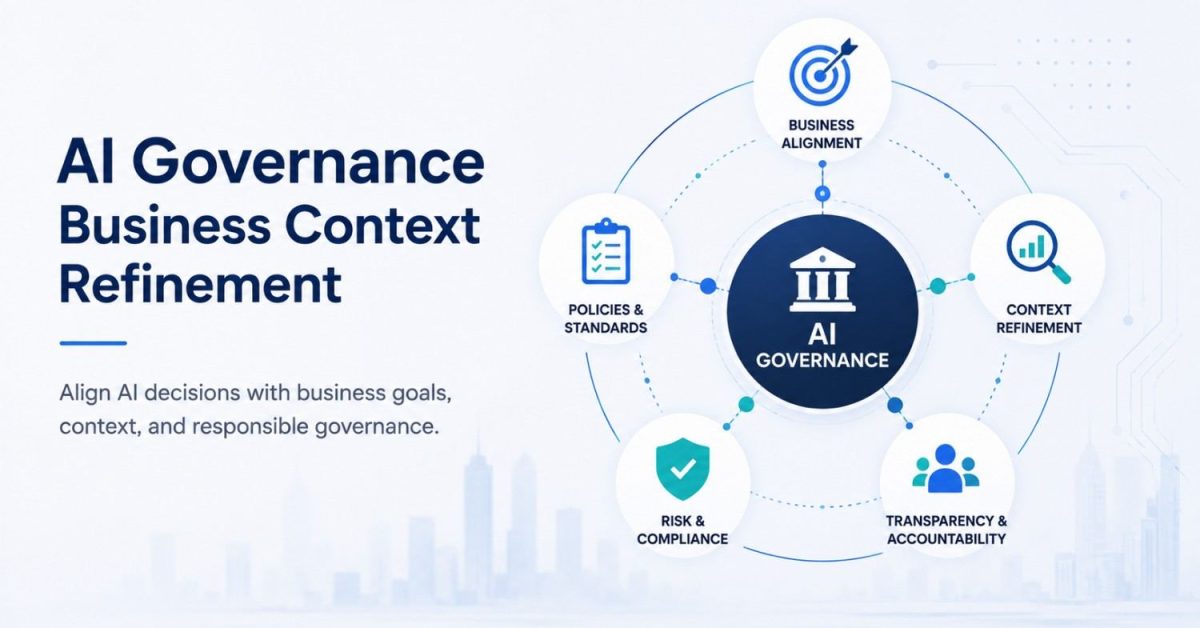
AI governance often looks solid on paper but breaks down when AI enters a real business workflow. A policy might say that sensitive decisions require human oversight, for example, but the system still needs to understand which decisions are sensitive, whose data is involved, what the user is trying to do, and what level of risk applies in that specific situation.
That is where AI governance business context refinement becomes important. It connects governance rules with real business context so AI systems can apply the right controls to the right situation instead of treating every task the same way.
This guide explains what business context refinement means in AI governance, how it works, which context signals matter, and how organizations can implement it without creating governance that slows down every AI workflow.
What Is AI Governance Business Context Refinement?
AI governance business context refinement is the process of continuously improving the business information and situational signals used to govern an AI system. These signals can include the user’s role, business process, data sensitivity, decision impact, regulatory requirements, risk level, and whether human approval is required.
Traditional governance often relies on broad rules:
“AI cannot make high-risk decisions without human approval.”
Business context refinement makes that rule operational:
“If this AI is evaluating a financial application involving customer data and the decision could materially affect the customer, route the recommendation to an authorized employee before any action is taken.”
The governance principle has not changed. The context has become precise enough for the system to apply it correctly.
This is especially important as businesses move from simple AI assistants to autonomous and semi-autonomous agents that can access data, call tools, and take actions.
Why Business Context Matters in AI Governance
The same AI capability can have completely different risk levels depending on where and how it is used.
Consider an AI model generating text.
Using it to suggest an internal meeting title is relatively low risk. Using the same model to draft personalized financial guidance, evaluate an employee, or communicate a healthcare-related decision creates very different requirements.
The model alone therefore cannot determine the appropriate governance.
Organizations need context such as:
| Context signal | Governance question |
|---|---|
| Business function | Where is the AI being used? |
| User role | Who is requesting or approving the action? |
| Data sensitivity | Does the workflow involve confidential or personal data? |
| Decision impact | What happens if the AI is wrong? |
| Regulation | Which legal or industry requirements apply? |
| Action authority | Can AI recommend, approve, or execute? |
| Customer impact | Does the decision materially affect a person? |
This allows governance to become risk-based rather than one-size-fits-all. Low-risk activities can move quickly, while high-impact actions receive stronger controls.
How Business Context Refinement Works
Business context should not be treated as a description written once during an AI project’s launch. It needs to remain accurate as workflows, users, data, regulations, and AI capabilities change.
A practical refinement cycle looks like this:
Business context → Risk classification → Governance policy → AI action → Monitoring → Human feedback → Context refinement
Suppose an organization deploys an AI customer-service agent. Initially, it may be allowed to answer FAQs and check order status. Later, the business gives it access to refunds.
The context has now changed.
The agent can perform an action involving money, so its governance should change as well. The company might introduce transaction limits, additional identity checks, logging, or human approval for refunds above a defined threshold.
The AI system did not necessarily become more dangerous. Its business authority changed, and governance needs to reflect that change.
This is why continuous refinement matters.
The Core Layers of Context-Aware AI Governance
A practical governance system needs more than policies. It needs a way to translate those policies into controls that operate inside real workflows.
1. Business Context
Start by documenting what the AI actually does.
Identify the business process, intended users, data sources, affected stakeholders, available tools, expected outcomes, and consequences of failure.
A useful question is:
What can this AI do, for whom, with which data, and what happens if it gets the decision wrong?
That gives governance teams far more useful information than a generic description such as “customer-service AI.”
2. Risk Classification
Once the context is understood, classify the use case according to its potential impact.
A simple model could use:
- Low risk: summarization, internal search, brainstorming
- Medium risk: customer communications, recommendations, operational analysis
- High risk: financial decisions, employment decisions, sensitive personal data, safety-critical actions
Risk tiers allow organizations to apply stronger governance where consequences are greater instead of forcing every AI use case through the same approval process.
3. Policy and Permissions
Governance rules should then determine what the AI is actually allowed to do.
Controls may include:
- role-based access
- data restrictions
- tool permissions
- spending or transaction limits
- mandatory disclosures
- human approval checkpoints
- prohibited actions
- escalation rules
For AI agents, this layer is particularly important because the system may be capable of doing more than generating text.
Our agentic framework guide explains how modern AI agents combine orchestration, memory, tool access, and human-in-the-loop controls. As those agents gain more operational authority, governance needs to control not only what they can say, but what they can do.
Human Oversight Should Follow Risk
Human-in-the-loop governance does not mean a person should approve every AI output.
That would defeat much of the value of automation.
Instead, human oversight should increase with the potential consequence of the action.
A customer-support agent answering “Where is my order?” may operate autonomously. The same agent issuing a large refund, changing account ownership, or accessing sensitive customer records may require approval.
A useful pattern is:
Low impact → automate
Moderate impact → monitor and audit
High impact → require human approval
This keeps governance proportional to business risk.
Monitoring Context Drift, Not Just Model Drift
Organizations already monitor AI systems for model drift and data drift, but business context can drift too.
A system originally approved for one use may gradually gain:
- new data sources
- additional user groups
- new tools
- broader permissions
- different geographic markets
- higher-value transactions
- greater decision authority
The underlying model may not have changed at all, yet the risk profile can be completely different.
That is business context drift.
Governance reviews should therefore ask not only:
Has the model changed?
but also:
Has the business context around the model changed?
This is one of the most important reasons AI governance needs continuous monitoring rather than an annual policy review.
Business Context Refinement for AI Agents
Context refinement becomes even more important with agentic AI.
A traditional chatbot usually waits for a prompt and returns an answer. An AI agent may search databases, call APIs, create files, send messages, update records, or trigger other systems.
That creates a new governance problem: authority.
An organization should know:
- which agents exist
- who owns each agent
- which systems they can access
- which tools they can call
- what data they can retrieve
- what actions they can execute
- where human approval is required
- how actions are logged and audited
An agent that can read a customer record does not automatically need permission to modify it. An agent that can prepare a payment does not necessarily need authority to send it.
Business context refinement helps maintain those boundaries as workflows evolve.
A Practical Framework for Implementing It
Organizations do not need to build an enormous governance program before using AI. Start with the highest-impact workflows and expand as AI adoption grows.
Step 1: Inventory AI Use Cases
Document where AI is already being used across the organization, including unofficial tools and experiments where possible. Record the owner, purpose, users, models, data sources, integrations, and actions available to each system.
Step 2: Map Business Context
For every important use case, identify:
- intended purpose
- affected stakeholders
- data sensitivity
- business impact
- regulatory exposure
- AI decision authority
- human responsibility
This creates the context needed for meaningful risk classification.
Step 3: Assign Risk Tiers
Separate low-impact productivity tools from AI systems that can materially affect customers, employees, finances, security, or operations.The higher the potential consequence, the stronger the controls should become.
Step 4: Define Guardrails
Translate governance principles into actual operating rules. Specify what the AI can access, what it can do autonomously, what requires approval, what must be logged, and which actions are prohibited.
Step 5: Monitor and Refine
Track more than model accuracy.
Monitor:
- policy violations
- human overrides
- unexpected tool use
- access changes
- failed actions
- user complaints
- changing business processes
- new regulatory requirements
These signals show where the original business context or governance rules need refinement.
If your organization is still deciding which controls belong around its AI systems, an AI consulting and strategy process can help connect technical capabilities with business risk, governance requirements, and measurable outcomes.
Common Mistakes to Avoid
One of the biggest mistakes is treating governance as a document instead of an operating system. A policy has limited value if it never becomes permissions, monitoring, approval workflows, and enforceable controls.
Another is defining context too broadly. Labels such as “finance AI” or “HR chatbot” do not tell you enough about the data involved, authority granted, or consequences of failure.
Businesses also frequently over-govern low-risk AI while under-governing high-impact actions. Requiring five approvals for an internal summary wastes time; allowing an autonomous agent to execute financial actions without clear thresholds creates unnecessary risk.
Finally, governance should not stop after deployment. Models change, regulations change, employees find new uses, integrations expand, and agents receive new permissions. The governance context must evolve with them.
What Good AI Governance Looks Like
Effective AI governance should not make every AI interaction slower. It should make risk visible and controls proportional.
A mature organization knows which AI systems it operates, what each system is allowed to do, which data it can access, who is accountable, when a human must intervene, and how those decisions are monitored.
That creates a better balance between innovation and control: low-risk AI can move quickly, while high-impact systems receive the oversight they actually require.
Final Thoughts
AI governance business context refinement closes the gap between high-level governance policies and what AI systems actually do inside a business.
The goal is not to create more rules. It is to give governance enough context to apply the right rule to the right situation.
As AI systems become more autonomous, that context will increasingly include not only the model and its data, but also user roles, business processes, tool permissions, decision authority, customer impact, and changing risk conditions.
Organizations that continuously refine those signals can scale AI without choosing between innovation and control. They can automate low-risk work, strengthen oversight where consequences are higher, and adapt governance as their AI systems and business evolve.
Frequently Asked Questions
1. What is AI governance business context refinement?
AI governance business context refinement is the process of improving the business and situational information used to govern AI. It helps organizations apply policies according to factors such as user role, data sensitivity, decision impact, regulatory requirements, and AI authority.
2. Why is business context important for AI governance?
The same AI model can be low risk in one workflow and high risk in another. Business context tells the governance system what the AI is doing, who is affected, what data is involved, and what could happen if the system makes a mistake.
3. What is contextual AI governance?
Contextual AI governance is an approach in which AI controls vary according to the situation rather than applying identical rules to every system. Higher-risk activities receive stronger monitoring, permissions, and human oversight.
4. What is business context drift?
Business context drift occurs when the environment around an AI system changes even if the underlying model does not. New data, users, tools, permissions, markets, or responsibilities can change the system’s risk profile and require governance updates.
5. How often should AI governance be reviewed?
High-impact AI systems should be monitored continuously, with governance reassessed whenever models, data sources, permissions, regulations, business processes, or decision authority change. Lower-risk systems can generally use lighter periodic reviews.
6. Does AI governance slow down innovation?
Poorly designed governance can. Context-aware governance is intended to do the opposite by applying lighter controls to low-risk use cases and stronger safeguards only where potential consequences justify them.
