
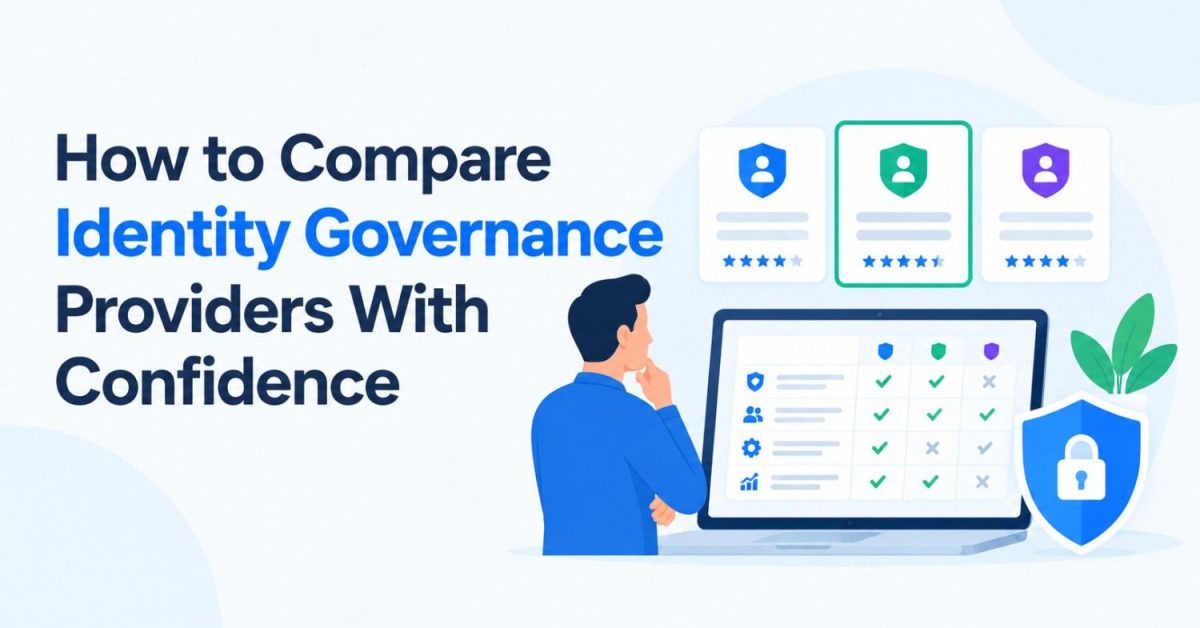
Choosing an identity governance provider is difficult because vendors often describe similar capabilities using different terminology. One platform may emphasize automation, another may focus on compliance, while another may position itself around identity security.
A shortlist should therefore be built around the organization’s actual needs rather than marketing categories. Buyers need to understand which identities and applications must be governed, what workflows need automation, how quickly value should be delivered, and what the total cost will look like. A structured evaluation can make those differences easier to identify.
Start With the Use Cases That Matter Most
The first step is defining what the organization expects identity governance to accomplish. Some companies may primarily need employee lifecycle automation. Others may struggle with access reviews, excessive privileges, application onboarding, compliance reporting, or non-human identities.
A buyer should document the most important use cases before contacting vendors. This prevents demonstrations from becoming feature tours that do not address actual problems.
Useful evaluation areas include:
- Employee joiner, mover, and leaver workflows
- Access certifications and entitlement reviews
- Provisioning and deprovisioning
- Governance for non-human identities
- Least-privilege enforcement
- Compliance reporting and audit evidence
Once those requirements are documented, vendors can be compared against the same criteria. Many of these tasks, especially joiner, mover, and leaver steps, are repetitive business workflows worth automating.
Compare Integration Depth, Not Connector Counts
Integration is one of the most important differences between identity governance providers. A vendor may advertise hundreds of integrations, but the number alone says little about how deeply those connections work.
Buyers should determine whether a provider can read users, groups, roles, entitlements, ownership information, and other relevant data from the systems that matter. They should also ask what actions the platform can perform. Reading access data is different from automatically provisioning, modifying, or removing permissions.
When comparing IGA vendors, teams should identify their most important applications and request a demonstration using those systems wherever possible. This makes integration claims easier to validate.
Measure Time to Value
A governance platform can provide long-term benefits while still being difficult to deploy. Lengthy implementations can delay access reviews, automation, and risk reduction.
Vendors should explain how quickly an organization can connect its first applications, create workflows, and complete a meaningful governance process. The buyer should also understand what internal resources are required. A platform that depends heavily on specialized consultants may create a different cost and staffing model from one designed for lower-effort deployment.
Linx, for example, describes its modern identity governance approach as designed for low-lift deployment in days or weeks rather than traditional implementations that may take months or years. That does not mean every organization will experience the same timeline. The complexity of the identity environment still matters.
Build a Useful Proof of Concept
A proof of concept should test real workflows rather than simply confirm that the software can log in.
Buyers can provide a representative group of applications, users, roles, and access relationships and ask vendors to demonstrate how those relationships are discovered and governed. The team should then examine how quickly an analyst can answer basic questions:
- Who has access to a sensitive application?
- Why do they have it?
- Which permissions appear excessive?
- What happens when an employee changes roles?
These exercises reveal usability and context quality much better than a standard presentation.
Examine the Total Cost
The purchase decision should include more than the annual license. Implementation services, integration work, administrator time, training, support, maintenance, and future expansion can all affect total cost. Buyers should ask vendors to explain what is included in the proposed price and which services may generate additional charges.
A provider that costs more per user may still deliver better value if it significantly reduces manual reviews or administrative work. Conversely, a lower license price may become expensive if the system requires extensive customization. The comparison should therefore measure cost against time to value and operational effort.
Ask Vendors Difficult Questions
A strong evaluation should include questions that force vendors to explain limitations as well as strengths. Ask:
- How are custom applications integrated?
- How is access data refreshed?
- How are excessive privileges detected?
- What happens when a connector fails?
- How do administrators troubleshoot workflow problems?
- How does the platform handle non-human and AI-agent identities?
That last question matters more each year. Modern governance needs to extend beyond employees as organizations increasingly depend on automation and agentic AI frameworks that act on their own credentials.
Buyers should request references or practical examples where possible and verify claims through a controlled proof of concept.
Creating a Confident Shortlist
The final shortlist should contain providers that can demonstrate the required use cases, integrate with important systems, provide an acceptable implementation path, and fit the organization’s budget. The best choice is not necessarily the most familiar vendor or the platform with the largest feature catalog.
A strong provider should help the organization understand identity relationships, automate repetitive governance processes, identify risky access, and maintain evidence for audits.
A structured comparison gives buyers a clearer basis for that decision. Instead of asking which provider has the most features, the more useful question is which one can solve the organization’s identity governance problems with the least unnecessary complexity.
