
Most companies no longer ask whether generative AI can help them. They ask why their promising pilot never made it into daily use. A chatbot that impressed leadership in a demo can stall for months once it meets real data, security reviews and actual users.
That gap is often where the choice of development partner matters most. Building a prototype is relatively easy today. Turning it into a reliable, secure system that people trust and use every day is much harder, and it calls for skills that go well beyond prompt writing.
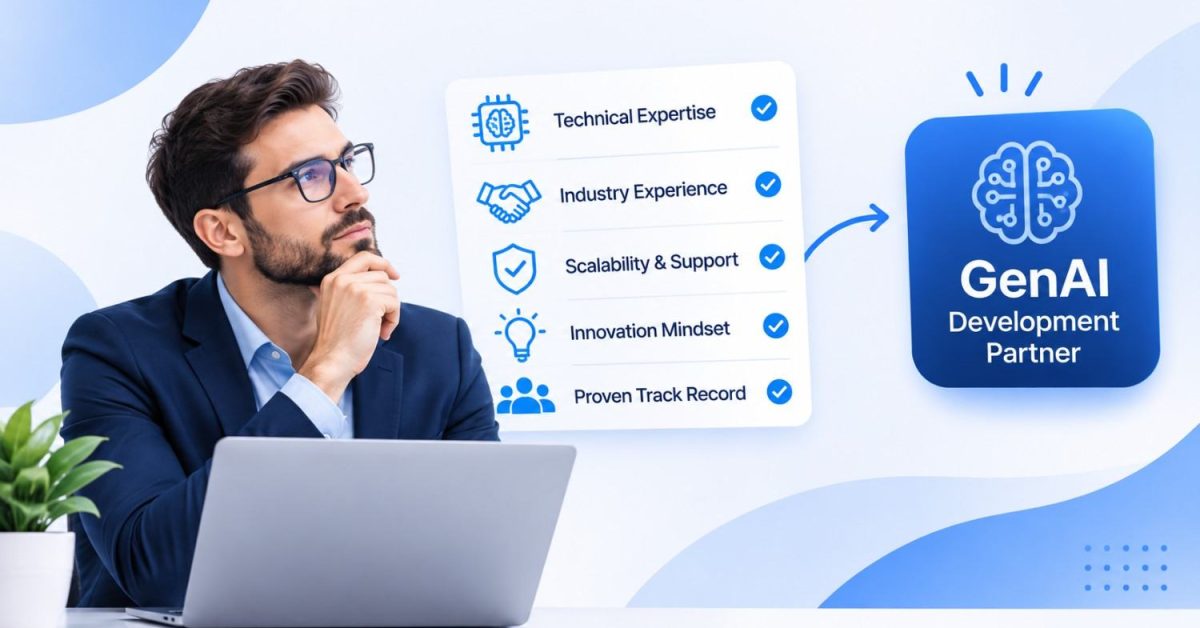
This guide covers four areas to examine before you sign: how a partner moves projects from pilot to production, how it protects your data, how it chooses models and vendors, and what support it provides after launch.
1. Look for a Proven Path From Pilot to Production
A strong partner treats the pilot as the first step of a production plan, not as a standalone demo.
Many generative AI projects fail at the same point. The prototype works on clean sample data, but the production version has to handle messy documents, edge cases, slow responses and thousands of users. Ask potential partners to explain how they bridge that gap.
Good questions include:
- How do you define success for a pilot? Look for measurable goals tied to a business process, such as time saved per ticket or the share of documents processed without correction.
- What changes between the pilot and production? A credible answer covers integration with existing systems, monitoring, access control and testing on real data.
- How do you evaluate output quality? The partner should describe a repeatable evaluation process, not just “we review the answers.”
- What happens when the model is wrong? Expect clear fallback rules, human review steps and escalation paths.
Ask for case studies that show a system running in production, not just a proof of concept. If a partner can only show demos, that’s a sign it may struggle with the harder, later stages of delivery.
It also helps to understand the wider architecture involved. If agents or multi-step workflows are part of your plan, our agentic framework guide explains how these systems are structured and what they need to run reliably.
2. Put Data Privacy First When Choosing a Partner
Data privacy should shape your shortlist from the start, because it affects architecture, cost and timeline.
Generative AI systems often work with sensitive material: customer records, contracts, internal documents or financial data. Before any data leaves your environment, you need to know exactly where it goes and who can see it. Ask each partner:
- Where will our data be stored and processed?
- Will any of it be used to train third-party models?
- How are prompts, outputs and logs retained, and for how long?
- How do you control access to data inside the AI system?
- How do you handle regulations that apply to us, such as GDPR or HIPAA?
A reliable partner will answer these questions clearly and put the answers into the contract. It should also be comfortable with options such as private deployments, data masking or keeping certain workloads inside your own cloud account.
Be cautious of vendors who treat privacy as a paperwork step at the end. Retrofitting security into a finished system is slower and more expensive than designing for it from day one.
3. Evaluate How the Partner Chooses Models and Vendors
The right partner picks models based on your use case, not on its own preferences or commercial ties.
The generative AI market moves quickly. New models appear every few months, prices change and capabilities shift. A partner locked into a single provider may push that option even when another model would be cheaper, faster or more accurate for your needs.
Ask how the partner compares options. A thoughtful process usually weighs:
| Factor | What to Ask |
|---|---|
| Accuracy | How will you test models on our real tasks and data? |
| Cost | What will each option cost at our expected usage? |
| Speed | Can the model respond fast enough for our users? |
| Privacy | Can it be deployed in a way that meets our data rules? |
| Flexibility | How hard would it be to switch models later? |
Flexibility deserves special attention. A well-designed system separates business logic from the model itself, so you can switch providers or upgrade to a newer model without rebuilding everything.
When comparing vendors, it helps to look at independent roundups of established generative AI development companies to see how different firms describe their technical approach, industry focus and delivery experience. Use these lists as a starting point, then test each shortlisted partner against your own requirements.
You should also ask about the partner’s view on open-source versus commercial models, and whether it has experience with retrieval-augmented generation (RAG), fine-tuning or both. The answers reveal whether the team understands trade-offs or simply follows trends.
4. Confirm What Ongoing Support Looks Like
A generative AI system needs continuous attention after launch, so long-term support is as important as the initial build.
Unlike traditional software, AI systems can change behavior over time. Model providers update their products, your data evolves and user needs shift. Without regular monitoring, answer quality can slowly decline without anyone noticing.
Before signing, clarify:
- Monitoring: How will the partner track accuracy, cost and response times in production?
- Updates: Who handles model upgrades, prompt changes and retesting?
- Incident response: What happens if the system produces harmful or incorrect output?
- Knowledge transfer: Will your team receive documentation and training so you’re not fully dependent on the vendor?
- Pricing: Is support billed as a retainer, by the hour or by usage?
A good partner will also help you plan for growth. As adoption spreads, you may want to connect the AI system to more tools and workflows. Our guide to AI automation and workflow integration explains how teams typically expand from one use case to several.
Finally, pay attention to how the partner communicates during the sales process. Clear, honest answers about limitations and risks are usually a good sign of how it will behave once the project is live.
Conclusion
Choosing a generative AI development partner is less about finding the most impressive demo and more about finding a team that can deliver reliable systems over time. Focus on four areas: a proven path from pilot to production, strong data privacy practices, an unbiased approach to model and vendor choice, and clear ongoing support.
Shortlist partners that answer these questions with specifics, test them on a small but real use case, and build from there. The right partner will help you move past experiments and turn generative AI into lasting business value.
