
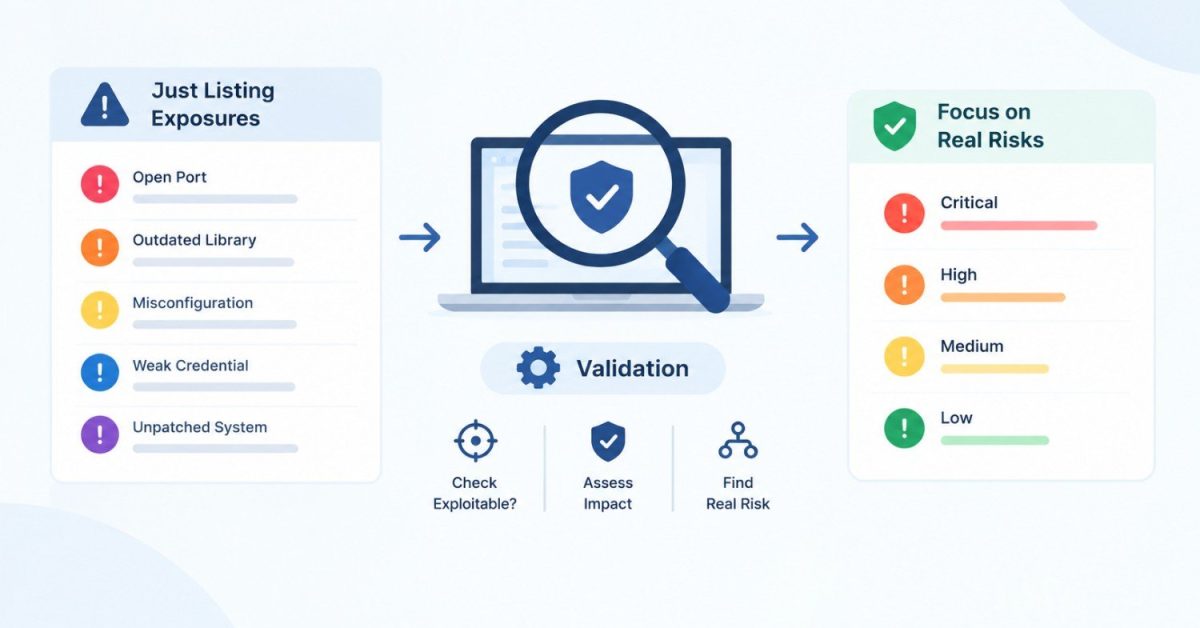
A vulnerability scan finishes, and the dashboard reports forty thousand findings. Security leaders know that most of them will never be exploited, and that a few might lead directly to a breach. The difficulty is that the list does not say which are which. Engineers receive the same long queue regardless, and the most dangerous item can sit on page forty while the team works through routine patches.
Listing exposures has become cheap. Scanners, cloud posture tools, and code analyzers all produce findings in volume. What remains scarce is knowing which exposures an attacker could actually use, and in what order to fix them. The sections below explain why long lists fail, how exploitability and context change priorities, what validation involves, and how to make it a working part of a security program.
The Problem With Long Lists
Findings lists are built to be comprehensive, not useful. A scanner flags every software version with a known weakness, every open port, every missing header, and every configuration that deviates from a benchmark. Each item is technically accurate, yet many are irrelevant in a particular environment because the vulnerable component is unreachable, the affected feature is disabled, or another control blocks the path.
Volume creates predictable problems. Teams cannot fix everything, so they triage by severity score, and scores such as CVSS describe the theoretical seriousness of a flaw in isolation, not the likelihood of exploitation in a given environment. A critical-rated issue on an isolated test server may deserve less attention than a medium-rated one on an internet-facing system holding customer data.
Trust erodes as well. When engineers repeatedly chase findings that turn out to be harmless, they begin to discount the whole program. Security teams gain a reputation for generating work rather than reducing risk, and legitimate warnings meet skepticism. Meanwhile, the metrics that organizations track, such as the count of open findings, reward activity over outcomes.
The deeper issue is that attackers do not work from lists. They look for paths: a chain of weaknesses leading from an entry point to something valuable. A list of isolated findings cannot show those paths, and defenders who think only in terms of individual items miss the combinations that matter.
Exploitability and Context
Exploitability asks a simple question: can this weakness actually be used, here, today? Several factors shape the answer:
- Reachability: Can an attacker get to the vulnerable component from the internet or from a plausible foothold?
- Preconditions: Does the exploit require authentication, a specific configuration, or user interaction?
- Compensating controls: Network segmentation, web application firewalls, and endpoint protection may block known techniques.
External intelligence helps. The Cybersecurity and Infrastructure Security Agency (CISA) maintains a catalog of vulnerabilities known to be exploited in the wild, which signals that attackers are actively using them. Scoring systems that estimate the probability of exploitation, such as the Exploit Prediction Scoring System (EPSS), add another view. Neither replaces local analysis, but both help separate theoretical risk from observed attacker behavior.
Context completes the picture. What does the affected asset do, what data does it hold, and what else does it connect to? A vulnerability on a system that stores payment data or holds administrative credentials has a different consequence from one on a kiosk. Identity matters too: an exposed service account with broad permissions can turn a minor flaw into a major compromise.
Combining these factors yields a more realistic ranking than a severity score alone. The aim is not to dismiss findings but to understand which ones sit on credible attack paths, so effort goes where it reduces actual risk.
Proof Through Adversarial Exposure Validation
The most reliable way to establish exploitability is to try it. Adversarial exposure validation uses attacker-style techniques, either automated or human-led, to test whether discovered weaknesses can be exploited and what an attacker could do afterward. Instead of reasoning about whether a flaw might be reachable, the process attempts safe exploitation and records the result.
Practitioners describe this as the discipline of confirming, with evidence, which exposures can be used in realistic attack scenarios. The output is not a longer list but a shorter one, with each item labeled by what was proven: reachable, exploitable, leading to which asset, under what conditions. Items that fail validation are deprioritized, along with an explanation of why, such as a blocking control.
Effective validation shares several traits:
- It stays within scope. Testing operates within defined scope and safety limits, so it does not disrupt production.
- It chains findings. It shows how a low-severity issue plus a misconfiguration can lead to sensitive data.
- It retests after fixes. It confirms that the path is actually closed.
- It produces reproducible evidence. Engineers can repeat the result, which builds trust.
Validation can come from several sources: penetration testers, automated attack simulation tools, AI-driven testing agents built on modern agentic frameworks, and red team exercises. The method matters less than the principle that claims about risk should be backed by demonstration wherever feasible. Safe techniques, such as proving access with harmless markers instead of extracting real data, keep validation responsible.
Turning Validation Into Prioritization
Validation changes how work gets sorted. Findings with proof of exploitability on critical assets rise to the top, and findings that could not be exploited drop in priority or move to routine maintenance. The queue becomes shorter and more credible, and remediation effort concentrates where it reduces the most risk.
Presentation helps engineers act. Each validated finding should state what was proven, how to reproduce it, what it leads to, and the simplest fix. Where multiple findings contribute to one path, group them, since fixing a single link may break the chain. Sometimes the cheapest fix is a configuration change or a new access rule, not a patch for every item.
Metrics shift from counts to outcomes. Useful measures include:
- The number of validated exploitable paths to critical assets
- The time taken to close them
- The share of fixes verified by retest
- The proportion of findings dismissed as non-exploitable, with evidence
Report these to leadership in terms of risk reduction, such as “three proven paths to customer data were closed this month.”
Not everything can or should be validated. Some systems are too fragile to test, and some weaknesses require destructive proof. For those, rely on careful reasoning, compensating controls, and expert judgment, and document the decision. Validation is a tool for sharpening priorities, not an excuse to ignore what cannot be tested.
Making Validation Operational
A practical program begins with inventory and goals. Identify the assets that matter most, such as systems holding sensitive data or providing privileged access, and define the attack scenarios that worry the organization. Start validation where the stakes are highest, then widen.
Practical steps for building the capability include:
- Combine discovery tools with validation, so new exposures are tested soon after they appear.
- Agree on rules of engagement, safe techniques, and escalation contacts.
- Integrate results into ticketing and engineering workflows, with clear owners and deadlines. Like other business workflows worth automating, this handoff works best when it happens without manual copying.
- Retest fixes automatically or on request, and record the outcomes.
- Review dismissed findings periodically to ensure assumptions still hold.
- Include periodic expert-led exercises to explore creative attack paths.
Cultural change matters as much as tooling. Encourage security and engineering teams to discuss proof together, so developers see evidence and security staff understand constraints. Share wins publicly, such as an attack path closed by a small change, to reinforce the value of focusing on what is demonstrably dangerous.
Finally, revisit the program regularly. Environments, attacker techniques, and tools evolve, so validation scenarios should be updated. Review metrics, gather feedback from engineers, and adjust scope and cadence accordingly.
Key Takeaways
Listing exposures is easy, and it often leaves teams with more work than they can do and little guidance on where to begin. Validation adds the missing information: which weaknesses can be exploited, what they lead to, and whether fixes actually work.
Organizations that combine exploitability analysis, attacker-style testing, and outcome-focused metrics can spend remediation effort where it counts. The result is a shorter, more credible queue, better relationships between security and engineering, and a clearer view of real risk.
A shorter list backed by proof is easier to defend to executives, easier for engineers to act on, and closer to how attackers actually think. Teams that adopt that habit tend to fix fewer things, but fix the right ones.
