
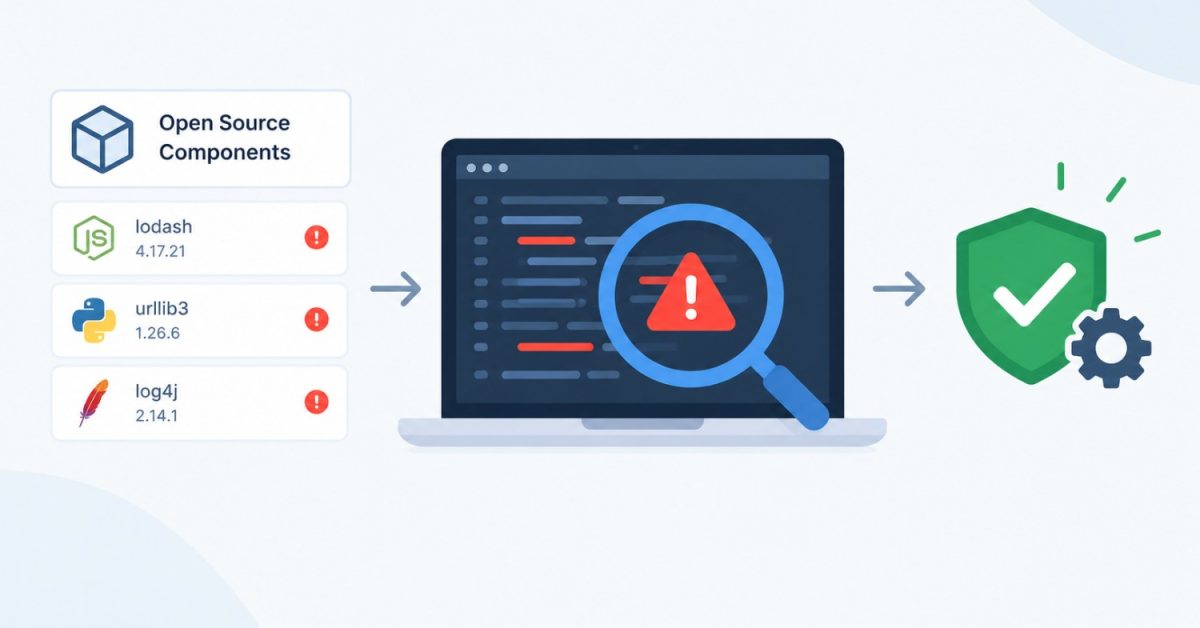
Open a modern application’s dependency manifest and the first surprise is usually its length. A few dozen direct dependencies pull in hundreds of indirect ones, each maintained by people the team has never met, each with its own release schedule and vulnerability history.
Most of the code in a typical application now comes from open source, and that arrangement works well until a widely used library turns out to carry a serious flaw. Then the question every security team dreads arrives: where do we use it? Teams that cannot answer within hours lose time they do not have.
The sections below explain why open source risk grows quietly, how scanning tools find vulnerable components, how to decide what to fix first, how remediation works in practice, and what license obligations add to the picture.
Why Open Source Risk Accumulates Quietly
Dependencies behave like debt. Each one adds capability, and each one also adds code that the team did not write, review, or fully understand. Over time, versions age, maintainers move on, and new vulnerabilities are disclosed against code that was safe when it was added.
Transitive dependencies make the problem harder to see. A team may choose one framework and receive forty packages beneath it. The vulnerable one might sit four levels down, absent from any file the developers edit by hand. Lock files record the exact versions, but nobody reads them for fun. Service-based designs such as SOA OS23 can multiply the effect, since each independent service brings its own dependency tree.
Public vulnerability disclosure also moves faster than most release cycles. New advisories appear daily across thousands of packages, and attackers monitor them. The window between disclosure and active exploitation can be short for popular libraries. A team that updates dependencies once a quarter spends most of the year exposed to known flaws, even if every individual developer is careful.
Managing that exposure requires a continuous process, built on an accurate, current inventory of what the software contains and automated comparison of that inventory against known vulnerabilities.
How Software Composition Analysis Finds Vulnerable Components
Software composition analysis, often abbreviated SCA, inspects an application’s dependencies and matches them against databases of known vulnerabilities and license data. The tool reads manifests and lock files, sometimes scans binaries and container images, builds a list of direct and transitive components, and reports which ones have known issues.
Quality depends on the data behind the tool. Public sources such as the National Vulnerability Database, vendor advisories, and ecosystem-specific databases supply identifiers like CVE numbers. Good tools enrich these with additional research, correct version ranges, and reduce mismatches where a name collision or wrong version produces a false alert. Coverage across languages and package ecosystems varies, so teams should check that the tool understands the ones they use.
Placement affects value:
- In the developer’s environment: Scanning catches a risky package before it is committed.
- In pull requests: Scanning prevents new vulnerable dependencies from merging.
- On built artifacts: Scanning container images and binaries catches what the manifests missed, which matters for teams running workloads in multitenant database containers and similar environments.
- Continuously after release: A component that was clean at release can become vulnerable next month when a new advisory appears.
The tool should alert on newly disclosed issues in already-deployed software, not only at build time. Producing a software bill of materials (SBOM) as a by-product gives the organization a ready answer when a new vulnerability makes headlines.
Prioritizing the Findings That Matter
Software composition analysis can produce thousands of findings, and treating them equally leads to paralysis. Prioritization asks which ones are likely to hurt. Several factors help:
- Severity scores: Scores such as CVSS offer a starting point, but they describe a flaw in general and not in context.
- Exploit evidence: This provides a sharper signal. Entries on the Known Exploited Vulnerabilities catalog maintained by CISA, and probability estimates such as the Exploit Prediction Scoring System (EPSS), indicate which vulnerabilities attackers are actually using or likely to use.
- Reachability: This asks whether the application ever calls the vulnerable code. A flaw in a function the software never invokes poses far less practical risk than one sitting on a hot path, though it should still be tracked.
- Exposure: A vulnerable component in an internet-facing service deserves faster attention than the same component in an internal batch job.
- Business context: Business criticality, data sensitivity, and the availability of a fix complete the picture.
Combining these signals produces a short list. Many teams define simple rules, such as fixing known-exploited and reachable critical issues within days, other high-severity issues within a few weeks, and the rest through routine maintenance.
Written service levels make expectations clear. They also reveal capacity problems, since a backlog that never shrinks means the team needs either more automation or fewer dependencies.
Remediation That Actually Gets Done
Finding a vulnerability is the easy half. Fixing it competes with feature work, and the fix can break things.
Minor and patch upgrades: The most common remedy is upgrading to a patched version. When the fix is a minor or patch release, the upgrade is usually low risk, and automated pull requests from dependency tools can handle it with little human effort. Test suites then confirm nothing broke.
Major version upgrades: These are harder. They may change interfaces, require code changes, and demand more testing. Teams may need to schedule them, assign owners, and sometimes apply a temporary mitigation in the meantime. Options include configuration changes that disable the vulnerable feature, web application firewall rules, or network restrictions that limit exposure.
Transitive dependencies: If the vulnerable package is indirect, the team may need to override the version, update the parent package, or wait for the maintainer to release a fix. When a library is unmaintained, replacing it may be the only durable answer.
Reducing the number of dependencies in the first place shrinks the problem. Practical habits include:
- Pinning versions
- Reviewing new packages before adoption
- Removing unused packages
- Keeping dependencies close to current so that individual upgrades stay small
Tracking mean time to remediate, by severity, shows whether the process is improving, and sharing the numbers with engineering leaders keeps the work visible.
License Risk Alongside Security Risk
Every open source component carries a license, and licenses create obligations. Permissive licenses such as MIT and Apache 2.0 generally allow broad use with attribution. Copyleft licenses, such as the GPL family, may require that derivative works be released under the same terms, and the details depend on how the code is combined and distributed. Some licenses restrict commercial use or impose network-use conditions.
Problems tend to surface at bad moments, such as during an acquisition, a customer audit, or a product release. A component pulled in transitively may carry a license that conflicts with the company’s distribution model. Missing attribution notices can also create compliance gaps.
Teams manage this risk with the same inventory they use for vulnerabilities. A reasonable approach follows a short routine:
- Define which license categories are approved, which need review, and which are prohibited.
- Scan for license data alongside vulnerabilities and flag violations at pull request time.
- Route exceptions to legal or compliance for a documented decision.
- Generate attribution notices and a bill of materials for releases.
- Recheck when dependencies change, since licenses can change between versions.
Legal advice should come from qualified counsel, as this summary is general information. Handling license questions early costs little, and discovering them late can force expensive rework.
Final Thoughts
Tracking and fixing vulnerable open source components comes down to knowing what is in the software, comparing it against current threat information, deciding what matters most, and fixing it through a repeatable process. Scanning provides visibility, prioritization focuses effort, and automation keeps upgrades small enough to land.
Licenses deserve a place in the same workflow, since they depend on the same inventory. Teams that start with accurate dependency data, set clear service levels, and measure results build software that is easier to defend and easier to update when the next widely used library makes the news.
