
AI agents are moving from answering questions to taking actions. An agent that once summarized a ticket can now restart a service, scale a cluster, update a firewall rule, or push a configuration to a group of servers. That shift changes the risk. A wrong answer costs someone a few minutes, while a wrong change to production can take a customer-facing service offline.
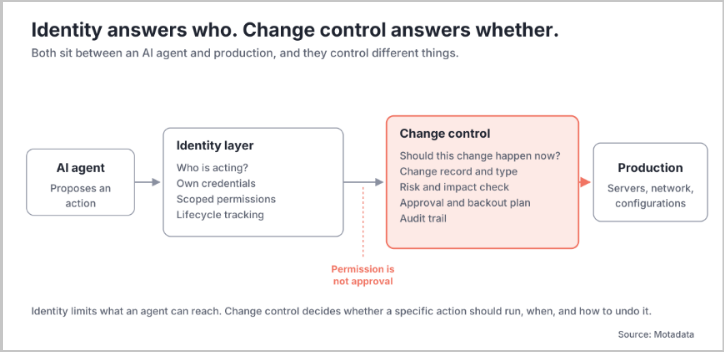
Most of the security discussion so far has focused on identity: giving each agent its own credentials, scoping its access, and tracking it through its lifecycle. That work matters, and it is covered well in why AI agents need their own identities. Identity tells you who the agent is. It does not tell you whether a specific change should happen, at this moment, on this system.
IT operations teams solved a version of this problem long before AI agents arrived. ITIL change enablement gives every change a record, a risk level, an approval path, a backout plan, and an audit trail. This article explains how to apply the same discipline to AI agents, so you can let them act on production systems without handing them unlimited authority.
Why Do AI Agents That Act on Production Need Change Control?
AI agents need change control because having permission to make a change is not the same as being right to make it. An agent with a service account that can modify servers will be technically allowed to restart a database during peak hours. Access control alone cannot judge whether that restart is wise.
Three traits make agents different from the scripts and runbooks that IT teams already govern:
- They act on inference. An agent decides what to do from its reading of logs, metrics, and instructions. That reading can be wrong, and the agent can act on it with full confidence.
- They act at machine speed. A person making a bad change usually pauses before the next step. An agent can chain several actions across many systems before anyone notices the first one.
- They act without a natural pause for review. Human engineers talk to colleagues, check a change calendar, or wait for a quiet window. An agent does none of this unless you build it into the workflow.
There is also a diagnostic cost. When an incident starts, the first question most operations teams ask is what changed. If an agent modified a configuration and no record exists, that question becomes very hard to answer. Every unrecorded agent action makes your incidents slower to resolve, even when the agent was not the cause.
Change control fills the space between identity and execution. Identity confirms the agent is who it claims to be and limits what it can reach. Change control decides whether a particular action should go ahead, under what conditions, and how to reverse it if it fails.
What Does ITIL Change Enablement Already Give You?
ITIL change enablement already gives you most of the controls an AI agent needs. The practice exists to increase the number of successful changes by assessing risk, authorizing changes, and managing the change schedule. Teams that follow ITIL change management best practices have spent years refining these controls for human engineers, and each one translates directly to agents.
| Change control element | What it does for an AI agent |
|---|---|
| Change record | Captures the proposed action, its reason, and the systems it touches before anything runs |
| Change type | Sorts actions into standard, normal, and emergency so each gets the right level of review |
| Change authority | Names who can approve each type, from a single owner to a change advisory board |
| Change schedule | Keeps agent actions out of blackout periods and away from other planned work |
| Backout plan | Requires a tested way to reverse the action before it is approved |
| Post-change review | Checks whether the change worked and feeds the result back into future risk ratings |
The value of reusing this structure is that you do not have to invent a separate governance model for AI. Your agents follow the same rules as your engineers, your approvers use the same queues, and your auditors read the same records. That consistency also makes it easier to expand what agents are allowed to do over time, because every decision rests on a track record you can inspect.
How Should You Classify Agent Actions by Risk?
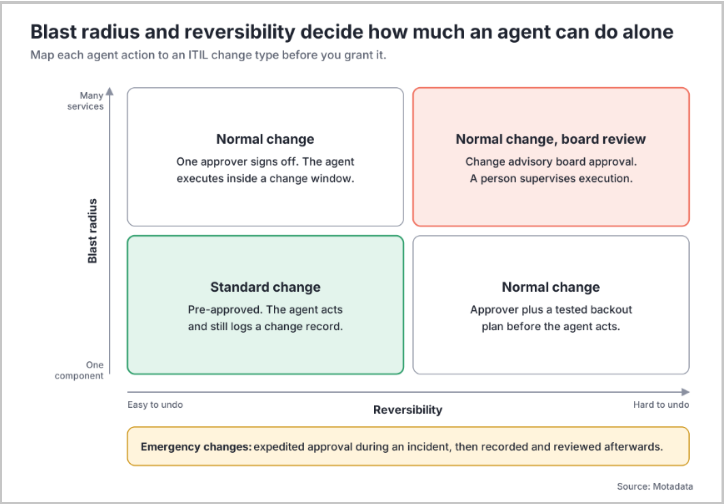
Classify every agent action by asking two questions: how many services it can affect, and how easily it can be undone. Those two answers decide whether the agent can act alone, needs a single approver, or needs a full change advisory board review.
ITIL already provides the three categories you need:
- Standard changes are low risk, well understood, and pre-authorized. Restarting a stateless service from an approved runbook or clearing a temporary directory on a single host usually fits here. This is the category where an agent can act without waiting for a person, as long as it still creates a record.
- Normal changes need assessment and authorization before they run. Most configuration updates, scaling decisions, and network rule changes belong here. The agent can prepare the change, but a human approves it.
- Emergency changes are expedited to restore service during an incident. They still need authorization from an emergency change authority, and they still get recorded and reviewed afterward.
Blast radius is easier to judge when you can see how systems depend on each other. Change impact analysis maps a proposed change against the components and business services that rely on it, so you know whether an action touches one host or a chain of customer-facing applications.
Reversibility matters just as much. A configuration change with a saved previous version is easy to undo. A schema migration, a data deletion, or a certificate rotation may not be. Treat any action that cannot be cleanly reversed as a normal change, even when its blast radius looks small.
Where Should Human Approval Sit in an Agent Workflow?
Human approval should sit between the agent’s plan and its execution, not after the fact. The agent does the analysis and prepares the change. A person approves the plan. The agent then carries out exactly what was approved and reports back.
In practice, this works best as a five-step loop:
- Propose. The agent opens a change record that states what it wants to do, why, and which systems are involved.
- Assess. The record gets a risk rating and an impact assessment, drawn from the change type and the dependency data for the affected systems.
- Approve. Standard changes pass automatically. Normal changes route to the right approver or board, and emergency changes route to the emergency authority.
- Execute. The agent runs the approved steps inside the scheduled window, using the identity and permissions assigned to it.
- Verify. The agent checks service health against the expected outcome and closes the record, or triggers the backout plan if checks fail.
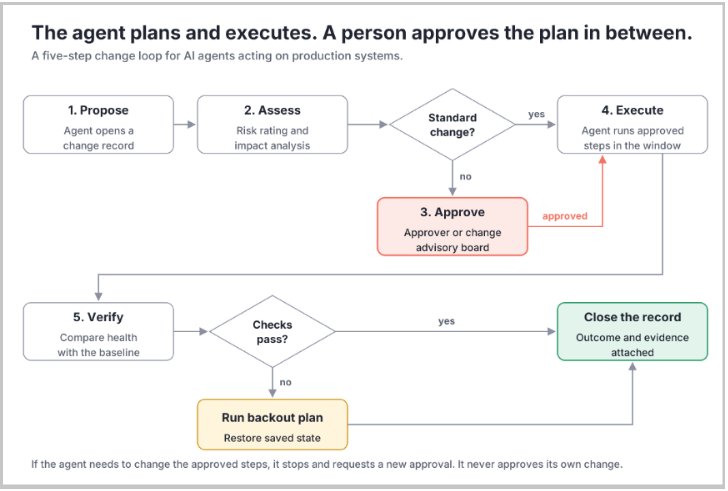
Two rules keep this loop honest. First, approval covers the plan as written. If the agent needs to deviate from the approved steps, it should stop and request a new approval rather than improvise. Second, the agent should never approve its own change, even when it has the technical rights to update the record.
Your agents do not need a custom approval system to follow this pattern. Modern change management software already supports standard, normal, and emergency change types, multi-stage approval chains, change advisory board routing, and a shared change calendar. Many of these platforms also expose APIs, so an agent can create a change record, attach its evidence, and wait for an approval decision before it acts.
How Do You Plan Rollback Before the Agent Acts?
You plan rollback by making a backout plan a condition of approval. If an agent cannot describe how to reverse a change, that change is not ready to run, no matter how confident the agent is about the outcome.
A good backout plan for an agent action covers three things:
- A saved starting point. Before the agent touches anything, it captures the current state: the existing configuration file, the previous version of a deployment, or the current rule set on a device.
- Stop conditions. The plan defines which health signals mean the change has gone wrong, such as rising error rates, failed health checks, or a service that stops responding. When those signals appear, the agent halts instead of continuing to the next step.
- A tested reversal path. The steps to restore the saved state should be written down and, for higher-risk changes, rehearsed in a non-production environment first.
Network devices show why the saved starting point matters. Network configuration management tools back up device configurations, track every version, and let teams restore a known-good configuration quickly. An agent working on routers, switches, or firewalls should depend on that history rather than trying to reconstruct the previous state from memory.
Rollback planning also helps you decide how much autonomy to give an agent. Actions with a fast, reliable reversal path are good candidates to become standard changes later. Actions without one should stay under human approval.
Why Does Every Agent Change Need an Audit Trail?
Every agent change needs an audit trail because you will eventually have to explain it, whether to an incident team, an auditor, or a customer. A complete record answers who requested the change, who approved it, what ran, which systems it touched, when it happened, and whether it worked.
For AI agents, the record needs two identities on it. The first is the agent’s own identity, which shows which agent acted and under which permissions. The second is the human approver, which shows that a person accepted responsibility for the plan. Without both, accountability becomes unclear the moment something goes wrong.
The record is far more useful when it is linked to your configuration management database (CMDB). A CMDB stores the configuration items in your environment and the relationships between them. When a change record points to the exact configuration items it modified, your teams can see the full history of any server, application, or device, including every change an agent made to it.
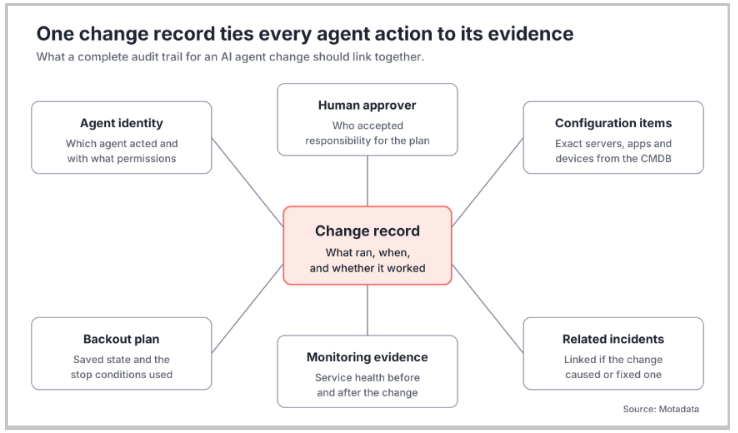
Keep the trail tamper-resistant and complete. An audit log that agents can edit or skip is not much of a control. Record the agent’s reasoning and the evidence it used alongside the action itself. That context helps reviewers understand why the agent made a decision, and it gives you material to improve the agent’s behavior over time.
How Do Monitoring and Change Records Work Together?
Monitoring tells you whether an approved change did what it was supposed to do. A change record without monitoring data is only a promise. Linking the two turns each agent action into something you can verify.
It supports agent changes at three points:
- Before the change. Baseline health data shows the normal state of the affected services, which gives the agent and the approver something to compare against.
- During and after the change. Live metrics, logs, and health checks show whether the service stays stable. These are the signals that trigger the stop conditions in your backout plan.
- When an incident starts. Correlating new alerts with recent change records helps your team spot whether an agent’s action is the likely cause, which shortens the time spent guessing.
Configuration drift detection catches the changes that never got a record. It compares the current state of a system with its last approved state, so a change made outside the process by an agent or a person shows up as a difference you can investigate.
The same discipline applies to the agents themselves. Track what each agent does, how often its changes succeed, and how often they need to be rolled back. Observability for AI agents gives you that view, and it is the evidence you need before moving an action type from human approval to standard change.
Is Your Team Ready to Let Agents Change Production?
Your team is ready when every agent action has a defined path from proposal to verified outcome. Use this checklist before you give any agent write access to production systems:
- Each agent has its own identity, separate from human and shared service accounts.
- Every action the agent can take is mapped to a change type: standard, normal, or emergency.
- Only low-risk, reversible, and well-tested actions are pre-approved as standard changes.
- Normal changes route to a named approver, and the agent cannot approve its own work.
- Every change record includes a backout plan and the stop conditions that trigger it.
- Change records link to the affected configuration items in your CMDB.
- Monitoring verifies the outcome of each change and flags unrecorded changes.
- You review agent change success rates on a regular schedule before widening their autonomy.
AI agents will keep getting more capable, and the pressure to let them act on their own will grow with them. The teams that benefit most will not be the ones that hand over the most access. They will be the ones that can show, for every agent action, what was proposed, who approved it, what happened, and how it would have been undone.
That is what change management was built for. Platforms such as Motadata ServiceOps bring change enablement, the CMDB, and approval workflows together in one ITIL-aligned system, so your agents and your engineers can work under the same rules.
